
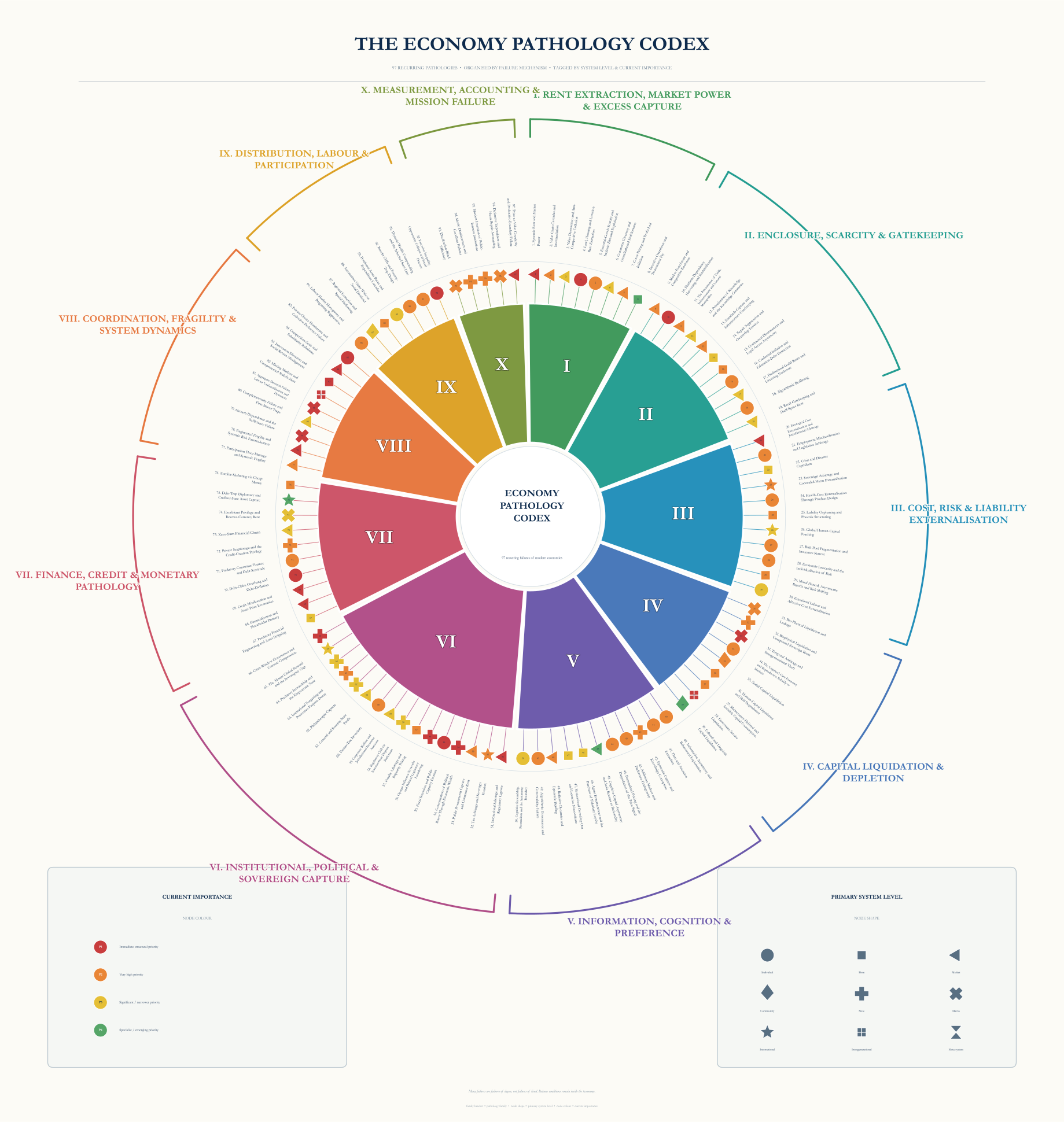
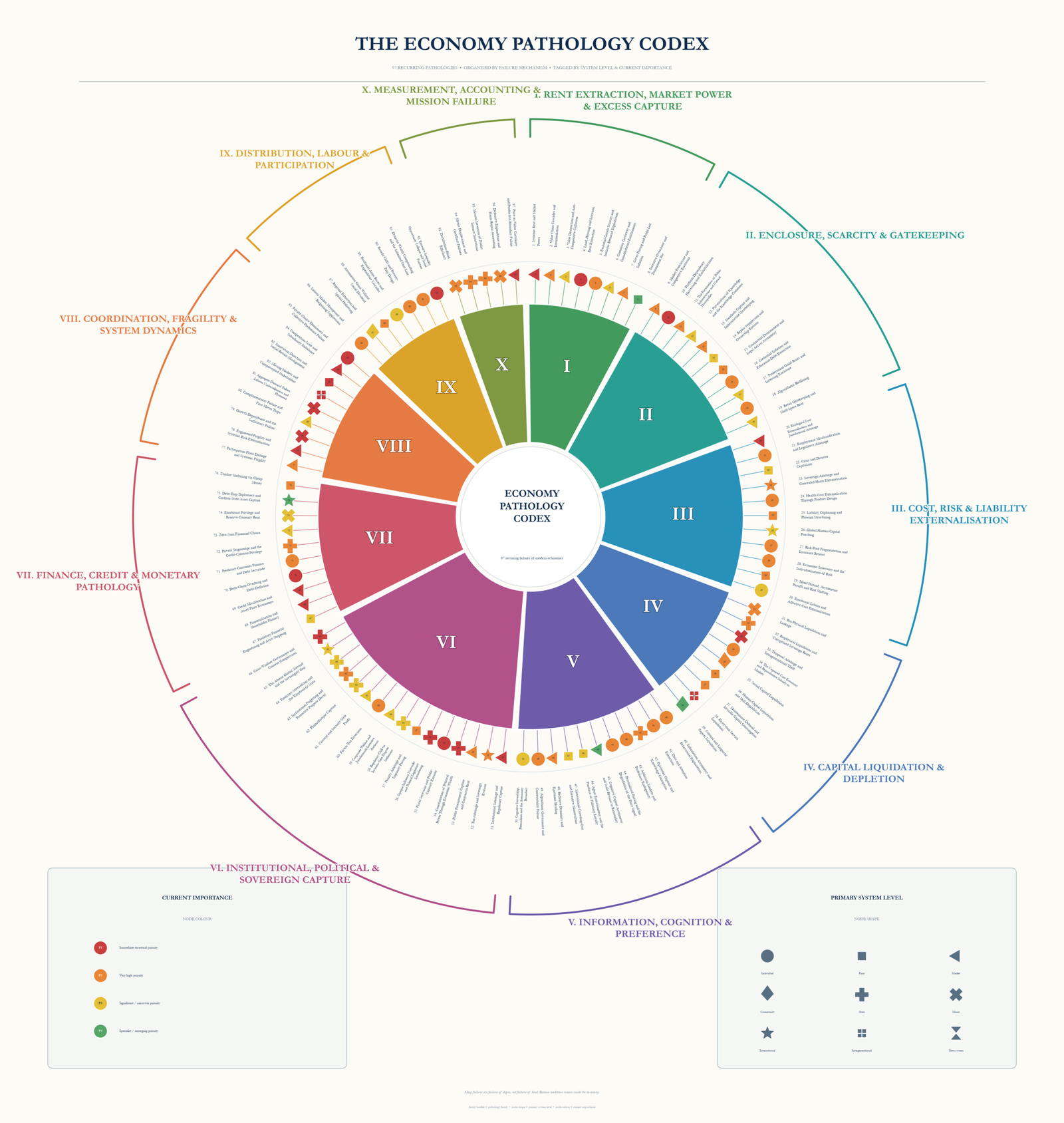
This graphic is designed for printing large scale to display nearly 100 failure modes per the Economy Pathology Codex.
Additionally, download the PNG version from here, or right-click the image above to save the SVG.
Economy Pathology Codex
Purpose
The following is a taxonomy of ways that modern economies fail to deliver outcomes of benefit to (i) the community, (ii) individual constituents of the community, (iii) the environment and/or (iv) the future. It is meant to be a comprehensive look at what’s wrong with the current economic systems so that any effort to redesign an improved system from first principles can be aware of the empirical reality of what pathologies have occurred under the current systems.
Not every mechanism below is pathological in itself. Profit, inequality, intellectual property, competition, regulation, credit, standardisation, risk pooling, growth etc etc can each be useful within a range. The problem begins when the mechanism passes the point where its marginal community benefit is lower than its marginal community cost, or when it is driven so far in the other direction that the useful function disappears. Where that matters, I use a Balance Condition rather than pretending the answer is simply more or less.
A flat list of 97 failures does not constitute a useful taxonomy. It fails to explain why the items belong together. This lack of cohesion reduces its explanatory power. A taxonomy should reveal connections beyond mere enumeration. In turn, stakeholders need clear reasoning to guide decisions.
The Codex therefore uses pathology mechanism as the primary hierarchy. That is the organising question: what is actually going wrong?
The same pathology can operate at multiple levels. It can damage several forms of community value. Therefore, each item carries three secondary classifications. These classifications help organize items for analysis. They guide interpretation and comparisons across levels. Without them, value assessment would be harder.
- System identifies where the pathology principally operates:
- Individual / Household;
- Firm / Transaction;
- Market / Value Chain;
- Community / Regional;
- Institution / State;
- Macroeconomy;
- International / Sovereign;
- Intergenerational / Ecological; or
- Meta-system / Epistemic.
- Damage identifies what is ultimately impaired or transferred:
-
R_sys(Systemic Rent); - Φ (Economic Participation Capability);
- BPL (Bio-physical liquidation);
- NRV (Net Retained Value);
- NET (Net External Transfers);
- Risk;
- Future;
- Signal / Agency;
- Institutional / Trust; and
- Coordination / Resilience (see Macroeconomic Profit Efficiency Framework for key terms).
-
- Current importance is a practical, deliberately time-sensitive priority judgement, not a moral score.
- P1 means an immediate structural priority: if only a handful of failures could be addressed first, these are the ones I would start with.
- P2 means a very high-priority pathology with broad or serious consequences, but usually less upstream leverage than P1.
- P3 means a significant pathology that is narrower, more downstream or more context-dependent.
- P4 means a real but comparatively specialist, emerging or locally contingent problem. Every item is here because it matters.
The primary grouping is deliberately not exclusive. Regulatory capture, for example, generates rent, damages participation and corrupts institutions. It is filed under institutional capture because that is the mechanism an economic steward would need to address first.
Codex at a Glance
| Pathology family | Items | Core failure |
|---|---|---|
| I. Rent Extraction, Market Power & Excess Capture | 1-8 | Value is captured beyond the productive inducement required to call forth the activity. |
| II. Enclosure, Scarcity & Gatekeeping | 9-19 | Access to markets, infrastructure, knowledge, remedies or participation is fenced, tolled or made artificially scarce. |
| III. Cost, Risk & Liability Externalisation | 20-30 | The actor capturing the gain does not bear the full cost, risk or liability created by the activity. |
| IV. Capital Liquidation & Intergenerational Depletion | 31-39 | Current income or efficiency is purchased by permanent consumption of non-renewable (or uncompensated damage to) natural, human, social, physical or cultural capital. |
| V. Information, Cognition & Preference Failure | 40-50 | The machinery by which people and institutions perceive, choose, learn and form preferences is manipulated, degraded or systematically biased. |
| VI. Institutional, Political & Sovereign Capture | 51-66 | Economic power bends the steward, the rules, enforcement or sovereign architecture toward extraction rather than community purpose. |
| VII. Finance, Credit & Monetary Pathology | 67-76 | Finance ceases to serve productive allocation, risk pooling and liquidity and instead becomes a source of rent, fragility or misallocation. |
| VIII. Coordination, Fragility & System Dynamics | 77-85 | Individually rational or locally efficient behaviour produces collectively inferior, brittle or self-reinforcing outcomes. |
| IX. Distribution, Labour & Participation | 86-92 | The distribution of income, opportunity, risk or adjustment costs damages the community’s capacity to participate productively. |
| X. Measurement, Accounting & Mission Failure | 93-97 | The score, proxy or institutional objective diverges from the underlying community outcome and begins to reward the failure itself. |
Table of Contents
I. Rent Extraction, Market Power & Excess Capture
- Systemic Rent and Market Power (
R_sys) - Value Chain Cascades and Intermediation
- Value Destruction and Anti-Competitive Collusion
- Land, Housing and Location Rent Extraction (
R_sys+ Φ) - Essential-Goods Scarcity and Inelastic-Demand Exploitation (
R_sys+ Φ) - Commons Giveaway and Grandfathered Entitlements (
R_sys+ BPL) - Cover-Pricing and Profit-Led Inflation (
R_sys+ Φ) - Incentive Overshoot and Tournament Pay (
R_sys+ Φ)
II. Enclosure, Scarcity & Gatekeeping
- Market Foreclosure and Competitive Enclosure
- Platform Dependency Harvesting and Enshittification (
R_sys+ Φ) - The Privatisation of Public Infrastructure and Natural Monopolies
- Privatisation of Knowledge and the Knowledge Commons (
R_sys+ Φ) - Standards Capture and Infrastructure Gatekeeping (
R_sys) - Repair Suppression and Ownership Erosion (
R_sys+ BPL) - Contractual Disarmament and Legal Access Asymmetry (Φ)
- Credential Inflation and Education-Debt Extraction (
R_sys+ Φ) - Professional Guild Rents and Licensing Enclosure (
R_sys) - Algorithmic Redlining (Φ)
- Retail Gatekeeping and Shelf-Space Rent (
R_sys)
III. Cost, Risk & Liability Externalisation
- Ecological Cost Externalisation and Jurisdictional Arbitrage
- Employment Misclassification and Legislative Arbitrage
- Crisis and Disaster Capitalism (
R_sys+ NET) - Sovereign Arbitrage and Concealed Harm Externalisation (
R_sys+ Φ + BPL + NET) - Health-Cost Externalisation Through Product Design (Φ + BPL)
- Liability Orphaning and Phoenix Structuring (BPL + NET)
- Global Human-Capital Poaching (NET + Φ)
- Risk-Pool Fragmentation and Insurance Retreat (Φ)
- Economic Insecurity and the Individualisation of Risk (Φ)
- Moral Hazard, Asymmetric Payoffs and Risk Shifting (
R_sys+ Φ) - Emotional Labour and Affective Cost Externalisation (Φ +
R_sys)
IV. Capital Liquidation & Intergenerational Depletion
- Bio-Physical Liquidation and Leakage (BPL & NET)
- Biophysical Liquidation and Uncaptured Sovereign Rents
- Temporal Arbitrage and Intergenerational Theft (BPL + Φ)
- The Unpriced Care Economy and Reproductive Subsidy to Markets (Φ)
- Social Capital Liquidation (Φ)
- Human-Capital Liquidation and Skill Degradation (Φ)
- Maintenance Deferral and Invisible Capital Consumption (BPL/NRV + Φ)
- Ecosystem-Service Liquidation (BPL)
- Cultural and Linguistic Capital Liquidation (Φ + BPL)
V. Information, Cognition & Preference Failure
- Information Asymmetry and Behavioural Exploitation
- Data and Attention Extraction (
R_sys+ BPL) - Epistemic Capture and Knowledge Corruption (
R_sys+ Φ) - Addiction Markets and Preference Endogeneity (
R_sys+ Φ) - Personalised Pricing and the Degradation of the Price Signal (
R_sys) - Cognitive-Capital Asymmetry and Scale Returns to Rationality (
R_sys) - Agent Entertainment and the Purchase of Fiduciary Loyalty (
R_sys+ Φ) - Motivational Crowding-Out and Incentive Monoculture (
R_sys+ Φ) - Reflexive Dynamics and Epistemic Herding (systemic)
- Algorithmic Governance and Contestability Failure (Φ)
- Cognitive Stewardship, Paternalism and the Autonomy Boundary (Φ)
VI. Institutional, Political & Sovereign Capture
- Institutional Sabotage and Regulatory Capture
- Tax Arbitrage and Sovereign Evasion (NET +
R_sys) - Public Procurement Capture and Contractor Rent (
R_sys+ Φ) - Concentration of Political Power Through Economic Wealth (
R_sys→ institutional feedback) - Fiscal Secession and Public-Capacity Erosion (
R_sys+ Φ) - Opaque Influence Networks and Political Legitimacy Laundering (
R_sys+ Φ) - Penalty Arbitrage and Impunity Pricing (
R_sys) - Regulatory Chill via Investor-State Dispute Settlement (NET +
R_sys) - Corporate Welfare and Jurisdictional Incentive Auctions (
R_sys+ NET) - Factor-Tax Inversion (
R_sys+ Φ) - Carceral and Security-State Profit (
R_sys+ Φ) - Philanthropic Capture (
R_sys→ institutions) - Institutional Forgetting and Protective-Purpose Decay (systemic)
- Predatory Stewardship and the Kleptocratic State (systemic + NET)
- The Absent Global Steward and the Sovereignty Gap (systemic + NET)
- Crisis-Window Governance and Consent Compression (systemic + Φ)
VII. Finance, Credit & Monetary Pathology
- Predatory Financial Engineering and Asset Stripping
- Financialisation and Shareholder Primacy (
R_sys+ Φ) - Credit Misallocation and Asset-Price Economies (
R_sys+ Φ) - Debt-Claim Overhang and Debt-Deflation (
R_sys+ Φ) - Predatory Consumer Finance and Debt Servitude (
R_sys+ Φ) - Private Seigniorage and the Credit-Creation Privilege (
R_sys) - Zero-Sum Financial Churn (
R_sys) - Exorbitant Privilege and Reserve-Currency Rent (NET +
R_sys) - Debt-Trap Diplomacy and Creditor-State Asset Capture (NET +
R_sys) - Zombie Sheltering via Cheap Money (
R_sys+ Φ)
VIII. Coordination, Fragility & System Dynamics
- Participation Floor Damage and Systemic Fragility (Φ)
- Engineered Fragility and Systemic Risk Externalisation (Φ +
R_sys) - Growth Dependence and the Sufficiency Failure (systemic)
- Complementarity Failure and First-Mover Traps (systemic + Φ)
- Aggregate-Demand Failure, Labour Underutilisation and Hysteresis (Φ + NRV)
- Missing Markets and Unrepresented Stakeholders (BPL + Φ)
- Innovation Direction and Social-Return Misalignment (
R_sys+ Φ) - Competition-Scale and Subsidiarity Imbalance (systemic)
- Private-Choice Dominance and Collective-Preference Failure (systemic + Φ)
IX. Distribution, Labour & Participation
- Labour Market Monopsony and Bargaining Suppression
- Regional Extraction and Spatial Hollowing (
NET+ Φ) - Automation Gains Without Social Dividend (
R_sys+ Φ) - Positional Arms Races and Expenditure Cascades (Φ)
- Benefit Cliffs and Poverty-Trap Design (Φ)
- Dynastic Wealth Compounding and the Inherited Start Line (
R_sys+ Φ) - Excessive Inequality, Opportunity Collapse and Social Fracture (
R_sys+ Φ)
X. Measurement, Accounting & Mission Failure
- Distribution-Blind Efficiency
- Metric Displacement and Goodhart Failures (systemic)
- Mission Inversion of Public-Interest Institutions (
R_sys+ Φ) - Defensive Expenditure and Harm-Repair Accounting (NRV + BPL + Φ)
- Price-as-Value Circularity and Productive-Boundary Failure (
R_sys+ Φ)
I. Rent Extraction, Market Power & Excess Capture
Value is captured beyond the productive inducement required to call forth the activity.
1. Systemic Rent and Market Power (R_sys)
System: Market / Value Chain Damage: R_sys; NRV Current importance: P1
- Positional Rent Extraction: Using dominant market share, network effects, or data monopolies to charge prices far above the productive inducement baseline.
- Regulatory Moats & Capture: Using political lobbying to secure protective legislation, subsidies, or complex compliance rules that insulate incumbents from innovative competitors.
- The SaaS Rent-Drain: Shifting technology from owned assets to permanent, escalating subscriptions that siphon off the productive economy’s retained value.
- Balance Condition, Productive Profit: Profit is not the goal of an economy; it is the price an economy pays to provide a profit incentive. Some expected return is necessary to induce investment, entrepreneurship, innovation and risk-bearing. The pathology is therefore not profit itself, but profit above the productive inducement baseline because market power, artificial scarcity, externalisation or institutional advantage allows the firm to collect more than was required to call forth the productive activity. The objective is to minimise the cost of the profit incentive whilst preserving the incentive.
- For Lay Readers: “Monopoly”; key academic: Gordon Tullock (1967, ‘The Welfare Costs of Tariffs, Monopolies, and Theft’, Western Economic Journal); exemplar: Standard Oil, broken up in 1911.
2. Value Chain Cascades and Intermediation
System: Market / Value Chain Damage: R_sys; NRV Current importance: P2
- Double Marginalisation (The Cascade): When successive nodes in a supply chain each hold market power, excess margins compound geometrically, artificially inflating final consumer prices.
- Administrative Layering: Introducing complex payment, billing, and intermediary layers (as seen in the US healthcare system) that extract profit without adding clinical or productive value.
- Zero-Sum IT Arms Races: Investing in local enterprise technology to capture market share or shift administrative burdens onto suppliers, causing systemic friction and industry-wide deadweight loss. Distinction from Administrative-Burden Offloading (below): the arms race is the competitive dynamic, every firm investing because its rivals have, so the industry ends on the same positions at a higher cost base; the offloading is the transfer mechanism the dynamic employs.
- Administrative-Burden Offloading: Shifting compliance, form-filling, verification and reconciliation work onto citizens and suppliers, so that the intermediary’s cost saving becomes an unpriced time tax on everyone downstream. Tax-filing complexity defended by tax-preparation lobbying is the textbook case; the corporate version is the centralised IT system whose internal savings are purchased by forcing suppliers and customers to perform the data entry that internal staff once did. Distinction from Zero-Sum IT Arms Races (above): the arms race is the competitive dynamic; this is the transfer mechanism, unpriced labour moved across the counterparty boundary and out of the initiator’s accounts, effective whether or not any rival follows suit.
- For Lay Readers: “Optimising locally, de-optimising globally”; key academic: Michael Porter (1985, Competitive Advantage); exemplar: Intuit’s lobbying to keep American tax filing complicated.
3. Value Destruction and Anti-Competitive Collusion
System: Market / Value Chain Damage: R_sys; NRV; BPL Current importance: P3
- Planned Obsolescence and Artificial Churn: Deliberately engineering goods to fail prematurely, rendering them unrepairable, or artificially restricting software updates to force frequent repurchase. While this forced throughput artificially inflates GDP and corporate revenue, it actively destroys National Retained Value (NRV) and accelerates Bio-Physical Liquidation (BPL). It is the literal destruction of community wealth to sustain a profit impost.
- Oligopolistic Quality Suppression (Shadow Cartels): Implicit or explicit collusion among dominant suppliers to establish an artificially low baseline for product quality, durability, or safety, alongside inflated pricing. By collectively refusing to compete on product excellence, the cartel neutralises the threat of creative destruction. This secures a permanent stream of Systemic Rent (
R_sys) for the incumbents whilst depriving the community of the innovation that profit is supposed to buy. - Algorithmic Tacit Collusion: Competitors adopting the same third-party pricing software (rental, hotel, retail) so that prices coordinate without any explicit agreement. The cartel outcome is reached through a shared algorithm, beyond the reach of collusion law written for humans in rooms.
- For Lay Readers: “Built to break”; key academic: Vance Packard (1960, The Waste Makers); exemplar: the Phoebus lightbulb cartel (1924).
4. Land, Housing and Location Rent Extraction (R_sys + Φ)
System: Individual / Household; Market / Value Chain; Macroeconomy Damage: R_sys; Φ; NRV Current importance: P1
- Land Value Capture by Private Owners: Much of the increase in urban land value arises from population growth, public infrastructure, schools, transport and surrounding economic activity rather than anything the landowner produced. Yet this socially created value accrues privately as capital gains and rent.
- Housing Financialisation: Treating housing primarily as an investment vehicle rather than shelter redirects credit and capital toward bidding up existing assets rather than constructing productive capacity.
- Artificial Housing Scarcity: Land banking, deliberate vacancy, restrictive development strategies, speculative withholding and concentrated ownership can make scarcity itself profitable.
- Infrastructure-Created Windfalls: A new railway, hospital or public precinct can add enormous value to nearby privately owned land whilst taxpayers fund the infrastructure that generated the gain.
- Rent Capitalisation Through Credit: Expected land rent can be capitalised into the purchase price of the land itself. When buyers can borrow more against a desirable location, competition between buyers raises the amount they can bid without creating any additional land, infrastructure or productive capability. Part of the future location value is therefore converted immediately into a higher asset price.
- Mortgage Capture of Location Value: Where socially created land value is capitalised into property prices, the purchaser may spend decades servicing the debt required to acquire access to that location. Income that might otherwise have remained with the household, landlord or community is converted into principal and interest payments. The location has not become more costly to produce; the financial claim over access to it has increased.
- Credit-Elastic Supply Failure: Additional mortgage capacity does not necessarily increase housing supply where the binding constraint is scarce land, planning capacity, infrastructure or construction capability. In those conditions easier credit can principally increase the price bidders are able to offer for the existing stock, transferring the financing benefit into asset values.
- The Capitalisation Feedback: Higher land prices justify larger mortgages; larger mortgages enable higher bids; higher comparable sales then support higher valuations and additional lending. Credit and location rent can therefore reinforce one another without a corresponding increase in the productive service provided by the land.
- Balance Condition, Mortgage Credit and Housing Access: Mortgage finance allows households to spread the cost of a long-lived asset across the years in which they use it and can substantially expand access to ownership. The pathology begins when additional credit primarily capitalises scarcity and socially created location value into higher prices rather than financing additional housing capability.
Housing is a keystone failure of the codex because it can simultaneously generate R_sys, reduce disposable income and participation (Φ), and redirect capital away from productive investment.
- For Lay Readers: “Unearned house inflation”; key academic: Henry George (1879, Progress and Poverty); exemplar: Sydney house prices.
5. Essential-Goods Scarcity and Inelastic-Demand Exploitation (R_sys + Φ)
System: Individual / Household; Market / Value Chain Damage: R_sys; Φ Current importance: P2
Markets behave very differently when consumers cannot meaningfully refuse to purchase.
- Necessity Pricing: Housing, medicine, electricity, water, childcare and basic food have extremely low demand elasticity.
- Scarcity Monetisation: Producers can sometimes benefit financially from maintaining shortages rather than expanding supply.
- Emergency Willingness-to-Pay Extraction: The maximum price a desperate consumer can pay replaces production cost or reasonable inducement as the pricing benchmark.
- Captive Consumer Markets: Hospitals, prisons, airports, universities and remote communities create consumers who lack ordinary substitution choices.
- Willingness-to-Pay as Value Circularity: In essential markets, the maximum amount a person or community is willing to pay can be determined by the severity of the harm avoided rather than by the productive contribution of the supplier. A patient may rationally be willing to surrender nearly everything to obtain a life-saving medicine. That willingness to pay measures the value of remaining alive to the patient; it does not establish that an equivalent amount of value was created by the firm supplying the treatment.
- The Avoided-Harm Appropriation Error: A product that prevents catastrophic harm can create enormous social value whilst requiring a much smaller payment to induce its development, manufacture and continued supply. Pricing the product against the full value of the avoided catastrophe allows the supplier to appropriate value that arises partly from the patient’s pre-existing vulnerability rather than from the productive cost or risk of supplying the remedy.
- Value-Based Pricing Without an Inducement Boundary: Pricing an essential product according to the value of the outcome can be economically defensible where it supports risky innovation and directs resources toward high-impact solutions. The pathology begins when the theoretical value of the benefit becomes the price ceiling without asking what reward was actually required to induce the innovation and supply.
- Need Magnitude Is Not Producer Contribution: The more catastrophic the untreated condition, the greater the apparent economic value of curing it. If that entire value is attributed to the producer, identical productive effort can command radically different rewards depending upon how desperate the buyer happens to be. The consumer’s vulnerability becomes a source of rent.
- Public Contribution and Therapeutic Value: Where foundational science, clinical infrastructure, public research funding or subsidised development contributed materially to the treatment, attributing the entire therapeutic value to the final rights-holder compounds the error. The value to the patient may be enormous whilst the productive contribution was distributed across many public and private actors.
- Balance Condition, Therapeutic Value and Innovation Incentive: High prices are not automatically excessive where research is risky, failure rates are high, patient populations are small or manufacturing is difficult. The correct benchmark is not production cost alone. The relevant question is the expected return required to induce socially valuable innovation, including failed research and genuine risk, without allowing monopoly position or patient desperation to convert the full value of avoided harm into private rent.
- Distinction from Item 97 [Price-as-Value Circularity and Productive-Boundary Failure]: Item 97 describes the general failure of inferring productive value from observed price. This is the essential-goods case where the error becomes particularly severe because willingness to pay is driven by the magnitude of the threatened harm.
The United States healthcare system is the canonical empirical illustration of this mechanism (also see Pricing the Cure a macroeconomic profit efficiency analysis of the US healthcare system).
- For Lay Readers: “Charge the desperate more”; key academic: Alfred Marshall (1890, Principles of Economics); exemplar: the EpiPen price hike (about $100 to $600, 2007-16).
6. Commons Giveaway and Grandfathered Entitlements (R_sys + BPL)
System: Market / Value Chain; Institution / State Damage: R_sys; BPL; NRV Current importance: P3
- Free Allocation on Historical Use: When a new property right is created over a commons (fishing quotas, water licences, radio spectrum, emissions permits, taxi plates, airport slots), it is typically handed to incumbents in proportion to past use rather than auctioned. The community creates the asset by fencing the commons and then gifts the entire rent stream to whoever happened to be extracting at the time.
- Capitalised Windfalls: Once tradable, the gifted right becomes a capital asset whose market value is the present value of the community’s forgone rent. Later reform must then “compensate” holders for removing a privilege they never paid for, locking the giveaway in permanently.
- Distinction from Item 32 [Biophysical Liquidation and Uncaptured Sovereign Rents]: Item 32 concerns rent extracted once a resource right exists; this item concerns the moment of allocation, where a single administrative decision determines who holds the rent for a generation.
- For Lay Readers: “First in, first owned”; key academic: Elinor Ostrom (1990, Governing the Commons); exemplar: free EU emissions permits and the power-sector windfall they created.
7. Cover-Pricing and Profit-Led Inflation (R_sys + Φ)
System: Market / Value Chain; Macroeconomy Damage: R_sys; Φ Current importance: P2
- Shock as Cover: Supply disruptions, energy spikes and emergencies give firms cover to raise prices beyond cost pass-through, with margins expanding under the narrative of “input costs”. The 2021 to 2023 episode showed profit shares rising alongside inflation across concentrated sectors.
- Ratchet Through Wage Restraint: The resulting inflation is then treated as a reason to hold wages down, so the real transfer from labour to capital is locked in after the shock passes.
- Distinction from Item 22 [Crisis and Disaster Capitalism]: Item 22 requires a crisis; this item operates in ordinary conditions whenever concentration is high enough for firms to coordinate implicitly on the timing of price rises.
- For Lay Readers: “Price doesn’t reflect costs”; key academic: Isabella Weber and Evan Wasner (2023, ‘Sellers’ Inflation, Profits and Conflict’, Review of Keynesian Economics); exemplar: US beef packers’ record pandemic margins.
8. Incentive Overshoot and Tournament Pay (R_sys + Φ)
System: Firm / Transaction; Market / Value Chain Damage: R_sys; Φ Current importance: P4
- Beyond-Sufficiency Pay: Remuneration ratcheting past the threshold required to elicit the behaviour: tournament and superstar pay set by benchmarked comparison rather than any marginal contribution, where the tenth million buys no more effort than the first but the benchmark has moved (e.g. executive pay set by compensation consultants surveying each other). The overshoot is rent paid for positional peace within the pay-setting club, cascading as each board benchmarks against the last ratchet (item 89 [Positional Arms Races and Expenditure Cascades]).
- Balance Condition, Incentive and Overshoot: High pay is not automatically rent. Scarce capability, difficult work, risk, responsibility and genuine opportunity cost can all require substantial remuneration. The pathology starts at the point where the next dollar buys no material increase in the behaviour or capability the community is paying to induce.
- Distinction from Item 68 [Financialisation and Shareholder Primacy]: The buyback-incentive dotpoint covers the form of pay (share-price linkage steering decisions); this item covers the level (beyond the sufficiency threshold, pure rent with no behavioural purchase).
- For Lay Readers: “CEO Pay”; key academic: Edward Lazear and Sherwin Rosen (1981, ‘Rank-Order Tournaments as an Optimum Labor Contract’, Journal of Political Economy); exemplar: Elon Musk’s $56 billion Tesla pay package.
II. Enclosure, Scarcity & Gatekeeping
Access to markets, infrastructure, knowledge, remedies or participation is fenced, tolled or made artificially scarce.
9. Market Foreclosure and Competitive Enclosure
System: Market / Value Chain Damage: R_sys; NRV; Coordination / Resilience Current importance: P2
- Walled Gardens and Platform Enclosure: Creating artificial monopolies by locking consumers into a physical or digital ecosystem (e.g., stadium precincts, theme parks, or massive e-commerce platforms like Amazon) and actively preventing competitors from accessing those captured buyers. The platform owner extracts massive positional rent simply for granting access to the enclosed space.
- Horizontal Shareholding (Common Ownership): When giant institutional investors, asset managers, or private equity firms acquire influential, overlapping stakes in all the major competing firms within a single industry (e.g., airlines, banking, or supermarkets). This acts as a shadow cartel; because the ultimate owners profit from the whole sector, the individual firms lose all incentive to compete on price or innovation, leading to industry-wide systemic rent extraction.
- Monopsonist Bullying and Vertical Exclusion: Using dominant buyer power (monopsony) to threaten upstream suppliers with a complete loss of market access unless they refuse to supply smaller, innovative competitors or only do so at a price acceptable to the dominant buyer. This starves new entrants of necessary inputs, choking off creative destruction and protecting the incumbent’s margins.
- Killer Acquisitions: Acquiring nascent competitors specifically to shut down their products or pipelines before they threaten the incumbent’s margins, a pattern prominent in pharmaceuticals and digital platforms. The purchase price is a rent-protection payment, and the community loses the innovation that competition would have delivered.
- Single-Provider Lock-in: Deliberately standardising on proprietary platforms, protocols, or vendors (e.g., AWS, Windows, iOS, SAP) to reduce integration costs in the short term, but eliminating redundancy and exit options in the long term. This creates vendor capture, where switching costs become prohibitive, and systemic failures (outages, security breaches, price hikes) cascade across dependent organisations, externalising the risk whilst privatising the efficiency gains.
- Contractual Input Enclosure (The Franchise Tie): Contractually obliging downstream businesses (franchisees, dealers, licensees) to purchase inputs and services from the upstream principal or its designated suppliers at inflated prices, under the guise of standardisation and brand consistency. The contract itself creates the artificial monopoly: the franchisee’s only options are to absorb the overcharge or exit the business, and exit is itself made punitive by the principal’s control of the brand, the site, and the customer base.
- Balance Condition, Competition and Scale: Competition is a means, not an end. Too little competition permits rent, foreclosure and stagnation; excessive fragmentation can sacrifice legitimate economies of scale, network coordination, common infrastructure and R&D capacity. The target is contestable scale: firms large enough to realise productive economies, but unable to convert scale into permanent exclusion (see Item 84 [Competition-Scale and Subsidiarity Imbalance]).
- Referee-Competitor Conflict: A platform can simultaneously operate the marketplace and compete inside it. The same intermediary that controls admission, search, ranking, recommendation, advertising and enforcement may also sell its own goods or services against the suppliers dependent upon that infrastructure. The market referee therefore has a direct financial interest in the result of the contest it administers.
- Self-Preferencing: Control of the interface permits the intermediary to privilege its own products, services or strategic partners through search position, default status, recommendation, access to features, lower effective fees or preferential treatment under rules nominally applied to everyone. Foreclosure no longer requires excluding the competitor outright. The platform can simply make the competitor progressively harder to find, more expensive to reach or less convenient to use.
- Platform Intelligence Appropriation: Operating the marketplace gives the intermediary privileged visibility over prices, conversion rates, demand, supplier performance, customer behaviour and emerging product categories. Where the platform also competes with participants, information supplied as a condition of market access can become an intelligence system for identifying attractive markets, copying successful offerings or selectively targeting profitable suppliers. The gatekeeper therefore learns from every competitor whilst competitors see only their own fragment of the market.
- Distinction from Platform Dependency Harvesting and Enshittification: This item concerns how the platform distorts competition between itself and market participants. Enshittification concerns the broader dynamic by which accumulated dependency permits the platform progressively to extract from all sides of the ecosystem.
- For Lay Readers: “Overcharging the inmates”; key academic: Joe Bain (1956, Barriers to New Competition); exemplar: United States v Microsoft (1998-2001).
10. Platform Dependency Harvesting and Enshittification (R_sys + Φ)
System: Individual / Household; Firm / Transaction; Market / Value Chain
Damage: R_sys; Φ; NRV; Signal / Agency; Coordination / Resilience
Current importance: P1
A market relationship can begin by creating genuine value and become extractive only after the participants have become dependent upon it. This creates a pathology that static analysis can easily miss. The product may have been excellent when adoption occurred; the failure lies in what happens after accumulated users, suppliers, creators, workers, data and complementary businesses make exit progressively more costly.
- Acquisition Subsidy and Dependency Formation: A platform can initially transfer unusually high value to users, suppliers, creators or business customers in order to accelerate adoption. Prices may be low, commissions small, reach generous and service quality unusually high. There is nothing inherently pathological about introductory subsidy or cross-subsidy. The problem begins when the attractive initial bargain is principally a mechanism for accumulating dependency that will later be harvested.
- Two-Sided Hostage Formation: In a platform market, users become valuable because sellers, creators or service providers are present, whilst those suppliers become dependent because the users are present. Each side becomes part of the switching cost faced by the other. Once the intermediary controls access between both groups, neither side can easily leave without losing access to the other.
- The Surplus Ratchet: After dependency has accumulated, the intermediary can progressively reclaim the surplus it previously distributed. Commissions rise, organic reach falls, advertising loads increase, free functions become paid functions, payouts decline, service deteriorates or additional tolls are inserted between counterparties. Each individual change may appear small, but the direction is persistently toward transferring value from the dependent ecosystem to the intermediary.
- Twiddling Power: Digitally mediated markets allow the platform to alter prices, rankings, recommendations, payouts, commissions, visibility, advertising density, contractual treatment and access conditions rapidly and repeatedly. The intermediary therefore possesses a degree of continuous control over the terms of exchange that ordinary counterparties do not. The rules can move faster than users, workers or suppliers can understand, organise around or escape them.
- Asymmetric Rule Mutability: The platform may reserve almost unlimited discretion to change the bargain whilst denying equivalent configurability to everyone else. Users cannot rewrite the feed, sellers cannot redesign the ranking mechanism and workers cannot alter the dispatch algorithm. Flexibility is concentrated on one side of the relationship.
- The Degradation Budget: Lock-in creates a quantity of deterioration that can be imposed before the expected cost of remaining finally exceeds the cost of exit. Accumulated network connections, data, purchased media, reputation, workflow integration, audience, transaction history and complementary investments all increase this budget. The more indispensable the service becomes, the more value can potentially be withdrawn without triggering departure.
- Minimum Viable Satisfaction: Once competition is sufficiently weak, the commercial objective can invert. The platform no longer maximises the value delivered to users or suppliers; it seeks the minimum quality, payout or functionality required to prevent enough of them from leaving. Satisfaction above that retention threshold can then appear internally as unmonetised surplus.
- Relationship-Capital Liquidation: Trust, habit, network density, creator ecosystems, developer communities, supplier relationships and accumulated goodwill are productive capital stocks. A platform can consume these stocks through repeated degradation whilst reporting the resulting extraction as current income. Enshittification is therefore partly a form of capital liquidation: yesterday’s goodwill becomes today’s margin.
- Terminal Ecosystem Harvest: Extraction can eventually damage users, suppliers, workers, advertisers and complementary businesses simultaneously. At this stage the intermediary begins consuming the productive ecology that made its position valuable. The final pathology is not merely high rent but the destruction of the system from which the rent is collected.
- Constraint Collapse: Dependency harvesting becomes easier as the institutions capable of disciplining it weaken. Competition provides exit; regulation places limits on permissible conduct; interoperability allows users and competitors to route around the intermediary; and worker power creates resistance from inside the organisation. The simultaneous weakening of these constraints gives the intermediary much greater freedom to alter the bargain after dependency has formed.
- Balance Condition, Platform Maturation and Extraction: Platforms legitimately change prices, introduce paid services, recover fixed costs and rebalance subsidies as they mature. A business is not required to preserve every introductory concession forever. The pathology begins when accumulated dependency rather than continuing value creation becomes the principal source of pricing power, allowing the intermediary to worsen the bargain beyond what counterparties would accept in a genuinely contestable market. The stewardship objective is not frozen business models but low-cost exit, contestability and sufficient countervailing power that continuing participation remains evidence of continuing value rather than captivity.
- Distinction from Item 9 [Market Foreclosure and Competitive Enclosure]: Item 9 concerns the construction of enclosure, foreclosure and switching costs. This item concerns the dynamic extraction strategy that becomes possible after those dependencies have accumulated. Enclosure creates the captive position; enshittification harvests it.
- Distinction from Item 13 [Standards Capture and Infrastructure Gatekeeping]: Item 13 concerns control of standards, interfaces and infrastructure through which markets must interoperate. This item concerns progressive redistribution of value across an already functioning platform relationship and can occur even where no single technical standard is itself the source of power.
- Distinction from Item 44 [Personalised Pricing and the Degradation of the Price Signal]: Item 44 concerns personalised extraction of an individual buyer’s willingness to pay and the resulting degradation of the common price signal. This item concerns the longitudinal reallocation of value between entire classes of platform participants as dependency increases.
- For Lay Readers: “Enshittification”; key academic: Cory Doctorow (2022, coining ‘enshittification’); exemplar: the decay of the Facebook news feed.
11. The Privatisation of Public Infrastructure and Natural Monopolies
System: Market / Value Chain; Institution / State Damage: R_sys; NRV; Coordination / Resilience Current importance: P2
- Natural Monopoly Rent Extraction: The conversion of publicly funded, essential infrastructure (e.g., energy grids, water systems, toll roads, and ports) from state provision to private ownership. Because these are natural monopolies, citizens cannot “shop elsewhere.” The private owner exploits this captive market to extract permanent Systemic Rent (
R_sys). To maximise margins, these operators frequently underinvest in maintenance and resilience, effectively liquidating the public’s prior capital investment to fund private dividends. - Balance Condition, Ownership and Stewardship: Private operation is not automatically pathological, and public ownership is not automatically efficient. The underlying problem is the absence of meaningful contestability. A natural monopoly requires price, quality, investment and resilience disciplines strong enough to prevent extraction regardless of whether the operator is publicly or privately owned.
- For Lay Readers: “Selling the farm”; key academic: John Stuart Mill (1848, Principles of Political Economy, on natural monopoly); exemplar: Thames Water.
12. Privatisation of Knowledge and the Knowledge Commons (R_sys + Φ)
System: Market / Value Chain; Institution / State Damage: R_sys; Φ; NRV; Signal / Agency Current importance: P3
- Publicly Funded, Privately Enclosed: Knowledge created at public expense is converted into private property and sold back to the community that paid for it (e.g. publicly funded pharmaceutical research patented into private medicine, public geographic and weather data enclosed in paid services, publicly created datasets absorbed into proprietary AI systems). The community pays twice: once to create the knowledge, and again to access it.
- The Journal Rent Loop: Researchers funded by the public publish through private platforms that acquire the distribution rights, and the same universities then pay enormous subscription fees to regain access to knowledge they helped create. The research, the peer review and the editorial labour are all supplied free by the academic community; the publisher supplies the fence.
- Positional Toll, Not Productive Margin: The rent flows from occupying the distribution chokepoint rather than from adding value to the knowledge itself. This is enclosure of an information commons: a positional toll on a commons the public already stocked.
- The Public Knowledge Substrate: Commercial innovation rarely begins inside the firm from first principles. Universities, public laboratories, education systems, scientific institutions, infrastructure, standards bodies and publicly funded research create much of the underlying knowledge on which private products are later built. The final commercial stage can therefore capture value generated by a much larger public productive substrate that conventional accounts leave economically invisible.
- Socialised Upstream Risk, Privatised Downstream Return: Government and public institutions frequently finance the uncertain, long-horizon stages of research for which commercial returns are least predictable. Once the technological uncertainty has been reduced, private firms can enter at the later stage where commercialisation is easier and appropriable returns are clearer. The community bears a disproportionate share of discovery risk whilst private owners can capture a disproportionate share of successful downstream value.
- Cumulative Innovation Blindness: Knowledge production is cumulative. A patentable or commercially successful breakthrough may depend upon decades of previous research, open scientific publication, public datasets, standards, infrastructure and education. Treating the final inventor as though it created the entire productive value exaggerates the private contribution and obscures the inherited knowledge commons embedded in the product.
- Public Data as Productive Infrastructure: Geographic, meteorological, health, scientific, transport, statistical and administrative datasets created by public institutions can function as infrastructure for entire industries. When downstream firms monetise that information, part of their productive capability derives from a publicly maintained knowledge asset just as surely as a logistics firm benefits from a publicly maintained road.
- The Double-Payment Risk: Where the public funds foundational research and later grants strong exclusive rights over the resulting application without preserving reasonable access, citizens can effectively pay once to create the knowledge and again through monopoly pricing to use its commercial expression. The problem is not private commercialisation but failure to recognise the public contribution when allocating downstream rights and returns.
- Invisible Public Equity: Public investment in knowledge frequently produces no conventional ownership stake even where it materially reduces the risk or cost of a successful private product. The absence of a formal equity claim can make the public contribution appear to have generated no return even though it was indispensable to the final productive outcome.
- Balance Condition, Public Contribution and Commercialisation: Public origin does not imply that every downstream product should be free or publicly operated. Commercial firms perform valuable functions in development, scaling, manufacturing, distribution and risk-bearing, and those functions require an inducement. The relevant question is whether the private claim reflects the value and risk actually contributed at the commercial stage or captures returns created substantially by a public knowledge stock without adequate reciprocal benefit to the community.
- Collective Creation, Private Attribution: Major innovations commonly combine public research, universities, infrastructure, workers, suppliers, standards, patient capital and private entrepreneurial capability. The firm owning the final commercial product may make an indispensable contribution without having created the entire productive capability from which the product emerged. Ownership of the final claim is not equivalent to authorship of all the value embodied within it.
- Risk-Reward Asymmetry: Public institutions can finance the early stages of innovation where technological uncertainty is highest and commercial returns least predictable. Once uncertainty has fallen and a profitable application becomes visible, private capital can enter at the lower-risk commercialisation stage and capture a large share of the upside. The community can therefore bear disproportionately high exploratory risk without receiving a corresponding claim on successful outcomes.
- The Last-Mile Attribution Error: Commercialisation is highly visible because it produces the final product, brand and revenue stream. Foundational research, enabling technologies, infrastructure, standards and cumulative scientific knowledge are less visible because they occurred earlier and across many institutions. Economic narratives can therefore attribute the entire success to the actor completing the final commercial mile.
- The Entrepreneurial-State Blind Spot: Governments and public institutions sometimes act under genuine technological uncertainty rather than simply funding predetermined public services. Early procurement, research grants, demonstration projects, infrastructure investment and strategic programmes can absorb uncertainty that private investors are unwilling to bear. Treating all such activity as passive subsidy understates the productive risk undertaken by the community.
- Upside Detachment: Public investment need not receive a direct financial return from every successful project because wider tax revenue, employment, knowledge diffusion and consumer benefit can provide the social return. The pathology begins where public institutions systematically absorb substantial downside risk whilst contractual or ownership structures ensure that unusually large upside remains almost entirely private.
- Risk Socialisation Before Crisis: Risk can be socialised long before a bailout occurs. If the public sector finances foundational research, infrastructure, workforce capability and early technical uncertainty whilst private actors enter principally after commercial viability becomes clearer, part of the private return rests on risk already removed from the project by collective investment.
- Reward Without Contribution Symmetry: The appropriate claim on an innovation should reflect productive contribution, risk, capability and the incentives required to induce each participant. Neither public funding nor private ownership automatically determines the morally or economically correct share. The failure occurs when institutional arrangements systematically disconnect reward from the contribution and risk actually supplied.
- Balance Condition, Collective Creation and Private Reward: Complex innovation requires both collective infrastructure and strong private incentives. Recognising public contribution does not imply that successful firms should surrender all downstream return, just as recognising private entrepreneurship does not justify treating publicly created knowledge as valueless. The useful boundary preserves enough reward to induce experimentation and scaling whilst ensuring that collectively financed capability is not simply transferred into permanent private rent.
- Distinction from Item 97 [Price-as-Value Circularity and Productive-Boundary Failure]: Price-as-Value Circularity concerns the conceptual mistake of treating market income as proof of productive contribution. This item concerns the historical and institutional attribution of productive contribution where the underlying innovation was jointly created across public and private actors.
- Distinction from Item 80 [Complementarity Failure and First-Mover Traps]: Item 80 explains why high-spillover knowledge may be underproduced without collective coordination. This item concerns what happens after the community has already financed or created that knowledge and private actors subsequently enclose or appropriate the resulting productive substrate.
- Distinction from Item 51 [Institutional Sabotage and Regulatory Capture] (The IP Trap): The IP trap abuses the statutory monopoly itself; this item encloses knowledge the public already paid to create.
- For Lay Readers: “Charging people (again) for publicly paid goods”; key academic: James Boyle (2003, ‘The Second Enclosure Movement and the Construction of the Public Domain’, Law and Contemporary Problems); exemplar: Elsevier’s roughly 37 per cent margins on publicly funded research.
13. Standards Capture and Infrastructure Gatekeeping (R_sys)
System: Market / Value Chain Damage: R_sys; NRV; Coordination / Resilience Current importance: P2
- The Interoperability Toll: Whoever controls a technical standard, payment rail, app store, certification system or essential interface can extract rent from everyone who must interoperate with it (e.g. app-store commissions, payment-network fees, certification monopolies). The product itself may be competitive whilst the infrastructure required to reach the market is monopolised.
- Enclosure by Specification: The gate is built into the artefact rather than the market: proprietary file formats, closed APIs, proprietary repair diagnostics and mandatory digital identity intermediaries force every complementary actor through the owner’s terms, and the rent scales with every adopter the specification obliges.
- Positional Information Rent: The standard-setter sees every implementation of its specification, accruing informational advantage as a by-product of position rather than investment. The rent flows from the position rather than the information stock, so competitors cannot contest it by matching expenditure.
- Balance Condition, Standardisation and Diversity: Standards can be profoundly productive. They create interoperability, reduce transaction costs and let complementary technologies work together. Too little standardisation produces incompatibility and duplication; too much, particularly where the standard is proprietary or monocultural, creates lock-in and correlated failure. The preferred architecture is open standards with plural implementations.
- End-to-End Inversion: An intermediary positioned between a willing sender and a willing receiver can cease acting as a neutral conduit and begin charging for the right to complete the connection the parties already requested. A user follows a publisher but the platform suppresses the publisher’s material unless visibility is purchased; a customer searches for a product but paid placement displaces the result most responsive to the search. The intermediary monetises its ability to frustrate rather than facilitate the expressed intention of its users.
- The Restoration Toll: Once the intermediary has degraded the connection, it can sell restoration of the original function as a premium service. Creators pay to reach followers who already requested their content; sellers pay for prominence in searches generated by demand for their own category; users pay subscriptions to remove advertising or recover functionality previously included in the product. Rent is extracted by first introducing friction and then charging to remove it.
- Adversarial Interoperability Suppression: A user, competitor or independent developer may be technically capable of building an alternative client, blocker, adapter, scraper, compatibility layer, repair tool or other modification that restores functionality or routes around the gatekeeper. Contract, intellectual-property law, anti-circumvention rules, authentication controls and technical countermeasures can be used to prevent that self-help. The incumbent thereby claims practical control not only over its own service but over the ways others are permitted to make that service interact with the rest of the economy.
- Configurability Asymmetry: The infrastructure owner can continuously reconfigure the system for its own commercial benefit whilst customers and competitors are prohibited from reconfiguring their own side of the interface. The problem is therefore not merely closed standards. It is asymmetric control over the mutability of the standard after adoption.
- Balance Condition, Interoperability and System Integrity: Unlimited interoperability can create genuine privacy, cybersecurity, safety and reliability risks, particularly where third-party software gains privileged access to sensitive systems. The alternative is not therefore unrestricted access to every interface. The balance is sufficient user-directed interoperability, portability and independent implementation to preserve exit and contestability whilst applying security restrictions proportionate to demonstrable technical risk rather than to the incumbent’s commercial interest.
- For Lay Readers: “Standards Lock-in”; key academic: W. Brian Arthur (1989, ‘Competing Technologies, Increasing Returns, and Lock-In by Historical Events’, Economic Journal); exemplar: the QWERTY keyboard.
14. Repair Suppression and Ownership Erosion (R_sys + BPL)
System: Firm / Transaction; Market / Value Chain Damage: R_sys; BPL; NRV; Signal / Agency Current importance: P3
- Repair Suppression: Software locks, withheld diagnostic information and serialised replacement parts prevent owners and independent repairers from maintaining purchased goods, converting the manufacturer’s aftermarket position into a rent on every repair it has made impossible elsewhere.
- The Erosion of Ownership Itself: Features physically present in purchased goods require subscriptions, and remote servers can disable previously purchased functionality. The economic relationship shifts from buy → own → maintain to buy → licence → subscribe → replace: the customer pays repeatedly for what they already hold.
- Distinction from Item 3 [Value Destruction and Anti-Competitive Collusion] (Planned Obsolescence): Obsolescence shortens the life of the good; this item erodes the ownership of it. The result is both systemic rent extraction and accelerated material throughput (BPL).
- For Lay Readers: “Selling use.. not ownership”; key academic: Aaron Perzanowski and Jason Schultz (2016, The End of Ownership); exemplar: John Deere’s software-locked tractors.
15. Contractual Disarmament and Legal Access Asymmetry (Φ)
System: Firm / Transaction; Institution / State Damage: Φ; Signal / Agency; Institutional / Trust Current importance: P2
- Remedy Enclosure: Forced arbitration clauses, class-action waivers, non-disclosure and non-disparagement terms strip the community’s remedies before any harm occurs. The consumer or worker signs away access to the courts as the price of participation.
- Contracts of Adhesion: Terms that no one reads and no one can negotiate, changed unilaterally, that shift risk wholesale to the weaker party. Consent becomes a formality.
- Litigation as Weapon: Strategic lawsuits against public participation, defamation threats against critics and journalists, and the sheer cost of legal process ensure that the party with deeper pockets sets the practical boundary of what may be said or contested.
- For Lay Readers: “Signing away your day in court”; key academic: Marc Galanter (1974, ‘Why the Haves Come Out Ahead’, Law and Society Review); exemplar: forced arbitration clauses in employment and consumer contracts.
16. Credential Inflation and Education-Debt Extraction (R_sys + Φ)
System: Individual / Household; Market / Value Chain Damage: R_sys; Φ; NRV Current importance: P2
- Positional Entry Tickets: Degrees become required for roles that did not previously need them, not because the work changed but because the credential became the sorting device. The cost of participation rises with no productive gain.
- Debt-Financed by the Student: The individual bears the cost of a positional arms race, often through non-dischargeable debt that consumes a decade of early-career income.
- For-Profit Capture of Public Subsidy: Providers optimised for enrolment rather than outcome capture public loan and grant systems whilst delivering credentials of low market value. The public subsidy becomes the provider’s rent.
- For Lay Readers: “Qualification Inflation”; key academic: Randall Collins (1979, The Credential Society); exemplar: US student debt passing $1.7 trillion.
17. Professional Guild Rents and Licensing Enclosure (R_sys)
System: Market / Value Chain; Institution / State Damage: R_sys; Φ Current importance: P3
- Self-Governed Supply Restriction: Professions that control their own entry (training places, residency caps, admission quotas, scope-of-practice rules) can restrict supply below community need and capture the resulting scarcity premium.
- Protection Framed as Quality: Restrictions are defended as safeguarding standards, and some do; but where the binding constraint is the number of training places rather than the number of qualified applicants, the safeguard functions as a cartel.
- Distinction from Item 51 [Institutional Sabotage and Regulatory Capture]: Item 51 concerns corporate incumbents shaping regulation; this item concerns occupational self-regulation turned against the community it serves.
- Balance Condition, Licensing and Access: Licensing can protect the public where quality is difficult to observe and incompetent practice can cause serious harm. Too little qualification control exposes the community to avoidable failure; too much turns quality assurance into supply restriction. Entry requirements should therefore track demonstrable competence and risk, not incumbent scarcity.
- For Lay Readers: “Artificial Scarcity: too few doctors”; key academic: Morris Kleiner (2006, Licensing Occupations: Ensuring Quality or Restricting Competition?); exemplar: the capped US medical residency pipeline.
18. Algorithmic Redlining (Φ)
System: Individual / Household; Market / Value Chain Damage: Φ; Signal / Agency Current importance: P2
- Statistical Exclusion at Scale: Opaque models in credit, insurance, tenancy and hiring reproduce historical patterns of exclusion, denying participation to whole categories of people on proxies they cannot see or contest.
- No Remedy Channel: Because the decision is automated and the model proprietary, the excluded person has no counterparty to argue with and no basis to appeal.
- Distinction from Items 40 [Information Asymmetry and Behavioural Exploitation] and 41 [Data and Attention Extraction]: Those concern confusion and extraction of those inside the market; this concerns exclusion from the market altogether.
- For Lay Readers: “Computer says no”; key academic: Cathy O’Neil (2016, Weapons of Math Destruction); exemplar: the COMPAS recidivism scores.
19. Retail Gatekeeping and Shelf-Space Rent (R_sys)
System: Market / Value Chain Damage: R_sys; Φ Current importance: P3
- Access Fees in Physical Markets: Slotting allowances, product-placement charges and pay-to-stay terms in concentrated retail make the shelf itself a toll booth. The supplier’s cost of reaching customers becomes the retailer’s rent; the consumer’s price carries both.
- The Physical Analogue of Item 13 [Standards Capture and Infrastructure Gatekeeping]: Platform gatekeeping (app stores, payment rails) has a bricks-and-mortar counterpart in concentrated grocery and pharmacy channels, which for most households is the binding value chain on essential goods (item 5 [Essential-Goods Scarcity and Inelastic-Demand Exploitation]).
- Distinction from Items 1 [Systemic Rent and Market Power] and 13 [Standards Capture and Infrastructure Gatekeeping]: Item 1 names positional rent generally; item 13 names technical-standard gatekeeping. This names the physical-space toll, increasingly relevant as retail concentration rises.
- For Lay Readers: “Rent for shelf space”; key academic: Paul Bloom, Gregory Gundlach and Joseph Cannon (2000, ‘Slotting Allowances and Fees’, Journal of Public Policy and Marketing); exemplar: the Coles and Woolworths duopoly.
III. Cost, Risk & Liability Externalisation
The actor capturing the gain does not bear the full cost, risk or liability created by the activity.
20. Ecological Cost Externalisation and Jurisdictional Arbitrage
System: Market / Value Chain; International / Sovereign; Intergenerational / Ecological Damage: R_sys; BPL; Φ; Risk; NET Current importance: P1
- Uncompensated Pollution (Negative Externalities): Treating surrounding lands, waterways, and the atmosphere as a free dumping ground. By imposing the physical costs of production, such as health impacts, cleanup, and biodiversity loss, on the community without compensation, the polluter artificially suppresses their operating costs. This converts an unpriced public harm directly into private systemic rent.
- Regulatory and Labour Arbitrage (Cost-Shifting): Rather than investing capital in cleaner, safer, and more resilient production technologies, firms outsource dirty or dangerous manufacturing to jurisdictions with weak environmental regulations and low labour standards. This exploits disparities in the global “Participation Floor,” allowing firms to protect their margins by exporting negative externalities to communities least equipped to defend themselves.
- Waste and End-of-Life Export: Shipping e-waste, plastics, textiles and end-of-life vessels to jurisdictions with weak handling standards, so that the disposal cost of consumption is booked as an export and the contamination lands on communities least able to refuse it.
- For Lay Readers: “Polluting where the community is powerless”; key academic: Arthur Pigou (1920, The Economics of Welfare); exemplar: Bhopal (1984).
21. Employment Misclassification and Legislative Arbitrage
System: Individual / Household; Firm / Transaction Damage: R_sys; Φ; Risk Current importance: P2
- Classification Arbitrage (The Gig Trap): Deliberately reclassifying core employees as “independent contractors” or “franchisees” to strip them of hard-won labour protections, minimum wage guarantees, health benefits, and workers’ compensation. The firm captures the savings as rent, whilst the worker absorbs all the volatility and systemic risk.
- Political Wage Deflation: Using lobbying power to freeze minimum wage increases, erode overtime pay thresholds, or weaken collective bargaining rights. By manipulating the institutional rules to keep the baseline artificially low, incumbents ensure that the legal wage floor remains divorced from actual productivity growth or the cost of living.
- Balance Condition, Labour Flexibility and Security: Genuine contracting, casual work and flexible scheduling can create value for firms and workers where the flexibility is mutual and appropriately priced. The pathology begins when the firm keeps the flexibility and transfers the volatility, downtime and social-insurance cost to the worker without compensation.
- For Lay Readers: “Replacing workers with contractors”; key academic: David Weil (2014, The Fissured Workplace); exemplar: Uber drivers ruled workers by the UK Supreme Court (2021).
22. Crisis and Disaster Capitalism (R_sys + NET)
System: Firm / Transaction; Institution / State; Macroeconomy Damage: R_sys; NET; Risk; Institutional / Trust Current importance: P3
- Disaster Profiteering: Exploiting emergencies (pandemics, wars, natural disasters) to price-gouge essential goods, secure no-bid contracts, or privatise public services under duress. The profit is extracted from collective vulnerability, not productive contribution.
- Austerity Arbitrage: Using self-inflicted or manufactured crises (e.g., debt ceilings, credit rating downgrades) to force privatisation of public assets (e.g., Greece’s ports, Argentina’s utilities) at fire-sale prices, then extracting monopoly rents from the now-captive populations.
- Bailout Socialisation: Privatising gains, socialising losses: financial institutions take excessive risks for outsized returns, then offload failures onto taxpayers (2008 bailouts, COVID corporate rescues). The profit asymmetry is systemic rent extraction from the community’s risk buffer.
- Disaster-Reconstruction Market Creation: Destruction creates a large, urgent and frequently publicly financed market for reconstruction, logistics, housing, security, consulting, infrastructure and emergency services. Where ordinary procurement and competitive disciplines are weakened by urgency, the disaster can transform social loss into concentrated commercial opportunity. The pathology is not that reconstruction firms earn a return for useful work; it is that the destruction itself creates a captive market in which urgency, public finance and weak contestability permit rents above the productive inducement required.
- Crisis Asset Arbitrage: Financial distress can force households, firms or governments to sell productive assets at prices determined by temporary liquidity shortage rather than long-run productive value. Buyers with access to capital can therefore acquire land, infrastructure, housing, firms or resource rights at crisis discounts and capture the subsequent recovery. The transfer records as a voluntary transaction even where one side is effectively selling under duress.
- Fire-Sale Privatisation as Intertemporal Transfer: A government facing an immediate fiscal emergency may sell assets whose long-run income stream materially exceeds the temporary budget relief obtained. The present crisis is alleviated by transferring future community income to the purchaser, converting a short-term liquidity problem into a permanent reduction in public wealth.
- Catastrophe Constituency Formation: Firms whose revenues expand during war, disaster, emergency reconstruction or crisis management can become a durable political constituency for maintaining the institutions, expenditure and contractual structures created during the emergency. A temporary response therefore creates private actors with an ongoing financial interest in its continuation.
- Recovery Capture: Public expenditure can restore damaged places whilst ownership of the rebuilt asset base shifts toward outside investors, contractors or financial institutions. The community bears the disaster and finances much of the recovery, yet the post-crisis income stream can accrue increasingly to actors who entered during the period of distress.
- Distinction from Crisis-Window Governance and Consent Compression: Crisis and Disaster Capitalism concerns the extraction of value from the economic conditions created by emergency. Crisis-Window Governance concerns exploitation of the reduced political contestability produced by emergency. They frequently operate together, but either can occur without the other.
- For Lay Readers: “Exploiting catastrophe”; key academic: Naomi Klein (2007, The Shock Doctrine); exemplar: New Orleans’ post-Katrina school sell-off.
23. Sovereign Arbitrage and Concealed Harm Externalisation (R_sys + Φ + BPL + NET)
System: International / Sovereign; Intergenerational / Ecological Damage: R_sys; Φ; BPL; NET; Risk Current importance: P2
- Authoritarian Resource Arbitrage: Funding or propping up dictators, strongmen, or kleptocratic regimes to suppress dissent, avoid royalties, and ignore environmental/social standards, all whilst extracting resources at a fraction of the cost of dealing with a functioning democratic government. The rent extracted is the difference between fair-market royalties and the bribes/extraction costs paid to the authoritarian regime, whilst Φ (participation floor) collapses for the terrorised population. Example: Oil companies backing African warlords instead of negotiating with stable governments.
- Stealth Product Degradation: Introducing hidden formulations, additives, or processing changes (e.g., ultra-processed foods, chemical preservatives, synthetic substitutes) that reduce production costs or extend shelf life but conceal unknown or slow-moving health risks (e.g., endocrine disruptors, microplastics, novel emulsifiers). The profit gain is immediate, whilst the health and social costs (cancer, metabolic disorders, reduced productivity) are externalised onto consumers and public health systems, degrading Φ (human capital) and increasing BPL (biophysical liquidation of population health).
- Jurisdictional Impunity Arbitrage: Structuring operations to exploit weak or captured legal systems (e.g., shell companies in secrecy jurisdictions, “flag of convenience” shipping registrations, or resource concessions in failed states) that enable extraction, pollution, or labour exploitation with near-zero legal or financial consequences. This socialises the risk (environmental damage, human rights abuses) whilst privatising the profit, with NET (net external transfers) masking the true cost.
- For Lay Readers: “Polluting where no-one’s watching”; key academic: Brian Copeland and M. Scott Taylor (2004, ‘Trade, Growth and the Environment’, Journal of Economic Literature); exemplar: Shell in Ogoniland, Nigeria.
24. Health-Cost Externalisation Through Product Design (Φ + BPL)
System: Individual / Household; Firm / Transaction; Market / Value Chain Damage: R_sys; Φ; BPL; NRV; Risk Current importance: P2
Distinction from Item 23 [Sovereign Arbitrage and Concealed Harm Externalisation]: stealth product degradation is one instance; the broader category is the commercial determinants of health.
Firms can profit from products whose cumulative effects generate:
- obesity;
- diabetes;
- cardiovascular disease;
- addiction;
- chronic stress;
- skin conditions;
- pollution exposure.
- Harm-Induced Captive Demand (The Poison Sells the Antidote): The product’s own medium- to long-term harms generate demand for the supplier’s next product rather than for anyone else’s remedy: barrier-damaging skincare actives create the dryness and sensitivity that repair serums are then sold to soothe; antidepressants produce side effects managed with adjunct medication and discontinuation syndromes that make cessation itself a purchase risk; rebound congestion sells the next bottle of decongestant spray. The harm is not merely externalised onto the community; it is converted into a captive revenue stream, so the supplier profits twice from the same injury. Distinction from Item 43 [Addiction Markets and Preference Endogeneity]: addiction engineers the preference; this mechanism engineers the injury the preference must then serve.
The company books the revenue whilst households and public health systems bear much of the downstream cost.
This means GDP can rise three times over:
- when the harmful product is sold;
- when society pays to treat the resulting harm; and
- when the supplier sells the mitigation back to the customer its product harmed.
This is the starkest demonstration that gross economic activity and welfare can diverge.
- For Lay Readers: “The poison sells the antidote”; key academic: Ilona Kickbusch, Luke Allen and Christian Franz (2016, ‘The Commercial Determinants of Health’, The Lancet Global Health); exemplar: Purdue Pharma and OxyContin.
25. Liability Orphaning and Phoenix Structuring (BPL + NET)
System: Firm / Transaction; Institution / State Damage: BPL; NRV; NET; Risk Current importance: P2
- Subsidiary Bankruptcy as Exit: Long-tail obligations (mine rehabilitation, asbestos, opioid harm, oil-well decommissioning, contaminated sites) are parked in a subsidiary that is later bankrupted or divested, whilst the parent keeps the gains earned in the years the liability was accruing.
- Under-Bonded Rehabilitation: Environmental bonds set far below true restoration cost mean that when the operator walks, the state inherits the site. Abandoned mines and orphan wells are the accumulated stock of this mechanism.
- Phoenix Operations: Firms liquidated to shed wages, tax and supplier debts, then re-established under a new shell by the same principals. The community absorbs the loss each cycle.
- For Lay Readers: “Killing the company to bury the debt”; key academic: Henry Hansmann and Reinier Kraakman (1991, ‘Toward Unlimited Shareholder Liability for Corporate Torts’, Yale Law Journal); exemplar: James Hardie’s asbestos restructure.
26. Global Human-Capital Poaching (NET + Φ)
System: International / Sovereign; Community / Regional Damage: NET; Φ; NRV Current importance: P3
- Importing Trained Labour: Wealthy economies recruit nurses, doctors, engineers and tradespeople whose training was paid for by poorer states, capturing the productive benefit whilst the origin community bears the cost and loses the capability.
- Temporary-Visa Suppression: Tied visas, employer sponsorship and deportation risk remove the bargaining power of the imported worker, so the receiving economy gains both the training subsidy and a suppressed wage.
- The International Form of Items 87 [Regional Extraction and Spatial Hollowing] and 36 [Human-Capital Liquidation and Skill Degradation]: Regional brain drain and skill liquidation, scaled to the global boundary, with NET masking the transfer.
- For Lay Readers: “Stealing the educated from the third world”; key academic: Jagdish Bhagwati (1976, The Brain Drain and Taxation); exemplar: the Philippines’ nurse export industry.
27. Risk-Pool Fragmentation and Insurance Retreat (Φ)
System: Individual / Household; Market / Value Chain; Institution / State Damage: Φ; Risk; Coordination / Resilience Current importance: P2
- Selection Over Pooling: Insurers profit by identifying and pricing out bad risks, so the pooling function that makes insurance socially valuable is progressively dismantled. Those who most need coverage face the highest prices or none.
- Climate Retreat: Withdrawal from flood-, fire- and cyclone-exposed regions pushes the risk back onto households and onto the state as insurer of last resort. The industry retains the premiums from the good years and exits before the losses.
- Participation Consequence: An uninsurable home or an uninsurable body is a direct participation-floor failure: the household cannot borrow, cannot sell, cannot recover.
- Balance Condition, Pooling and Risk Discipline: Too little pooling leaves individuals carrying risks they cannot diversify; complete insulation from controllable risk can create moral hazard. The useful range pools catastrophic and genuinely non-diversifiable risks whilst retaining proportionate incentives to prevent losses where the insured party can reasonably control them.
- For Lay Readers: “Insuring only the houses that never burn”; key academic: George Akerlof (1970, ‘The Market for Lemons’, Quarterly Journal of Economics); exemplar: insurers retreating from flood-prone postcodes after Lismore (2022).
28. Economic Insecurity and the Individualisation of Risk (Φ)
System: Individual / Household; Firm / Transaction Damage: Φ; NRV; Risk Current importance: P2
- Risk Transfer Downward: Firms, governments and financial institutions can improve their own balance-sheet stability by transferring income, employment, retirement, healthcare, housing and insurance risk onto individual households. Casualised work, variable scheduling, defined-contribution pensions, high insurance excesses and self-funded contingencies are different expressions of the same mechanism.
- Security Without Poverty: A household does not need to be currently poor to suffer serious participation damage. A worker who cannot predict next month’s income, a household one emergency away from insolvency, or a family unable to insure its home may reduce investment, training, family formation and entrepreneurial risk-taking even whilst current income statistics appear adequate.
- Precautionary Retrenchment: Persistent insecurity induces households to hold buffers, postpone consumption and investment, remain in unsuitable employment and avoid productive risks. The system therefore sacrifices dynamism by shifting risks toward those least able to diversify them.
- Psychological and Institutional Cost: Economic insecurity imposes costs before any actual income loss occurs. Fear of unemployment, housing loss, medical costs or retirement inadequacy can degrade well-being, trust and willingness to make long-horizon commitments.
- Risk-Pooling Failure: Institutions with large and diversified balance sheets are often structurally better able to absorb volatility than individual households. Transferring that volatility downward can therefore increase total systemic risk rather than merely redistribute it.
- Balance Condition, Flexibility and Security: Some exposure to changing prices, demand and technology is necessary if labour and capital are to move toward better uses. The pathology is not adjustment; it is loading adjustment risk onto the party least able to diversify it. The productive range preserves mobility without making ordinary participation contingent on absorbing institutional-scale volatility at household scale.
- Distinction from Items 21 [Employment Misclassification and Legislative Arbitrage], 71 [Predatory Consumer Finance and Debt Servitude], 27 [Risk-Pool Fragmentation and Insurance Retreat] and 90 [Benefit Cliffs and Poverty-Trap Design]: Those describe particular mechanisms that create insecurity. This item identifies the broader systemic pathology: risk that institutions are capable of pooling is instead pushed onto individuals who cannot pool it themselves.
- For Lay Readers: “Transfer consequences to the most vulnerable”; key academic: Jacob Hacker (2006, The Great Risk Shift); exemplar: the switch from pensions to 401(k) accounts.
29. Moral Hazard, Asymmetric Payoffs and Risk Shifting (R_sys + Φ)
System: Firm / Transaction; Institution / State Damage: R_sys; Φ; Risk; Coordination / Resilience Current importance: P2
- Decision Without Consequence: Economic systems malfunction when the actor making a decision captures a disproportionate share of the upside whilst another party bears much of the downside. Behaviour that is rational for the decision-maker can therefore be destructive for the principal, institution or community.
- Originate-and-Distribute Incentives: A lender who can originate a loan, collect fees and sell the exposure has weaker incentives to ensure that the underlying credit is sound. Similar failures occur wherever the economic reward is realised before the long-term risk becomes visible.
- Other People’s Money: Executives, fund managers, consultants and financial intermediaries may be rewarded for short-term performance whilst losses accrue later to shareholders, pension holders, customers, creditors or taxpayers.
- Paid-by-the-Subject Gatekeepers: Auditors, credit-rating agencies, certifiers, consultants and other assurance providers whose income comes from the organisations they assess face a structural incentive to avoid judgements that could cost them the client.
- Limited-Liability Risk Amplification: Where the maximum private loss is capped but potential gains are open-ended, actors can rationally prefer risk levels that are excessive from the community’s perspective.
- Moral Hazard Under Public Backstops: Deposit guarantees, implicit too-big-to-fail protection and expected government rescue can encourage risk-taking when private actors receive the gains but expect catastrophic losses to be collectively absorbed.
- Tail-Risk Export: Compensation and performance systems can reward frequent small gains whilst rare catastrophic losses occur outside the evaluation window, allowing decision-makers to appear highly productive by selling risks that others will discover later.
- Balance Condition, Protection and Risk Discipline: Insurance, limited liability and public backstops are economically useful because they make productive risk-taking possible. Remove them entirely and useful enterprise becomes prohibitively dangerous. Make them unconditional and actors can gamble with somebody else’s downside. The balance is protection against risks the actor cannot efficiently bear, coupled to enough retained consequence that avoidable risk still has a price.
- Distinction from Items 22 [Crisis and Disaster Capitalism] and 46 [Agent Entertainment and the Purchase of Fiduciary Loyalty]: Item 22 captures the eventual socialisation of losses in crisis; Item 46 captures the corruption of an agent’s loyalty through reciprocity and gifts. This item concerns the broader structural failure created when decision rights, rewards and ultimate consequences are separated even without bribery or disloyalty.
- For Lay Readers: “Heads I win, tails you pay”; key academic: Kenneth Arrow (1963, ‘Uncertainty and the Welfare Economics of Medical Care’, American Economic Review); exemplar: the originate-and-distribute mortgage chain behind 2008.
30. Emotional Labour and Affective Cost Externalisation (Φ + R_sys)
System: Individual / Household; Firm / Transaction Damage: R_sys; Φ; NRV Current importance: P3
- The Smile Tax: Service workers are expected to regulate facial expression, tone, patience and emotional presentation as part of the product, often without the emotional load appearing anywhere in workload or remuneration.
- Care as a Productive Input: Empathy, reassurance, de-escalation and emotional connection can be genuine productive inputs in nursing, teaching, hospitality, retail, aged care, call centres and professional services. The market buys the observable service but often treats the psychological effort required to produce it as free.
- Affective Risk Transfer: Firms can create customer frustration through understaffing, queues, pricing policy, poor systems or product failure and then transfer the task of absorbing that frustration to frontline staff. The firm creates the emotional liability; the worker’s nervous system settles it.
- The Authenticity Paradox: Workers are required to appear spontaneous, caring and authentic whilst scripts, monitoring, customer ratings and performance systems standardise the emotion they are permitted to display.
- Balance Condition, Service and Psychological Cost: Emotional skill is a legitimate part of many jobs; removing it entirely would degrade the service itself. The pathology begins when the demanded affect exceeds the compensated and psychologically sustainable boundary, particularly where the worker has little discretion to refuse abuse or disengage.
- Distinction from Items 34 [The Unpriced Care Economy and Reproductive Subsidy to Markets] and 36 [Human-Capital Liquidation and Skill Degradation]: Item 34 concerns unpaid care in households and the reproductive subsidy to markets; Item 36 concerns depletion of workforce skill and capability. This item concerns affective regulation supplied inside paid work as an underpriced production input.
- For Lay Readers: “Mandated Fakeness”; key academic: Arlie Hochschild (1983, The Managed Heart); exemplar: call-centre scripts and burnout.
IV. Capital Liquidation & Intergenerational Depletion
Current income or efficiency is purchased by consuming natural, human, social, physical or cultural capital.
31. Bio-Physical Liquidation and Leakage (BPL & NET)
System: Macroeconomy; International / Sovereign; Intergenerational / Ecological Damage: BPL; NRV; NET; Future Current importance: P2
- Depletion as Income: Liquidating foundational natural capital (soils, freshwater, old-growth forests, subsoil resources) and falsely recording the resource rent as economic output rather than a capital stock loss.
- Failure of Sovereign Conversion: Extracting national biophysical wealth without reinvesting the proceeds into durable, community-owned assets (e.g., Australia liquidating roughly $1.0 trillion of patrimony since 1965 with near-zero conversion).
- Net External Transfers: Siphoning domestically generated value across borders via profit remittances, IP licensing, and tax arbitrage.
- For Lay Readers: “Consuming the future”; key academic: Herman Daly (1996, Beyond Growth); exemplar: Nauru’s stripped phosphate island.
32. Biophysical Liquidation and Uncaptured Sovereign Rents
System: Institution / State; Intergenerational / Ecological Damage: R_sys; BPL; NRV; Future Current importance: P2
- Uncaptured Resource Rents: Making outsized profits on the low-cost extraction of naturally occurring minerals or fossil fuels without adequately compensating the sovereign owners (the public). Because these resources were not created by the firm, the revenue above the cost of extraction (the “resource rent”) rightfully belongs to the community. When this rent is captured by private extractors, it functions as a massive, unearned wealth transfer rather than a reward for innovation.
- Rapid Depletion of Non-Renewable Patrimony: Accelerating the extraction of finite natural resources to maximise short-term cash flows, whilst accounting systems falsely record this liquidation as economic “growth.” Without verified sovereign conversion, where the financial proceeds of depletion are strictly reinvested into durable, community-owned assets, this practice is simply intergenerational theft, impoverishing future citizens to inflate present-day scoreboards.
- For Lay Readers: “Unearned superprofits”; key academic: Richard Auty (1993, Sustaining Development in Mineral Economies: The Resource Curse Thesis); exemplar: Qatar earning more from gas than Australia does from larger exports.
33. Temporal Arbitrage and Intergenerational Theft (BPL + Φ)
System: Macroeconomy; Intergenerational / Ecological Damage: BPL; Φ; NRV; Future Current importance: P1
- Discount Rate Manipulation: Applying excessively high discount rates to future costs/benefits (e.g., climate damage, pension liabilities), justifying ecological liquidation and underinvestment in long-term resilience. This converts intergenerational obligations into present-day profit (BPL).
- Quarterly Earnings Tyranny: The financial market’s demand for smooth, ever-growing quarterly earnings forces firms to sacrifice R&D, maintenance, and workforce development, directly degrading Φ (participation floor) to meet short-term profit targets.
- Pension and Asset Stripping: Raiding defined-benefit pension funds or public asset sales (e.g., selling off water utilities, ports) for short-term budget relief, transferring wealth from future generations to current shareholders: intergenerational theft as accounting sleight-of-hand.
- Balance Condition, Present and Future Claims: A zero discount rate can give remote future claims effectively unlimited weight over present needs; an excessively high rate licenses the liquidation of the future for trivial present gains. The appropriate balance recognises real opportunity cost whilst refusing to discount irreversible intergenerational harm into insignificance.
- For Lay Readers: “That’s the future’s problem”; key academic: Nicholas Stern (2006, The Economics of Climate Change: The Stern Review); exemplar: climate change itself.
34. The Unpriced Care Economy and Reproductive Subsidy to Markets (Φ)
System: Individual / Household; Macroeconomy; Intergenerational / Ecological Damage: Φ; NRV; Future Current importance: P2
This is one of the largest omissions in conventional national accounting.
- Unpaid Care Work: Childrearing, elder care, household work and informal disability care create and maintain the labour force but often have zero measured market value.
- Private Appropriation of Human-Capital Formation: Families bear much of the cost of producing healthy, educated future workers whilst employers later receive the productive benefit.
- Care Compression: Wage pressure and long working hours can reduce the time available for parenting, caregiving and community participation.
- Demographic Externalisation: An economy can appear efficient whilst making family formation so expensive that fertility collapses, effectively consuming its future labour base.
- Time Poverty as an Unpriced Input: Always-on availability, unpaid overtime, long commutes and administrative burden consume citizens’ time as a free input to production. Time is the substrate of care, civic life and rest; its depletion never appears as a cost anywhere in the accounts.
This is a structural Participation Floor problem: the system can consume human reproductive capacity without treating its depletion as a cost.
- For Lay Readers: “Ignoring unpaid work”; key academic: Marilyn Waring (1988, If Women Counted); exemplar: the ILO’s estimate of 16.4 billion unpaid care hours a day.
35. Social Capital Liquidation (Φ)
System: Community / Regional; Institution / State Damage: Φ; NRV; Institutional / Trust Current importance: P2
This is the social form of BPL: the liquidation of a capital stock the accounts never recorded.
Economic activity can consume trust, reciprocity, institutional legitimacy and community cohesion just as it can consume physical natural capital.
- Trust Depletion: Fraudulent pricing, exploitative contracts and institutional dishonesty force everyone to spend more on lawyers, compliance, verification and security.
- Community Hollowing: Local firms, clubs, public spaces and civic institutions disappear as activity becomes concentrated in remote corporations and platforms.
- Atomisation Externality: Business models can increase individual transactions whilst weakening stable families, communities and social networks.
- Institutional Legitimacy Depletion: Persistent perceptions that economic rules favour insiders can reduce voluntary compliance and confidence in public institutions.
- Guard Labour (The Supervision Tax): As trust collapses, a growing share of the workforce is diverted from production into supervision, security, compliance and enforcement, what Bowles and Gintis call guard labour. The economy pays twice: once for the conduct that destroyed the trust, and again for the monitors hired to replace it. The supervision is recorded as output in the national accounts whilst producing nothing the community wanted.
The natural formalisation is a social-capital stock analogous to natural capital: depleted by extraction, rebuilt only slowly.
- For Lay Readers: “Exploiting past trust”; key academic: Samuel Bowles and Arjun Jayadev (2006, ‘Guard Labor’, Journal of Development Economics); exemplar: the emptying RSL and Rotary halls.
36. Human-Capital Liquidation and Skill Degradation (Φ)
System: Firm / Transaction; Market / Value Chain; Intergenerational / Ecological Damage: Φ; NRV; Future Current importance: P2
Businesses can increase short-term profitability by consuming the stock of workforce capability.
- Eliminating apprenticeships and graduate training.
- Replacing skilled workers with minimally trained casual labour.
- Chronic understaffing.
- Excessive workloads and burnout.
- Outsourcing training costs to workers or government.
- Poaching trained employees rather than contributing to industry training.
At the individual-firm level, not training workers can be rational.
At the system level, if everyone behaves this way, the economy progressively destroys its own skill base.
The mechanism is the natural-resource depletion logic of BPL applied to the human stock: workforce capability liquidated and booked as if it were income.
- For Lay Readers: “Treating humans like resources”; key academic: Harry Braverman (1974, Labor and Monopoly Capital); exemplar: the fast-food kitchen’s deskilled assembly line.
37. Maintenance Deferral and Invisible Capital Consumption (BPL/NRV + Φ)
System: Firm / Transaction; Institution / State; Intergenerational / Ecological Damage: BPL; NRV; Φ; Risk Current importance: P2
A distinct accounting failure, hiding in the depreciation line.
A company or government can apparently improve financial performance simply by not maintaining assets.
For example:
- bridges;
- electricity grids;
- water systems;
- railways;
- buildings;
- machinery;
- software infrastructure.
The deterioration often does not appear immediately in GDP or profit calculations.
The result:
current income is overstated because depreciation of productive capacity is understated.
This is effectively capital liquidation masquerading as efficiency.
- Balance Condition, Maintenance and Lifecycle Cost: The answer is not maximum maintenance expenditure. Gold-plating assets and replacing serviceable components early also destroys value. The objective is lifecycle-cost minimisation: enough maintenance to preserve productive capacity and resilience, but no more than the expected value of the capability being protected.
- For Lay Readers: “Deferring maintenance”; key academic: David Aschauer (1989, ‘Is Public Expenditure Productive?’, Journal of Monetary Economics); exemplar: Flint’s water crisis (2014).
38. Ecosystem-Service Liquidation (BPL)
System: Intergenerational / Ecological Damage: BPL; NRV; Future Current importance: P1
- Unpriced Functional Inputs: Pollination, soil formation, flood buffering, pest regulation and climate stabilisation are consumed by production but priced nowhere. The services enter as free inputs and their collapse registers as a productivity “mystery” rather than a stock loss.
- The BPL Blind Spot Within BPL: Item 31 [Bio-Physical Liquidation and Leakage]’s depletion-as-income covers subsoil, forest, water. This covers the functions of living systems, distinct from their standing biomass, and is the reason the biodiversity line in the packaged BPL is valued conservatively at all.
- Distinction from Items 31 [Bio-Physical Liquidation and Leakage], 20 [Ecological Cost Externalisation and Jurisdictional Arbitrage] and 32 [Biophysical Liquidation and Uncaptured Sovereign Rents]: Those track the standing stock and the externality flow; this tracks the flow of ecosystem function, a separate account the community cannot rebuild once degraded.
- For Lay Readers: “Treating nature as a free service”; key academic: Robert Costanza and colleagues (1997, ‘The Value of the World’s Ecosystem Services and Natural Capital’, Nature); exemplar: collapsing bee colonies.
39. Cultural and Linguistic Capital Liquidation (Φ + BPL)
System: Community / Regional; Intergenerational / Ecological Damage: Φ; BPL; NRV; Future; Institutional / Trust Current importance: P4
- Language as an Accumulated Knowledge Stock: A language contains more than interchangeable labels. It carries classifications, oral history, ecological knowledge, practical technique, social memory and ways of expressing distinctions that may have accumulated over centuries. When the last competent community of speakers disappears, part of that stock can become irrecoverable.
- Commercial Homogenisation: Scale economies in media, entertainment, education and digital platforms can crowd out locally produced language and culture not because the latter has no community value, but because the market cannot monetise its dispersed and intergenerational value at comparable scale.
- Traditional-Knowledge Enclosure: Medicinal, agricultural, ecological and cultural knowledge developed collectively over generations can be patented, branded or otherwise enclosed by organisations better able to translate it into formal property rights, separating the originating community from the economic value of its own accumulated knowledge.
- Intergenerational Irreversibility: Cultural knowledge can survive low current commercial demand if institutions transmit it. Once transmission stops for long enough, rebuilding the stock is not equivalent to restarting an ordinary industry because the tacit knowledge holders themselves may be gone.
- Balance Condition, Cultural Exchange and Preservation: Cultures are not museum exhibits and change is not itself a pathology. Borrowing, mixing, migration and commercial innovation can create enormous value. The pathology is economically induced irreversible loss where concentrated distribution power or market pricing wipes out non-reproducible cultural knowledge whose option and community value never entered the price.
- Distinction from Items 35 [Social Capital Liquidation], 12 [Privatisation of Knowledge and the Knowledge Commons] and 38 [Ecosystem-Service Liquidation]: Item 35 concerns social cohesion, Item 12 concerns enclosure of formal knowledge outputs, and Item 38 concerns ecosystem functions. This item concerns cultural and linguistic knowledge as an intergenerational capital stock.
- For Lay Readers: “Diverse Culture destruction”; key academic: David Crystal (2000, Language Death); exemplar: Australia’s lost Aboriginal languages.
V. Information, Cognition & Preference Failure
The machinery by which people and institutions perceive, choose, learn and form preferences is manipulated, degraded or systematically biased.
40. Information Asymmetry and Behavioural Exploitation
System: Individual / Household; Firm / Transaction Damage: R_sys; Φ; Signal / Agency; Risk Current importance: P2
- Behavioural Rent Extraction: Using extreme pricing complexity, obfuscation, or algorithmic “dark patterns” to confuse consumers and exploit bounded human rationality. Because the market transaction is not based on clear, symmetric information, the resulting profit is a positional rent extracted from consumer confusion rather than a reward for creating a superior product.
- Hidden Harm and Toxic Externalities: Concealing the use of toxic, biologically disruptive, or untested materials (such as microplastics, PFAS, or endocrine disruptors) in food and consumer goods. This allows firms to minimise short-term production costs whilst shifting catastrophic, slow-moving health and ecological costs onto the public. Under the MPEI framework, this directly damages the community’s Participation Floor (Φ) by impairing long-term health and biome stability, artificially inflating present-day margins at the expense of future capabilities.
- Loyalty Penalties and Drip Pricing: Charging existing customers more than new ones (energy, insurance, telecommunications) to monetise inertia, and revealing mandatory fees late in the transaction so that the advertised price never exists. Both extract rent from the cost of paying attention rather than from any product advantage.
- Balance Condition, Precaution and Innovation: No precaution externalises unknown tail risks onto the community; impossible demands for certainty can block useful innovation and lock in an incumbent technology that is itself harmful. The burden of evidence should therefore rise with the plausible magnitude, irreversibility and uncertainty of harm. The objective is not zero risk. It is evidence-proportionate risk.
- For Lay Readers: “Exploiting ignorance and confusion”; key academic: Xavier Gabaix and David Laibson (2006, ‘Shrouded Attributes, Consumer Myopia, and Information Suppression in Competitive Markets’, Quarterly Journal of Economics); exemplar: printer ink.
41. Data and Attention Extraction (R_sys + BPL)
System: Individual / Household; Market / Value Chain Damage: R_sys; Φ; NRV; Signal / Agency Current importance: P2
- Surveillance Capitalism: Monetising personal data, behavioural patterns, and private experiences as raw material for prediction products, where the extraction cost is borne by individuals (privacy loss, manipulation vulnerability) but the profit accrues to platforms, a classic uncompensated externality (BPL).
- Attention Rent: Capturing and fragmenting human attention as a finite resource, then selling it to advertisers via auction-based ad markets (e.g., Google/Facebook). The marginal cost of attention extraction is near-zero, but the social cost, eroded focus, mental health, democratic discourse, is systemically externalised.
- Algorithmic Behavioural Manipulation: Using dark patterns, variable rewards, and psychological targeting to induce compulsive engagement (e.g., social media, gambling apps). The profit is extracted from cognitive vulnerabilities, not productive contribution: pure systemic rent disguised as “user value.”
- For Lay Readers: “If it’s free, you’re the product”; key academic: Shoshana Zuboff (2019, The Age of Surveillance Capitalism); exemplar: Facebook and Cambridge Analytica.
42. Epistemic Capture and Knowledge Corruption (R_sys + Φ)
System: Institution / State; Meta-system / Epistemic Damage: R_sys; Φ; Signal / Agency; Institutional / Trust Current importance: P2
- Credential Laundering (Ghostwriting & Eminent Fronting): Corporations draft scientific papers or policy reports, then recruit respected academics or clinicians to attach their names as authors, borrowing legitimacy to lend false credibility to profit-driven narratives (e.g., pharmaceutical or tobacco industry tactics). The rent extracted is the reputation premium that allows harmful or low-value products to masquerade as evidence-based.
- Selective Publication Bias: Conducting dozens of clinical trials or safety studies, then suppressing negative results whilst amplifying favourable ones (e.g., pharmaceutical companies hiding adverse drug effects). This manufactures a false evidence base, allowing systemic rent extraction under the guise of scientific rigour whilst externalising the cost of harm onto patients and public health systems.
- Think Tank Capture: Funding or founding think tanks to produce and disseminate corporate-aligned research, op-eds, and policy briefs, disguising lobbying as scholarship. The rent is extracted when these manufactured narratives shape regulation, public opinion, and investment flows in favour of extractive industries (e.g., fossil fuel-funded climate denialism, Big Tech’s “self-regulation” advocacy).
- Media and Narrative Arbitrage: Placing corporate-friendly experts on news panels, sponsoring “native content” in reputable outlets, or flooding discourse with industry-funded “studies” to drown out independent research. This erodes Φ (participation floor) by degrading the public’s ability to discern truth, leaving communities vulnerable to exploitation under the pretense of consensus.
- Local-News Collapse and Civic Information Deserts: Platform capture of advertising revenue destroys local journalism, leaving councils, courts and regional firms unscrutinised. The lost accountability is an externality of the attention market: capture becomes cheaper wherever nobody is watching.
- Endowed Chairs and Curriculum Capture (Buying the Knowledge Pipeline): Rather than commissioning a single study (Credential Laundering) or fronting a think tank, the funder purchases the knowledge-production apparatus itself: endowed professorial chairs, research centres and pre-drafted model curricula, concentrated with particular effect in economics, the discipline that supplies the categories through which policy is debated. The donor’s return is not one favourable paper but a generation of credentialled experts, textbook framings and expert witnesses whose baseline assumptions were set by the funding that installed them. The gift is one-off and the appointment permanent, which makes this the highest-leverage form of epistemic capture: a single endowment manufactures decades of apparently independent authority. Distinction from Item 62 [Philanthropic Capture]: philanthropy steers what gets funded; the endowed chair steers who gets heard and what gets taught. Distinction from Item 95 [Mission Inversion of Public-Interest Institutions]: there the university commercialises itself; here an outside funder buys its authority wholesale.
- Ideological Infrastructure Investment: A funder need not purchase a particular conclusion directly. It can finance the institutional infrastructure that determines which questions are researched, which scholars obtain fellowships and appointments, which conferences occur, which journals and policy outlets receive support, which experts become available to media and government, and which conceptual frameworks acquire professional legitimacy. The return is not necessarily a false paper. It is a durable increase in the supply of credentialled arguments compatible with the funder’s interests.
- Pipeline Capture Rather Than Output Capture: Buying one report influences one debate. Funding scholarships, graduate programmes, research centres, professional networks and career opportunities influences the population of experts who will participate in many future debates. Epistemic capture therefore becomes more durable as it moves upstream from purchasing conclusions to shaping who acquires authority to produce conclusions at all.
- Manufactured Replication: Apparent independent confirmation can be produced when multiple researchers or institutions draw upon the same funded intellectual infrastructure, datasets, assumptions or policy networks without the common provenance being obvious to the reader. Repetition then acquires evidentiary weight it has not necessarily earned. What appears to be convergence across independent sources may partly be convergence produced by a shared funding architecture.
- The Framing Prior: The highest-leverage influence can occur before evidence is evaluated. Funding can shape which questions are regarded as legitimate, which variables count as costs, which alternatives are considered realistic and which outcomes require explanation. Once the frame is installed, later analysis can remain technically competent whilst still producing a systematically narrowed range of permissible conclusions.
- Distinction from Opaque Influence Networks and Political Legitimacy Laundering: Epistemic capture concerns the production and framing of knowledge. Political legitimacy laundering concerns the institutional network that makes coordinated influence appear diffuse and independent. The two mechanisms frequently reinforce one another but need not occur together.
- For Lay Readers: “Manufacturing doubt”; key academic: Naomi Oreskes and Erik Conway (2010, Merchants of Doubt); exemplar: the tobacco industry’s doubt-is-our-product memo (1969).
43. Addiction Markets and Preference Endogeneity (R_sys + Φ)
System: Individual / Household; Firm / Transaction; Market / Value Chain Damage: R_sys; Φ; Signal / Agency Current importance: P2
Traditional economics often assumes consumer preferences are exogenous. Modern firms increasingly engineer the preferences themselves.
Beyond the attention economy (item 41 [Data and Attention Extraction]), the same preference-engineering logic operates across:
- gambling;
- ultra-processed food;
- nicotine;
- alcohol;
- gaming monetisation;
- speculative trading platforms;
- social media.
A producer may make its product more profitable by increasing compulsive consumption.
That creates a fundamental welfare problem because:
revealed preference no longer necessarily indicates welfare enhancement.
A consumer buying more can simultaneously become worse off.
- For Lay Readers: “Exploiting addiction”; key academic: Gary Becker and Kevin Murphy (1988, ‘A Theory of Rational Addiction’, Journal of Political Economy); exemplar: the pokies.
44. Personalised Pricing and the Degradation of the Price Signal (R_sys)
System: Individual / Household; Market / Value Chain Damage: R_sys; Signal / Agency; Coordination / Resilience Current importance: P2
- Bespoke Willingness-to-Pay Pricing: Data lets the seller price each buyer near their individual reservation price, converting consumer surplus into producer rent without the confusion that classical dark patterns require.
- The Signal Failure: Once prices are personalised per buyer, the uniform price no longer aggregates information about relative scarcity. Price ceases to direct capital, labour and entrepreneurial attention toward perceived opportunities (Hayek, 1945), and the signal the community uses to decide where value creation should focus is destroyed. The extraction is not around the price system; it is a corruption of the price system itself.
- Distinction from Items 40 [Information Asymmetry and Behavioural Exploitation] and 18 [Algorithmic Redlining]: Item 40 extracts rent from confusion inside the market; item 18 excludes categories of people from the market altogether. This extracts within the market by personalising the price, degrading the signal for everyone, buyers and non-buyers alike.
- Balance Condition, Price Discrimination and the Price Signal: Some price discrimination can expand access, smooth peak demand or recover high fixed costs (e.g. student discounts, off-peak pricing). The pathology begins when opaque individual surveillance prices each buyer near their reservation price, converting consumer surplus into rent and destroying the common price signal other actors use to allocate resources.
- For Lay Readers: “Personalised Prices have no value signal”; key academic: Friedrich Hayek (1945, ‘The Use of Knowledge in Society’, American Economic Review); exemplar: Orbitz steering Mac users to pricier hotels (2012).
45. Cognitive-Capital Asymmetry and Scale Returns to Rationality (R_sys)
System: Market / Value Chain; Meta-system / Epistemic Damage: R_sys; Φ; Signal / Agency Current importance: P4
- Debias Scaffolding as Proprietary Defensive Capital: Organisations with the resources to institutionalise decision hygiene (red teams, pre-mortems, checklists, structured forecasting, legal and compliance review) systematically correct the heuristics and biases Kahneman and Tversky documented. The capability is genuinely useful, which is precisely why it entrenches incumbency: it protects insiders from the errors that destroy smaller operators, converting cognitive capital into an unpriced barrier to entry.
- Information Gathering as Decision-Quality Moat: Research departments, proprietary datasets, market intelligence and legal advantage give the incumbent a systematically better informed decision basis. The advantage accrues through legitimate channels, and it is more entrenched for that reason: it is not illegible conduct but a structural property of scale.
- Distinction from Items 1 [Systemic Rent and Market Power], 40 [Information Asymmetry and Behavioural Exploitation], 41 [Data and Attention Extraction] and 54 [Concentration of Political Power Through Economic Wealth]: Item 1 presumes deliberate positional rent; items 40 and 41 presume deliberate cognitive exploitation; item 54 presumes political capture. Item 45 [Cognitive-Capital Asymmetry and Scale Returns to Rationality] accounts for the case where the asymmetry arises without conduct by being genuinely productive. The community’s participation-floor concern is that the capability, not the conduct, does the enclosing.
- Balance Condition, Cognitive Capability and Access: The answer is not to suppress the genuinely useful decision scaffolding of large organisations. It is to diffuse it. Public data, open analytical tools, shared standards, education and accessible decision-support can turn cognitive capital from an incumbency moat into community infrastructure.
- For Lay Readers: “Smart money sells to confused money”; key academic: Daniel Kahneman and Amos Tversky (1974, ‘Judgment under Uncertainty: Heuristics and Biases’, Science); exemplar: Renaissance Technologies versus the retail investor.
46. Agent Entertainment and the Purchase of Fiduciary Loyalty (R_sys + Φ)
System: Firm / Transaction Damage: R_sys; Φ; Signal / Agency; Institutional / Trust Current importance: P3
- The Gift Channel (Reciprocity Capture): Hospitality, sponsored travel, speaking and consulting fees, conference largesse and small repeated gifts directed at the individuals who make purchasing decisions on behalf of others: doctors prescribing for patients, procurement officers buying for the public, formulary and standards committees choosing for institutions. No explicit bargain is struck; the mechanism is the reciprocity norm itself, which even trivial gifts reliably activate. The agent’s judgement tilts toward the sponsor whilst remaining consciously honest, which is what makes the channel so cheap relative to the purchasing volume it moves.
- Deniability by Diffusion: Each individual gift sits below the threshold of bribery and is plausibly social; the corruption is statistical, visible only in aggregate prescribing and purchasing patterns, so enforcement aimed at individual transactions finds nothing to prosecute.
- Distinction from Item 53 [Public Procurement Capture and Contractor Rent]: Revolving-door procurement purchases the official’s future career; the gift channel purchases the agent’s present goodwill, in private agency relationships as readily as in public ones.
- For Lay Readers: “Corrupting agents against their clients”; key academic: Michael Jensen and William Meckling (1976, ‘Theory of the Firm: Managerial Behavior, Agency Costs and Ownership Structure’, Journal of Financial Economics); exemplar: the Hayne royal commission’s fees-for-no-service scandal.
47. Motivational Crowding-Out and Incentive Monoculture (R_sys + Φ)
System: Firm / Transaction; Institution / State; Meta-system / Epistemic Damage: R_sys; Φ; NRV; Signal / Agency Current importance: P3
- Market Incentives in Intrinsic-Motivation Domains: Applying pay-for-performance to work previously sustained by professional or civic motivation (nursing, teaching, care, volunteering, public service) can destroy the motivation it prices: fines that increase late pickups, payments that reduce blood donation, targets that convert care into box-ticking (e.g. the day-care and blood-donation experiments of Gneezy, Rustichini and Titmuss). The steward pays more and gets less, and the withdrawn goodwill must then be replaced with monitoring at guard-labour cost (item 35 [Social Capital Liquidation]).
- Profit as the Only Instrument: Where the price signal cannot reflect social value (basic research, emergency preparedness, care), deploying profit incentives anyway monetises the domain, erodes the intrinsic substrate, and degrades the service into whatever the metric rewards (item 94 [Metric Displacement and Goodhart Failures]). A steward with only one instrument is not economical; it is impoverished.
- Balance Condition, Intrinsic and Extrinsic Motivation: Intrinsic motivation does not make pay, accountability or performance incentives unnecessary. Under-rewarded altruism can simply become exploitation. But external incentives should support the professional or civic motive rather than replace it. The useful mix pays people properly, monitors what must be monitored, and leaves room for judgement, duty and purpose.
- Distinction from Item 94 [Metric Displacement and Goodhart Failures]: Goodhart failures game the metric; crowding-out destroys the motivation the system previously ran on for free.
- For Lay Readers: “When paying for it kills the goodwill”; key academic: Richard Titmuss (1970, The Gift Relationship); exemplar: the Haifa day-care late-fee experiment (Gneezy and Rustichini, 2000).
48. Reflexive Dynamics and Epistemic Herding (systemic)
System: Market / Value Chain; Macroeconomy; Meta-system / Epistemic Damage: Risk; Signal / Agency; Coordination / Resilience Current importance: P2
- Self-Fulfilling Equilibria: Beliefs perform the system they describe: confidence sustains credit, panic destroys solvent banks, and pessimistic conventions settle economies into low-output equilibria no fundamental required (Keynes’s beauty contest; Soros’s reflexivity; Farmer’s multiple equilibria). Bubbles and bank runs are the same mechanism with the sign flipped: the belief creates the reality that validates the belief, until it cannot.
- Model Monoculture and Correlated Failure: When every institution prices risk with the same models (e.g. the Gaussian copula for CDOs, near-identical VaR regimes, index-tracking allocations), idiosyncratic error becomes systemic error: everyone sells at the same trigger and discovers the model’s flaw simultaneously. Diversity of models is a robustness property (item 78 [Engineered Fragility and Systemic Risk Externalisation]); homogeneity converts each model’s blind spot into a system-wide cliff edge.
- Information Cascades and Suppressed Dissent: Rational actors discard private information in favour of apparent consensus, so institutions converge on the comfortable view and sideline the awkward analyst; the crisis is always invisible from inside the consensus. The defence is protecting the heterodox voice, not better forecasting.
- Distinction from Items 42 [Epistemic Capture and Knowledge Corruption] and 94 [Metric Displacement and Goodhart Failures]: Item 42 is the deliberate purchase of corrupted knowledge; item 94 is gaming a known metric; this item is undirected social dynamics, no buyer required.
- For Lay Readers: “Groupthink”; key academic: George Soros (1987, The Alchemy of Finance); exemplar: the Gaussian copula that priced CDOs before 2008.
49. Algorithmic Governance and Contestability Failure (Φ)
System: Individual / Household; Institution / State; Meta-system / Epistemic Damage: Φ; Signal / Agency; Institutional / Trust Current importance: P2
- Delegated Authority Without Accountability: Algorithms increasingly make or materially determine life-altering decisions (credit, insurance, hiring, welfare eligibility, healthcare triage, policing, parole, taxation and regulatory enforcement) without a human decision-maker who can genuinely own, explain and reverse the outcome. Authority is delegated; accountability is not.
- Opaque Governance: Proprietary code, inaccessible training data and model complexity can determine access to essential services without allowing the affected person to inspect the rule actually applied to them. A rule that cannot be seen cannot meaningfully be contested.
- Responsibility Diffusion: The agency blames the vendor, the vendor blames the model or training data, and the human official says the decision was system-generated. Decision power becomes concentrated whilst responsibility becomes impossible to locate.
- The Automation of Injustice: An erroneous or discriminatory human decision harms one case at a time; an erroneous automated rule can reproduce the same failure across millions of cases before ordinary correction mechanisms notice the pattern.
- Balance Condition, Automation and Accountability: Algorithmic decision support can improve speed, consistency, accessibility and even reduce some forms of human bias. The pathology is therefore not automation itself. It begins when the gain from automation is purchased by removing explanation, human review, appeal and a clearly identifiable bearer of responsibility.
- Distinction from Item 18 [Algorithmic Redlining]: Item 18 concerns algorithmic exclusion from markets. This item concerns the delegation of governing or quasi-governing authority itself, including cases where the decision does not exclude the person from a market at all.
- For Lay Readers: “Blackbox decisions”; key academic: Frank Pasquale (2015, The Black Box Society); exemplar: Robodebt.
50. Cognitive Stewardship, Paternalism and the Autonomy Boundary (Φ)
System: Individual / Household; Institution / State; Meta-system / Epistemic Damage: Φ; Signal / Agency; Institutional / Trust Current importance: P3
- Corrective Stewardship: Humans are not perfectly rational agents. Present bias, salience, availability, default dependence, overconfidence, recency bias, confirmation bias and limited attention can systematically push individual choices away from the person’s own stated long-run interests. Collective institutions can improve outcomes through information, defaults, cooling-off periods, commitment devices, disclosure and decision scaffolding.
- The Steward Is Also Biased: Regulators, experts, courts and political institutions are run by the same species. They are also vulnerable to confirmation bias, groupthink, ideological priors, institutional incentives and blind spots. Identifying a private cognitive failure therefore does not establish that the public correction will be better.
- Agency Crowding-Out: Excessive intervention can weaken individual judgement, experimentation and learning by insulating people from ordinary consequences and progressively transferring responsibility for choice to the steward.
- Preference Imposition: There is a material difference between helping people achieve their own long-run objectives and deciding what those objectives ought to be. Once the steward crosses that line, bias correction becomes paternalistic governance.
- The Reversibility Test: Corrective interventions are least problematic where they are transparent, understandable and cheap to resist. A default that can be changed in ten seconds is categorically different from an opaque prohibition or algorithmic decision with no appeal.
- Balance Condition, Stewardship and Autonomy: The choice is not laissez-faire acceptance of predictable cognitive failure or a nanny state correcting every choice somebody considers irrational. The target is the minimum effective scaffolding required to improve decision quality whilst preserving autonomy, pluralism, learning and low-cost exit.
- Distinction from Items 40 [Information Asymmetry and Behavioural Exploitation], 18 [Algorithmic Redlining] and 49 [Algorithmic Governance and Contestability Failure]: Item 40 concerns private exploitation of cognitive weakness; Item 18 concerns automated exclusion; Item 49 concerns accountability after authority is delegated to algorithms. This item asks the prior question: when should the community intervene in an individual’s imperfect decision-making at all?
- For Lay Readers: “Nudge or Nanny State”; key academic: Richard Thaler and Cass Sunstein (2008, Nudge); exemplar: pension auto-enrolment.
VI. Institutional, Political & Sovereign Capture
Economic power bends the steward, the rules, enforcement or sovereign architecture toward extraction rather than community purpose.
51. Institutional Sabotage and Regulatory Capture
System: Market / Value Chain; Institution / State Damage: R_sys; Φ; Institutional / Trust; Coordination / Resilience Current importance: P1
- Regulatory Moats and Anti-Competitive Fencing: Using political lobbying and campaign funding to write complex, bespoke compliance rules or licensing requirements. Large incumbents can easily absorb these costs, but they act as an insurmountable barrier to entry for new, innovative competitors, actively suppressing creative destruction.
- Artificial Monopoly Expansion (The IP Trap): Weaponising and over-extending intellectual property laws (e.g., patent thickets on pharmaceuticals, endless copyright extensions, claiming ownership of naturally occurring genetic sequences) to create artificial scarcity, transforming minor iterations or public-funded research into permanent rent-yielding moats.
- Defunding the Steward (Institutional Sabotage): Actively lobbying to defund, defang, or disband the regulatory agencies designed to protect consumers, suppliers, and systemic stability. By placing industry insiders on oversight boards or starving watchdogs of resources, incumbents ensure that extractive and abusive behaviours go unpunished.
- Incumbent Transition Blocking: Fossil-fuel and network incumbents using grid-access rules, connection queues, planning objections and lobbying to delay the energy transition, protecting stranded-asset values by holding the community in a higher-cost, higher-liquidation system for longer than the technology requires.
- Lobbyist-Responsive Regulation (Principal-Agent Inversion): Regulation responds more rapidly and more completely to the organised minority that pays for lobbying than to the dispersed majority that votes. The public is the nominal principal of the regulator and the politician, but the feedback loop that actually disciplines their behaviour, campaign funding, media coverage, access, future employment, is supplied by the corporations and wealthy individuals with the resources to maintain permanent professional representation. The agent’s incentive structure is inverted: responsiveness flows to whoever can pay for attention, whilst the voting public’s interests are served only when they coincide with the payers’. The result is regulation calibrated to the incumbent’s balance sheet rather than to the community’s welfare.
- Regulatory Revolving Door (Sanction-Softening Career Pipelines): Officials move freely between the regulator and the regulated: regulators and politicians who declined to heavily sanction an industry later take cushy executive or advisory roles inside it, whilst executives of the regulated firm are appointed to head the agencies that oversee them. The prospect of future employment disciplines current behaviour: the official who would sanction heavily is sacrificing a future payday, and the official who signs off softly is investing in one. Each individual move looks like legitimate career movement; the aggregate effect is a systematic softening of enforcement toward the industries best placed to hire, and a systematic flow of regulatory knowledge and leniency into the boardrooms of the regulated.
- Balance Condition, the IP Incentive Boundary: Intellectual property can be socially productive where temporary exclusivity is necessary to induce costly innovation whose benefits would otherwise be appropriated by imitators. The pathology begins when the scope, duration or strategic use of that exclusivity exceeds what was required for inducement, converting an innovation incentive into a rent-preserving barrier against diffusion and follow-on innovation.
- Competitive Political Arms Race: Political influence can become an input into competition itself. Once regulation, tax treatment, procurement, subsidies or market access materially affect competitive position, a firm that abstains from lobbying can leave an advantage available to rivals. One firm therefore builds a government-relations operation because its competitors have one; competitors expand theirs in response; industries fund trade associations, lobbyists, lawyers, campaign vehicles and policy institutes because unilateral restraint carries a private cost. The resulting political expenditure can be individually rational for every firm whilst collectively producing no corresponding social value. Competition that should occur through price, quality and innovation is displaced into competition over the rules governing the market.
- The Political Red Queen Effect: Even where no participant initially seeks wholesale capture, each actor must spend merely to avoid losing relative position to the political expenditure of others. The system can therefore arrive at deep regulatory capture without requiring every participant to be unusually corrupt. What begins as defensive representation becomes an arms race in access, drafting capability and influence, with the community paying both the resource cost of the contest and the cost of rules increasingly written around organised private interests.
- For Lay Readers: “Fox in charge of the hen house”; key academic: George Stigler (1971, ‘The Theory of Economic Regulation’, Bell Journal of Economics); exemplar: the FAA certifying Boeing’s own 737 MAX.
52. Tax Arbitrage and Sovereign Evasion (NET + R_sys)
System: International / Sovereign; Institution / State Damage: R_sys; NET; Institutional / Trust Current importance: P2
- Transfer Pricing: Artificially shifting profits to tax-haven subsidiaries via internal transactions (e.g., IP licensing, “management fees”), depriving sovereigns of tax revenue (NET) whilst inflating reported profitability in low-tax jurisdictions.
- Tax Competition Race to the Bottom: Jurisdictions competing to offer the lowest corporate tax rates, forcing a global downward spiral that erodes public revenue (NET) without corresponding increases in productive investment: pure rent extraction from the commons.
- Sovereign Immunity Exploitation: Multinationals structuring ownership through shell companies in secrecy jurisdictions, rendering themselves legally untouchable whilst extracting value from real economies, a direct attack on national sovereignty and Φ.
- For Lay Readers: “Transfer pricing and wealth hiding”; key academic: Gabriel Zucman (2015, The Hidden Wealth of Nations); exemplar: Apple’s Irish tax structure and the 13 billion euro EU ruling (2016).
53. Public Procurement Capture and Contractor Rent (R_sys + Φ)
System: Market / Value Chain; Institution / State Damage: R_sys; Φ; NRV; Institutional / Trust Current importance: P2
Distinction from Item 51 [Institutional Sabotage and Regulatory Capture]: regulatory capture corrupts the writing of the rules; procurement capture corrupts the spending of the budget, and it has machinery of its own.
- Vendor Dependency: Governments outsource internal expertise, then become structurally dependent on the same consultants or contractors.
- Cost-Plus Incentive Failure: Suppliers earn more when projects become more expensive.
- Contract Complexity Rent: Only incumbent firms possess the legal/compliance machinery needed to bid.
- Revolving-Door Procurement: Firms that advise government on what should be purchased later compete to supply it.
- Public Capability Hollowing: Outsourcing saves apparent short-term headcount whilst destroying the government’s ability to evaluate future contracts.
- Off-Balance-Sheet Liability Arbitrage (PPP and PFI): Structuring infrastructure as public-private partnerships so that decades of fixed payments sit outside headline public debt. The state pays a private cost of capital for accounting optics, and the contractor’s rent is locked in for a generation.
- Emergency Procurement Ratchet: Genuine urgency can require governments to suspend ordinary tender periods, competitive bidding, consultation and due diligence. The problem begins when emergency awards create incumbent positions that survive the emergency. A supplier selected because no time existed for competition can emerge from the crisis with proprietary systems, embedded staff, privileged data and organisational knowledge that make later competition substantially harder.
- No-Bid Lock-In: A temporary sole-source contract can become the foundation of a permanent vendor relationship. Once government systems, procedures and staff are reorganised around the contractor’s technology or operating model, switching suppliers requires migration, retraining and reintegration costs that did not exist when the emergency contract was signed.
- Crisis-Driven Capability Displacement: During an emergency, outsourcing can provide scarce expertise or capacity faster than government can build it internally. Repeated reliance on the external provider can nevertheless displace rather than supplement public capability. Staff, institutional memory and technical expertise atrophy whilst the contractor becomes increasingly indispensable.
- The Emergency Expertise Loop: Government under crisis conditions purchases external expertise because internal capability is insufficient. The contractor then acquires additional knowledge through performing the work whilst the public institution fails to rebuild its own capability. The next emergency therefore finds the state even more dependent on the same market, turning the first shortage of capacity into a self-reinforcing procurement structure.
- Temporary Price Insensitivity: During genuine emergencies the cost of delay can exceed the cost of an inflated contract, making unusually high prices economically rational in the moment. Suppliers can exploit this altered willingness to pay if emergency pricing is later embedded into renewals or long-term contracts after the urgency has disappeared.
- Emergency Contract Permanence: Contracts negotiated under extraordinary conditions can contain extensions, intellectual-property restrictions, minimum-volume commitments or renewal provisions whose consequences outlive the emergency. A decision made when speed was valuable becomes a long-lived claim on future public expenditure.
- Balance Condition, Emergency Procurement and Preparedness: Emergency procurement is not inherently evidence of capture. Competitive processes can be too slow where delay imposes catastrophic cost, and pre-qualified private suppliers can provide valuable surge capacity. The relevant test is whether exceptional procurement powers remain proportionate to the duration of the emergency, whether contract terms remain transparent and reviewable, and whether temporary external capacity supplements rather than permanently substitutes for public capability.
The state gradually becomes a price-taking customer of industries it created.
- For Lay Readers: “Corrupt government contracts”; key academic: Janine Wedel (2009, Shadow Elite); exemplar: PwC Australia’s leaked government tax plans (2023).
54. Concentration of Political Power Through Economic Wealth (R_sys → institutional feedback)
System: Institution / State; Macroeconomy Damage: R_sys; Φ; Institutional / Trust Current importance: P1
Beyond the individual acts of lobbying catalogued in items 51 [Institutional Sabotage and Regulatory Capture] and 42 [Epistemic Capture and Knowledge Corruption] sits a larger feedback mechanism:
economic concentration → political influence → rules favouring concentration → greater economic concentration.
This is more than individual regulatory capture.
It is a self-reinforcing political-economic feedback loop.
Large fortunes purchase:
- lobbying;
- political access;
- media influence;
- litigation capability;
- campaign finance;
- policy expertise;
- pre-drafted model legislation and turnkey bills, distributed ready-made to dozens of legislatures at once, industrialising lobbying from persuasion into drafting;
- revolving-door personnel.
Market outcomes therefore reshape the institutional rules governing future market outcomes.
The name for the loop is endogenous institutional capture.
- Legal and Judicial Infrastructure Capture: Wealth can influence the rules of the economy not only through legislatures and regulators but through the institutions that determine how those rules are interpreted. Funding legal scholarship, litigation organisations, professional societies, judicial education, clerkship and fellowship pipelines, constitutional advocacy and long-horizon test cases can progressively alter the legal environment within which future economic disputes are decided.
- Doctrine as Political Capital: A favourable legal rule can be more durable than a favourable elected government. Once a doctrine is embedded in precedent, administrative interpretation or constitutional reasoning, reversing it may require years of litigation, different judicial appointments or legislative majorities capable of drafting around the decision. Investment in legal doctrine can therefore convert temporary economic resources into unusually persistent institutional power.
- Strategic Litigation Pipelines: Rather than waiting for a favourable dispute to arise naturally, well-resourced networks can identify plaintiffs, select jurisdictions, finance litigation and advance a sequence of carefully chosen cases designed to establish progressively broader precedent. The courtroom becomes another venue in which concentrated economic resources can pursue institutional change unavailable through ordinary market competition.
- Personnel Before Decision: Influence over judicial and administrative outcomes need not take the form of influencing a sitting decision-maker. A longer-horizon strategy can invest in the education, professional networks, credentialling and career pathways from which future judges, regulators, advisers and senior officials are selected. The institutional preference is embedded before the individual reaches the office.
- The Persistence Asymmetry: Electoral victories expire. Institutional appointments, precedent, legal doctrine and professional networks can persist for decades. Concentrated wealth therefore has an incentive to shift resources toward forms of political capital whose duration exceeds the electoral cycle, making policy change progressively less responsive to subsequent changes in public preference.
- Distinction from Item 51 [Institutional Sabotage and Regulatory Capture]: Item 51 concerns capture of current regulation and enforcement. This mechanism concerns the deeper legal architecture that determines what regulation governments are permitted to enact, how statutes will be interpreted and which doctrines constrain future democratic choice.
- For Lay Readers: “Voters don’t count as much as money”; key academic: Martin Gilens and Benjamin Page (2014, ‘Testing Theories of American Politics’, Perspectives on Politics); exemplar: Citizens United (2010) and the Federalist Society’s judicial pipeline.
55. Fiscal Secession and Public-Capacity Erosion (R_sys + Φ)
System: Individual / Household; Institution / State; Macroeconomy
Damage: R_sys; Φ; NRV; Institutional / Trust; Coordination / Resilience
Current importance: P1
A functioning public system normally contains a feedback mechanism: citizens depend upon common infrastructure and institutions, experience deterioration when those systems fail, and therefore possess an incentive to demand their repair.
Extreme private wealth can weaken that feedback.
Those with the greatest economic and political influence can increasingly purchase private substitutes for public healthcare, education, transport, security, legal protection, infrastructure resilience and other common capabilities. At the same time, wealth, mobility and political influence can increase their ability to reduce their contribution to the fiscal systems financing those capabilities.
The result is a form of fiscal secession. The actors with the greatest capacity to restore public institutions can become progressively less dependent upon them and therefore less exposed to the consequences of their decline.
- Fiscal Exit: High-income individuals and firms can use tax preferences, legal structuring, jurisdictional mobility, asset composition and political influence to reduce their effective contribution to the common fiscal base. The greater the mobility and complexity available to the taxpayer, the easier it becomes to separate economic participation in a community from proportional contribution to the institutions sustaining it.
- Service Exit: Wealth allows households and firms to replace deteriorating common provision with private substitutes. Private schools replace public schools; private healthcare supplements strained health systems; private security substitutes for public safety; private transport bypasses common infrastructure; private insurance, legal teams, backup power and geographically diversified assets provide resilience unavailable to ordinary households.
- Broken Stakeholder Feedback: Public deterioration imposes less direct cost upon actors capable of purchasing substitutes. The citizens with the greatest capacity to influence policy can therefore have the weakest personal dependence upon successful public provision. Political power and exposure to public failure become inversely related.
- The Public-Capacity Spiral: Fiscal erosion reduces service quality. Declining service quality encourages those who can afford private alternatives to exit further. Their exit weakens both the tax base and the politically influential constituency for high-quality universal provision. The remaining public system increasingly serves those with the least capacity to supplement it privately, making further underinvestment politically easier.
- Two-Tier Resilience: Private affluence can conceal public fragility. Wealthy households and firms purchase redundant power, healthcare access, insurance, mobility, communications, security and legal capability whilst the common system loses equivalent capacity. The economy can therefore appear highly prosperous whilst becoming progressively less capable of protecting the median citizen from systemic shocks.
- Private Affluence / Public Incapacity: Growth in private wealth does not guarantee growth in common capability. A society can contain extraordinarily wealthy individuals alongside deteriorating transport, schools, hospitals, emergency preparedness, public administration and infrastructure. Aggregate wealth therefore becomes a poor proxy for the capabilities actually available to the community.
- Fiscal Burden Displacement: The services and infrastructure from which mobile wealth withdraws still require financing. Where high-capacity taxpayers reduce their contribution, the adjustment falls through some combination of higher taxes on less mobile bases, greater user charges, reduced service quality, deferred investment or additional public debt. Fiscal exit does not remove the underlying social cost; it redistributes it.
- The Insulation Dividend: Private substitutes do more than protect the purchaser. They reduce the purchaser’s incentive to support improvement of the common alternative. The better an affluent household becomes at insulating itself from public failure, the lower its private return from paying additional tax to repair that failure.
- Crisis Exposure Asymmetry: The consequences of public-capacity erosion can remain hidden during normal periods because private substitutes compensate for weakness. A pandemic, natural disaster, financial crisis, infrastructure failure or security shock can reveal that individually purchased resilience cannot fully substitute for functioning collective systems. The cost appears suddenly even though the capability was depleted gradually.
- Fiscal Reciprocity Breakdown: Tax compliance partly depends upon a belief that burdens and benefits are governed by tolerably reciprocal rules. Visible avoidance by highly affluent actors, particularly where accompanied by substantial political influence, can weaken the willingness of ordinary citizens to contribute voluntarily. The fiscal problem then becomes institutional as well as arithmetic.
- The Exit-and-Influence Asymmetry: Ordinary exit from a service usually reduces the user’s influence over it. Extreme wealth can produce the opposite outcome. An affluent actor can cease using the public system whilst retaining, or even increasing, influence over the taxes, regulations and budgets governing it. Exit therefore does not terminate voice.
- Public Failure Without Elite Failure: In an ordinary feedback system, sufficiently poor public outcomes eventually affect decision-makers and powerful constituencies. Fiscal secession allows public systems to fail badly for a large part of the population without producing equivalent failure in the lives of those with the strongest capacity to change policy.
- Common-System Residualisation: Universal public institutions can gradually be reframed as services primarily for people unable to purchase private alternatives. Once this occurs, political support can shift from maintaining a high-quality common system toward minimising the cost of a residual safety net. Universal infrastructure becomes welfare provision, weakening the coalition that originally sustained it.
- The Secession Feedback Loop: Wealth concentration increases fiscal and service exit; exit weakens common capability; weaker common capability encourages additional private exit; declining public dependence reduces political support for restoration; and the deterioration disproportionately harms those without sufficient private resources. Economic inequality therefore reproduces institutional inequality even without any explicit decision to create separate systems.
- Balance Condition, Private Provision and Public Capability: Private alternatives are not inherently pathological. Private schools, healthcare, insurance, security, transport and infrastructure can expand choice, innovation and capacity, and may reduce pressure on public systems. The pathology begins when private exit combines with fiscal exit and political influence strongly enough that actors can withdraw from common obligations whilst retaining substantial power over the institutions upon which everyone else depends. The objective is not compulsory uniformity of provision but a common capability floor strong enough that private alternatives supplement rather than politically substitute for functioning public systems.
- Distinction from Item 52 [Tax Arbitrage and Sovereign Evasion]: Item 52 concerns the mechanisms through which firms and individuals reduce taxation or move taxable income across jurisdictions. This item concerns the systemic consequence when those capable of reducing their fiscal contribution can also reduce their dependence upon the public systems that contribution supports.
- Distinction from Item 60 [Factor-Tax Inversion]: Item 60 concerns how the tax burden is distributed across factors of production and forms of income. This item concerns the feedback between fiscal contribution, private exit and deterioration of common productive capability.
- Distinction from Item 77 [Participation Floor Damage and Systemic Fragility]: Item 77 concerns the systemic fragility created when essential capability, slack and public goods are underprovided. This item explains one political-economic mechanism through which that under-provision can persist: influential actors are increasingly insulated from the consequences.
- Distinction from Item 92 [Excessive Inequality, Opportunity Collapse and Social Fracture]: Item 92 concerns the economic and social damage produced by excessive inequality itself. Fiscal secession identifies a specific institutional transmission mechanism through which concentrated wealth converts inequality into deteriorating common capability.
- For Lay Readers: “Freedom of the wealthy trumping the common good”; key academic: Robert Reich (1991, ‘Secession of the Successful’, New York Times Magazine); exemplar: gated communities with private security and fire brigades.
56. Opaque Influence Networks and Political Legitimacy Laundering (R_sys + Φ)
System: Institution / State; Meta-system / Epistemic; Macroeconomy
Damage: R_sys; Φ; Signal / Agency; Institutional / Trust; Coordination / Resilience
Current importance: P1
Concentrated economic power does not need to exercise political influence openly. It can route money, ideas, personnel and strategy through networks of foundations, nonprofit organisations, think tanks, academic institutions, advocacy groups, litigation organisations, media channels and political intermediaries until the original source of the influence becomes difficult to identify.
The pathology is not merely that wealthy actors participate in politics. Citizens are entitled to advocate for their interests. The failure begins when concentrated private power is deliberately transformed into the appearance of independent scholarship, spontaneous civic mobilisation, dispersed public opinion or institutional consensus, preventing the community from seeing who is exercising power over whom.
- Donor-Opacity Chains: Political and policy funding can pass through foundations, trusts, donor-advised funds, nonprofit organisations and intermediary entities before reaching the institution that ultimately spends it. Each additional layer separates the visible political activity from the economic actor financing it. The public sees the message but cannot reliably observe the principal behind it.
- Influence Laundering: A proposition originating with a concentrated economic interest can pass through a funded research centre, think tank, advocacy organisation, expert commentator and political office before appearing as public policy. Each institution lends its own legitimacy to the proposition, progressively concealing the financial origin beneath layers of apparently independent authority.
- Manufactured Independence: Several organisations financed from the same underlying donor network can appear to provide independent confirmation of the same proposition. A think tank publishes the research; an academic cites it; an advocacy group campaigns on it; a commentator discusses it; a litigation organisation advances it in court. Apparent corroboration is created by institutional multiplication rather than genuinely independent discovery.
- Astroturfing and Manufactured Constituency: Professional funding can create organisations, campaigns, petitions, local chapters, advertising and media appearances that mimic spontaneous bottom-up mobilisation. Political decision-makers then receive what appears to be evidence of broad public demand even where the organisational capacity originated with a small number of concentrated funders.
- Political Attribution Failure: The identity and economic interest of a speaker are themselves useful information. A claim made by an independent researcher and the same claim financed by an actor that stands to gain billions from its adoption should not necessarily carry identical evidentiary weight. Concealing financial provenance deprives citizens, journalists and policymakers of information needed to evaluate motive, independence and conflict of interest.
- Institutional Multiplication: Wealth can purchase not one intervention but an ecosystem of mutually reinforcing institutions. Because each entity possesses its own name, board, publications and public identity, the scale of the underlying concentration can become less visible as the number of organisations it funds increases. Organisational plurality can therefore conceal financial concentration.
- Long-Horizon Influence Capital: Political expenditure need not target the next election. Funding legal scholarship, fellowships, university centres, think tanks, leadership programmes, litigation organisations, professional networks and policy training can build an intellectual and institutional capital stock whose returns appear decades later. Influence becomes an asset accumulated over time rather than merely a current campaign expense.
- Personnel Pipeline Formation: Institutions financed today can train, credential and connect the researchers, lawyers, officials, judges, advisers and political staff who exercise authority tomorrow. The influence operates through the future supply of apparently independent personnel rather than through instructions issued to current officeholders.
- Distributed Deniability: No individual grant, report, fellowship, campaign or lawsuit need contain an explicit quid pro quo. Each transaction may be individually lawful and superficially independent whilst the network as a whole produces a predictable directional effect. Influence becomes difficult to regulate because the unit of analysis used by law is the transaction whilst the economically relevant unit is the network.
- Narrative Saturation: Repetition across nominally independent institutions can shift the perceived centre of legitimate debate. A proposition need not persuade everyone to succeed. It may be enough to make the proposition familiar, respectable, continuously represented and readily available to journalists, legislators and courts whilst competing framings lack equivalent institutional infrastructure.
- The Democratic Audit Failure: Democratic accountability requires more than formal freedom of speech. Citizens must be able to identify significant concentrations of influence, trace the interests behind political interventions and distinguish independent agreement from coordinated amplification. Where funding provenance and organisational relationships are systematically obscured, the electorate cannot meaningfully audit the forces attempting to shape its judgement.
- Policy Supply Capture: Governments frequently lack the internal analytical capacity to develop every legislative proposal themselves. Well-resourced private networks can supply finished research, expert witnesses, draft regulations, model legislation, legal theories and implementation plans. The influence therefore operates not merely by persuading government but by becoming the infrastructure from which government obtains ready-made policy.
- Balance Condition, Privacy and Political Transparency: Political participation should not require every citizen to disclose every association or donation publicly. Privacy can protect dissenters, minorities and unpopular causes from retaliation, and anonymous political speech has legitimate democratic uses. The pathology begins when secrecy combines with concentrated resources, institutional multiplication and coordinated influence at a scale capable of materially shaping public rules whilst preventing the community from identifying the economic interests involved. The appropriate balance protects ordinary political privacy whilst requiring progressively stronger transparency as concentrated funding acquires institutional and policy-making power.
- Distinction from Item 42 [Epistemic Capture and Knowledge Corruption]: Item 42 concerns corruption of the knowledge-production process itself, including manufactured research, captured expertise and purchased authority. This item concerns the network architecture through which multiple funded institutions can make coordinated influence appear independent even where the individual outputs are not demonstrably false.
- Distinction from Item 54 [Concentration of Political Power Through Economic Wealth]: Item 54 concerns the conversion of concentrated wealth into political power. This item explains how that power can be routed through intermediary institutions so that its concentration, coordination and provenance become difficult for the public to observe.
- Distinction from Item 62 [Philanthropic Capture]: Item 62 concerns private philanthropic wealth setting public priorities. This item concerns the laundering of political agency through networks of nominally independent organisations, whether or not the intermediary institutions describe their activity as philanthropy.
- For Lay Readers: “Dark Money”; key academic: Jane Mayer (2016, Dark Money); exemplar: the Koch brothers’ network.
57. Penalty Arbitrage and Impunity Pricing (R_sys)
System: Firm / Transaction; Institution / State Damage: R_sys; Signal / Agency; Institutional / Trust Current importance: P2
- Fines as a Cost of Doing Business: Where the expected penalty is smaller than the expected gain, illegal conduct becomes a rational line item. Emissions cheating, account fraud, wage theft and opioid distribution were each sustained for years because the arithmetic favoured continuing.
- Corporate Shield, No Individual Consequence: Settlements are paid by shareholders, deferred-prosecution agreements avoid conviction, and the executives who made the decisions retain their gains. Without personal liability, deterrence is priced at the corporate level and passed through.
- Distinction from Item 51 [Institutional Sabotage and Regulatory Capture]: Item 51 is about writing the rules and defunding the referee; this item is about the enforcement calculus once rules exist and the referee is present but toothless.
- For Lay Readers: “Fines too small”; key academic: Gary Becker (1968, ‘Crime and Punishment: An Economic Approach’, Journal of Political Economy); exemplar: HSBC’s $1.9 billion money-laundering settlement (2012), with no executive charged.
58. Regulatory Chill via Investor-State Dispute Settlement (NET + R_sys)
System: Institution / State; International / Sovereign Damage: R_sys; NET; Φ; Institutional / Trust Current importance: P3
- Sovereign Regulation as Compensable Expropriation: Treaty provisions allow corporations to sue governments before private tribunals for regulating in the public interest (plain-packaging tobacco rules, environmental protections, mining moratoria). A sovereign’s protection of its own participation floor becomes a financial liability.
- Chilling Effect: Even unsuccessful claims impose years of legal cost and uncertainty, so governments pre-emptively soften or abandon regulation. The rent is extracted not through winning but through the threat.
- Trade-Architecture Capture: Modern trade and investment agreements can govern far more than tariffs. Intellectual property, procurement, services regulation, capital flows, investment protection, technical standards and dispute settlement can all be embedded in international agreements whose practical effect reaches deeply into domestic economic policy. Where concentrated commercial interests possess substantially greater access to the negotiating process than workers, consumers, local communities or future taxpayers, private advantage can be constitutionalised above the ordinary domestic political process.
- International Lock-In of Domestic Rent: A policy advantage that might be contested and reversed through ordinary domestic politics can become substantially more durable once embedded in treaty obligations. International commitments can therefore transform a temporary political victory into a constraint on future governments, increasing the cost of later democratic correction.
- Negotiating-Access Asymmetry: Industries with substantial financial stakes in trade rules can maintain permanent teams of lawyers, economists, lobbyists and technical experts capable of participating in complex negotiations. Workers and diffuse communities affected by those rules generally lack equivalent representation. The resulting agreement can therefore reflect an asymmetry of organised participation even where the formal negotiating process is lawful.
- Aggregate Gain, Concentrated Loss: International trade can increase total productive efficiency whilst imposing severe adjustment costs on particular workers, industries and regions. Where the gains accrue broadly to consumers or capital owners but unemployment, retraining, wage compression, relocation and regional decline are concentrated elsewhere, a positive aggregate result can coexist with substantial Participation Floor damage.
- Adjustment-Cost Externalisation: The firm that benefits from relocating production or reorganising supply chains does not necessarily bear the full cost of the transition it creates. Redundant workers, families, local governments and national social-insurance systems absorb much of the cost, allowing the private calculation to favour restructuring even where the nett community gain is considerably smaller than the firm’s gain suggests.
- The Compensation Failure: Economists can correctly identify a policy as potentially Pareto-improving because winners could in principle compensate losers, but the compensation is often hypothetical. If the redistribution required to convert an aggregate efficiency gain into a genuine community gain never occurs, the theoretical possibility of compensation does not repair the actual participation loss.
- Race-to-the-Lowest-Cost Rule: Highly mobile capital can shift production or legal domicile toward jurisdictions offering lower wages, taxes, environmental protections or regulatory obligations. Where governments compete for mobile investment by weakening protections whose benefits accrue diffusely to citizens, international competition can become competition over how much community value each jurisdiction is willing to surrender.
- Balance Condition, Trade and Sovereign Openness: Trade, specialisation and international investment can generate enormous productive gains, diffuse technology and raise living standards. The pathology is not economic openness. It begins when international rules protect private claims without equally accounting for adjustment costs, democratic policy space and the participation capability of affected communities. The objective is open exchange whose gains remain large enough, and sufficiently distributed, to exceed the full domestic and international cost of achieving them.
- For Lay Readers: “Suing the government for making laws”; key academic: Gus Van Harten (2007, Investment Treaty Arbitration and Public Law); exemplar: Philip Morris v Australia over plain packaging (2011-15).
59. Corporate Welfare and Jurisdictional Incentive Auctions (R_sys + NET)
System: Market / Value Chain; Institution / State Damage: R_sys; NET; Φ; Institutional / Trust Current importance: P3
- Firm-Specific Subsidy Extraction: Footloose investment is auctioned to the jurisdiction willing to pay the most in grants, tax holidays, land and infrastructure. The winning community pays a transfer to a named firm for activity that would have occurred somewhere regardless.
- Stadium and Precinct Deals: Public funding of privately owned venues on the promise of economic spillovers that the evidence consistently fails to find, with the asset’s revenue streams retained by the private operator.
- Distinction from Item 52 [Tax Arbitrage and Sovereign Evasion]: Item 52 concerns competition over general tax rates; this item concerns bespoke transfers negotiated with individual incumbents.
- For Lay Readers: “Locales inducing companies with tax breaks”; key academic: Charles Tiebout (1956, ‘A Pure Theory of Local Expenditures’, Journal of Political Economy); exemplar: the 238-city Amazon HQ2 auction (2017-18).
60. Factor-Tax Inversion (R_sys + Φ)
System: Individual / Household; Institution / State; Macroeconomy Damage: R_sys; Φ; NRV Current importance: P2
- Effort Taxed, Holding Rewarded: Tax systems that fall more heavily on labour income than on capital gains, land, inheritance and passive income, through capital-gains discounts, negative gearing, imputation credits and untaxed bequests. The rules reward owning over doing.
- Compounding with Housing and Credit: Because the tax advantage attaches to existing assets, it steers credit toward bidding up land and financial claims (items 4 [Land, Housing and Location Rent Extraction] and 69 [Credit Misallocation and Asset-Price Economies]), reinforcing the asset-price economy that the tax system then rewards again.
- Rent Left Untaxed: Economic rent is the least distorting base available and the one most consistently exempted. Its absence from the tax base is a policy choice that leaves the entire
R_sysstream in private hands. - Tax-Rent-Credit Substitution: Leaving economic rent untaxed does not necessarily leave the resulting benefit with the eventual user of the asset. Where future rent can be capitalised into the asset price, buyers may simply bid more for ownership and finance the higher price with additional debt. Part of the untaxed rent is thereby transformed into capital gain for the seller and a larger financial claim for the lender.
- Tax Preference Capitalisation: A tax concession attached to ownership can increase what buyers are willing or able to pay for the favoured asset. The nominal recipient receives the concession, but competitive bidding can capitalise part of its expected value into a higher purchase price. The ultimate incidence may therefore differ materially from the party named in the tax rule.
- The Rent Does Not Disappear: Reducing taxation of land, monopoly privilege or other scarce assets does not remove the underlying economic rent. It changes who is positioned to capture it. Where asset markets and credit are deep, some of the released rent can reappear as higher asset values, capital gains and interest-bearing debt.
- Compounding with Credit Allocation: Preferential treatment of existing assets can increase both demand for those assets and the collateral value against which banks lend. Tax policy and credit allocation then reinforce one another, rewarding acquisition of existing claims over financing of new productive capacity.
- Balance Condition, Tax Incidence and Capitalisation: Tax reform should be evaluated by its final economic incidence rather than its statutory recipient. A tax reduction can improve investment and participation where it genuinely lowers the cost of productive activity. The pathology arises where the concession is substantially capitalised into the price of a scarce asset, leaving new entrants with a larger acquisition cost and little enduring reduction in the cost of participation.
- Fiscal Burden Migration: When one class of taxpayer reduces its effective contribution, the cost of public provision does not automatically disappear. Unless expenditure falls by the same amount, the fiscal requirement migrates toward less mobile tax bases, higher user charges, borrowing or deteriorating services. Tax avoidance and tax preference therefore have an incidence beyond the immediate beneficiary.
- Mobility As a Tax Advantage: Labour, ordinary consumption and owner-occupied households are geographically and legally less mobile than multinational profits, financial assets and sophisticated ownership structures. A tax system forced to compete for highly mobile bases can consequently shift its burden toward the factors least able to leave.
- Exit Threat as Fiscal Bargaining Power: The credible ability to move investment, headquarters, intellectual property or taxable income gives mobile capital leverage over governments unavailable to ordinary taxpayers. The tax schedule can therefore reflect bargaining power rather than an economically neutral allocation of the fiscal burden.
- The Residual Taxpayer Problem: When highly mobile or politically influential actors obtain exemptions, concessions or avoidance opportunities, those without equivalent mobility become the residual claimants on the public budget. The effective tax burden is determined not simply by statutory rates but by who remains available to pay after everyone capable of exiting has exercised that option.
- Revenue Loss as Capability Loss: A reduction in tax revenue is not merely an accounting change where the forgone revenue would otherwise have financed productive public capability. Reduced taxation of one factor can translate into lower infrastructure investment, education, health capacity, administration or resilience elsewhere in the system.
- Tax Competition and Service Competition: Jurisdictions may compete to attract capital through lower taxation whilst simultaneously requiring the same capital to rely upon infrastructure, skilled workers, legal systems and public institutions financed by the remaining tax base. Competition over tax rates can therefore consume the common capabilities that made the jurisdiction attractive in the first place.
- Balance Condition, Mobility and Fiscal Competition: Tax competition can discipline wasteful government and prevent states from treating productive activity as an unlimited revenue source. The pathology begins when mobility allows one factor to avoid a reasonable contribution to capabilities it materially relies upon, forcing less mobile participants either to pay more or accept weaker common provision.
- For Lay Readers: “Workers are easier to tax”; key academic: Henry Simons (1938, Personal Income Taxation); exemplar: Warren Buffett paying a lower effective rate than his secretary.
61. Carceral and Security-State Profit (R_sys + Φ)
System: Market / Value Chain; Institution / State Damage: R_sys; Φ; Institutional / Trust Current importance: P3
- Paid Per Occupant: Private prisons, detention centres and bail-bond markets earn revenue in proportion to the volume of punishment, creating a commercial constituency for longer sentences, wider detention and stricter enforcement.
- Threat Inflation Industries: Security, surveillance and defence contractors profit from the perception of threat and have every incentive to sustain it, shaping policy through the same channels as item 54 [Concentration of Political Power Through Economic Wealth].
- Distinction from Item 5 [Essential-Goods Scarcity and Inelastic-Demand Exploitation]: Item 5 notes prisons as captive markets for goods and services; this item concerns the incentive to enlarge the captivity itself.
- Emergency-Market Institutionalisation: A temporary emergency can create an enduring commercial market in security, surveillance, detention, defence, emergency logistics or disaster response. Firms invest in specialist capability, government agencies reorganise around contracted provision and expenditure develops its own administrative constituency. Once the emergency recedes, the market created to respond to it may nevertheless seek continuing public demand.
- The Permanent Emergency Revenue Model: Where revenue depends upon perceived threat, instability or exceptional preparedness, suppliers possess an incentive for the emergency category to remain broad. The commercial interest need not require fabricating a threat; it is enough that firms benefit when temporary danger is interpreted as requiring permanent expenditure.
- Readiness Ratchet: Each crisis can establish a higher baseline of spending, infrastructure and contracted capability that is retained after the immediate threat falls. The next emergency begins from that higher baseline and ratchets capacity upward again. What began as exceptional preparedness gradually becomes a permanent industry whose scale is no longer calibrated to ordinary expected risk.
- Threat-Definition Expansion: Once institutions and contractors are financed around a particular class of danger, there is an incentive to widen the category of conduct classified as requiring intervention. Security markets can therefore expand not only through higher expenditure per threat but through expansion of what counts as a threat.
- Privatised Sovereign Capacity: Reliance on private military, detention, intelligence, surveillance or disaster-response providers can shift capabilities traditionally associated with sovereign responsibility into organisations whose incentives are partly determined by contract volume. The state retains formal authority whilst becoming operationally dependent on firms that benefit from continued demand.
- Preparedness Versus Perpetuation: A resilient society requires spare emergency capacity precisely because crises cannot be predicted perfectly. Maintaining strategic reserves, trained personnel and specialist suppliers is not waste merely because they are unused in normal years. The pathology begins when preparedness institutions acquire incentives to preserve or enlarge the emergency itself, or when commercial demand rather than expected social risk determines the scale and duration of exceptional capacity.
- Distinction from Item 22 [Crisis and Disaster Capitalism]: Item 22 concerns extracting value during a crisis. This mechanism concerns the persistence of a commercial emergency economy after the originating crisis, creating an institutional interest in maintaining the expenditure and threat architecture that the emergency produced.
- For Lay Readers: “Profit per prisoner”; key academic: Michelle Alexander (2010, The New Jim Crow); exemplar: CoreCivic and GEO Group.
62. Philanthropic Capture (R_sys → institutions)
System: Institution / State; Meta-system / Epistemic Damage: R_sys; Signal / Agency; Institutional / Trust Current importance: P3
- Tax-Subsidised Agenda Setting: Foundations, donor-advised funds and naming-rights giving steer public priorities in health, education, research and culture with money that is partly the forgone tax of the community, under no democratic accountability.
- Reputation Laundering: Philanthropy purchases legitimacy for fortunes built through the mechanisms elsewhere in this codex, softening scrutiny of how the wealth was acquired.
- The Benign Arm of Item 54 [Concentration of Political Power Through Economic Wealth]: Where item 54 buys rules, this buys the framing of what counts as a public good.
- Tax-Advantaged Political Infrastructure: A philanthropic vehicle can finance research centres, advocacy institutions, legal organisations, fellowships, policy programmes and public-education campaigns whose cumulative effect is political even where no individual grant constitutes direct electoral expenditure. Because the original contribution may receive favourable tax treatment, the community can effectively subsidise part of the institutional infrastructure through which a private fortune attempts to reshape the community’s rules.
- Public Subsidy Without Public Governance: The tax deduction or exemption attached to philanthropy represents forgone public revenue. Yet the resulting allocation of resources is determined by the donor rather than through ordinary democratic budgeting. A sufficiently large philanthropic estate can therefore obtain something resembling a privately administered public budget: partly financed through tax privilege, directed toward purposes selected by the wealth holder and insulated from electoral accountability.
- Perpetual Donor Preference: Foundations can preserve the policy preferences of wealth long after the original donor has ceased participating in economic life. Capital accumulated in one generation can continue financing political, cultural and intellectual priorities across many subsequent generations. The donor’s preference acquires an institutional lifespan unavailable to an ordinary citizen’s vote.
- Civil-Society Substitution: Privately financed organisations can gradually perform functions once undertaken by universities, government research bodies, local journalism, public-interest litigation and civic institutions. The immediate funding may provide real social value, but dependency creates agenda-setting power: fields that attract donor interest develop institutional capacity whilst equally important but unfashionable public needs remain weakly represented.
- Legitimacy Conversion: Philanthropy can convert economic wealth into moral and civic authority. A donor moves from being an interested economic participant to being treated as a public benefactor whose policy preferences receive additional credibility because of the institution’s charitable activities. Financial capital is thereby converted into reputational capital and then back into political influence.
- Balance Condition, Philanthropy and Pluralism: Private philanthropy can fund experimentation, neglected causes, independent research and public goods that government or markets fail to supply. The pathology is not private giving. It begins when tax privilege, scale, opacity and institutional dependency allow a small number of fortunes to exercise quasi-public agenda-setting power without corresponding transparency or accountability. The objective is to preserve plural philanthropic initiative without allowing charitable form to become a privileged channel for durable political capture.
- Distinction from Opaque Influence Networks and Political Legitimacy Laundering: Philanthropic capture concerns who chooses the destination of tax-advantaged private wealth. Political legitimacy laundering concerns what happens when funding is distributed through multiple organisations in ways that obscure common provenance and manufacture the appearance of independent civic authority.
- Virtue Substitution: Voluntary philanthropy, corporate social initiatives and stakeholder commitments can be presented as substitutes for taxation, regulation, collective bargaining or other enforceable obligations. The contribution may be genuinely beneficial whilst still changing who possesses the authority to decide how resources are used. An obligation determined collectively is replaced by benevolence controlled by the wealth holder.
- Discretion Substituted for Obligation: Taxation and regulation establish rules that apply independently of whether the affected actor agrees with each individual use of the resources. Philanthropy preserves donor discretion over amount, recipient, timing, purpose and withdrawal. Treating the two as interchangeable therefore transfers agenda-setting authority from democratic institutions to the owner of the wealth.
- The Philanthropic Offset Fallacy: A highly visible charitable contribution can be compared with the donor’s social contribution whilst ignoring tax concessions, regulatory privileges, wage suppression, rent extraction or public costs generated elsewhere in the same economic system. The visible benefit is counted whilst the institutional counterfactual is not.
- Selective Public-Good Provision: Private giving naturally follows donor preferences. Some causes consequently receive enormous resources whilst equally important needs attract little attention because they lack donor interest, prestige or reputational value. Philanthropy can therefore produce high-quality provision in selected domains without supplying the comprehensive coverage required of a public system.
- Benevolence Without Reciprocity: A donor can finance a hospital wing, university programme or social initiative whilst opposing the taxation that would finance equivalent capabilities for people or places outside the donor’s chosen field. The community receives a valuable gift but loses authority over the distributional rule.
- The Voluntarism Shield: Public criticism of structural extraction can be redirected toward the actor’s voluntary social contributions. The relevant question shifts from whether the underlying rules allocate value fairly to whether the individual wealth holder behaves generously after the allocation has occurred.
- Balance Condition, Philanthropy and Additionality: Philanthropy can finance experimentation, neglected causes and public goods that neither markets nor government provide effectively. The pathology is not voluntary giving. It begins when discretionary generosity is used to justify weakening universal obligations or to substitute private agenda-setting for institutions requiring reciprocal contribution from all similarly situated actors.
- For Lay Readers: “Reputation washing”; key academic: Rob Reich (2018, Just Giving); exemplar: the Sackler name on museum walls.
63. Institutional Forgetting and Protective-Purpose Decay (systemic)
System: Institution / State; Meta-system / Epistemic Damage: Institutional / Trust; Risk; Coordination / Resilience Current importance: P2
- Crisis-Memory Half-Life: Protective statutes and agencies are almost always built in the wreckage of a disaster everyone alive remembers vividly (e.g. the Sherman Act out of the trust era, Glass-Steagall out of the 1933 banking collapse). As the originating crisis fades from living memory, the protection’s purpose fades with it: enforcement budgets, staffing and political will erode even whilst the formal power survives on the books.
- The Red-Tape Inversion: Once the reason for a protection is forgotten, the protection is re-framed as burden. The guardrail built to rebalance power now reads as pointless red tape, and the interests it restrains fund and amplify that framing (items 51 [Institutional Sabotage and Regulatory Capture] and 42 [Epistemic Capture and Knowledge Corruption] supply the active machinery), so repeal becomes politically cheap at precisely the point when the danger it was built against has not gone away.
- Dormancy as Dead Letter: Sustained non-enforcement converts a statute into precedent against itself. The Sherman Act’s decades of watered-down application meant that reviving competition enforcement required re-litigating the original case for why the power existed at all. A protection no one understands is a protection no one defends the moment it proves inconvenient.
- Distinction from Item 51 [Institutional Sabotage and Regulatory Capture]: Item 51 is active sabotage by concentrated interests; this item is the passive entropy that makes the sabotage cheap. The two compound: forgetting supplies the political cover, capture supplies the push.
- Countervailing-Power Decay: Markets do not contain an automatic mechanism ensuring that gains in productivity or bargaining power remain broadly shared. Historically, unions, professional associations, regulators, competition authorities, local institutions, public utilities, civic organisations and other forms of countervailing power forced concentrated economic interests to negotiate with workers, consumers and communities rather than simply transmit their preferred outcome through the market. When those institutions weaken, the underlying productive economy may continue functioning whilst the bargaining architecture surrounding it becomes progressively one-sided.
- Asymmetric Organisational Persistence: Concentrated interests usually have stronger incentives and greater resources to remain organised than the diffuse public affected by them. A firm or industry may rationally maintain permanent legal, lobbying and policy capability because the expected return is concentrated on a small number of beneficiaries. The public benefit from resisting that influence is dispersed across millions of citizens, giving each individual little incentive to organise. Protective institutions therefore face a structural entropy problem: the interests they constrain remain organised precisely because the rules matter to them, whilst the beneficiaries of the protection can forget why the institution exists.
- The False Obsolescence of Protection: A successful institution can destroy the evidence of its own necessity. Effective competition law reduces visible monopoly abuse; financial regulation reduces bank failures; workplace protections reduce industrial injury. Once the prevented harm disappears from lived experience, the protection can appear unnecessary rather than successful. Its achievement becomes the argument for its removal.
- Balance Condition, Countervailing Power and Institutional Burden: Protective institutions can themselves become rigid, captured, inefficient or excessively restrictive. Their preservation is therefore not justified merely because they were once useful. The test is whether the underlying power imbalance or failure they were created to constrain still exists, and whether the institution remains the lowest-cost means of constraining it. Reform should remove obsolete burden without mistaking successful prevention for evidence that the original danger disappeared.
- For Lay Readers: “Forgetting the reasons for the rules”; key academic: G. K. Chesterton (1929, The Thing, the fence parable); exemplar: the repeal of Glass-Steagall (1999).
64. Predatory Stewardship and the Kleptocratic State (systemic + NET)
System: Institution / State; International / Sovereign Damage: R_sys; NET; Φ; Institutional / Trust Current importance: P3
- The Internally Predatory Steward: The state itself becomes the principal extractor: licensing rent-generating monopolies to insiders, running the proceeds through an elite consumption circuit, and deliberately suppressing the participation floor because an educated, secure population would demand the trust floor back (e.g. resource-curse petro-states). The PEI signature: denominator inflated with
R_sys, numerator collapsing, Φ actively held down. - The Externally Predatory Steward: A national steward whose prosperity rests on hosting global extraction (conduit tax havens, secrecy jurisdictions, treaty-shopping architecture): domestically legitimate and politically stable precisely because the costs fall on foreign communities (item 74 [Exorbitant Privilege and Reserve-Currency Rent]’s reserve-currency privilege is one instance).
- Distinction from Item 65 [The Absent Global Steward and the Sovereignty Gap]: Item 65 concerns the missing steward at planetary scope; this item concerns stewards who are themselves the predator, whether by domestic kleptocracy or by hosting extraction.
- Distinction from Items 51 [Institutional Sabotage and Regulatory Capture] and 63 [Institutional Forgetting and Protective-Purpose Decay]: Capture and forgetting are failures of an otherwise legitimate steward; here extraction is the steward’s operating model from the start.
- For Lay Readers: “Running nations for private enrichment”; key academic: James K. Galbraith (2008, The Predator State); exemplar: Equatorial Guinea’s oil kleptocracy.
65. The Absent Global Steward and the Sovereignty Gap (systemic + NET)
System: International / Sovereign; Macroeconomy Damage: R_sys; NET; Φ; Institutional / Trust Current importance: P3
- The Scope Mismatch: The largest firms now operate continuously at planetary scope, allocating capital, profit, production and data across borders as a single internal decision, whilst stewardship remains stubbornly national: the taxing power, the criminal sanction and the coercive backstop all stop at the border. International bodies (the UN, WTO, OECD, IMF) convene, coordinate and recommend, but none possesses those powers; their rules bind only where sovereigns choose to be bound, and the actors most in need of constraint are best placed to refuse. The result is a standing asymmetry in which the most mobile economic actors live permanently in the spaces between stewards, and every national steward’s policy space is disciplined by the credible threat of exit (items 52 [Tax Arbitrage and Sovereign Evasion], 58 [Regulatory Chill via Investor-State Dispute Settlement] and 59 [Corporate Welfare and Jurisdictional Incentive Auctions]).
- Predation in the Sovereign-Bankruptcy Gap (The Holdout Extraction): There is no bankruptcy steward for nations. When a sovereign becomes distressed, ordinary creditors typically accept restructuring, but a distressed-debt fund can buy the defaulted claims at deep discounts and enforce full face value plus interest through foreign courts, seizing assets and blocking the refinancing on which recovery depends. The return is not earned by lending to the desperate nation; it is extracted by purchasing the right to demand payment it cannot sustain and refusing the settlement other creditors accept (e.g. NML Capital v Argentina: roughly $177 million of bonds pursued for fifteen years into a settlement of about $2.4 billion). The extraction is legal precisely because no steward exists at the scope where it operates.
- Distinction from Item 64 [Predatory Stewardship and the Kleptocratic State]: There the steward itself has become the predator; here there is no steward at the scope where the predator operates. The null steward is the limiting case, since capture at least presupposes a steward worth capturing.
- Distinction from Item 70 [Debt-Claim Overhang and Debt-Deflation]: Item 70 concerns the macroeconomic consequences when the stock of financial claims outgrows the productive capacity servicing them. This item concerns the missing institutional architecture that allows the most aggressive of those claims to be enforced across borders in the first place.
- For Lay Readers: “No sheriff at the border”; key academic: Dani Rodrik (2011, The Globalization Paradox); exemplar: the missing sovereign bankruptcy court, exploited by vulture funds (NML Capital v Argentina).
66. Crisis-Window Governance and Consent Compression (systemic + Φ)
System: Institution / State; Macroeconomy; International / Sovereign; Meta-system / Epistemic
Damage: R_sys; Φ; NRV; Risk; Institutional / Trust; Signal / Agency; Coordination / Resilience; Future
Current importance: P1
A crisis changes more than economic conditions. It can temporarily alter the political conditions under which economic decisions are made.
War, financial collapse, natural disaster, pandemic, institutional breakdown or other emergency can compress decision time, overload public institutions, reduce information quality and redirect public attention toward immediate survival. Decisions with consequences lasting decades may therefore be made precisely when the community has the least capacity to scrutinise alternatives, organise opposition or distinguish genuinely necessary emergency measures from unrelated structural change.
The pathology does not require the crisis itself to have been deliberately created. It begins when temporary impairment of collective decision capacity is exploited to impose durable economic or institutional changes that would face materially greater contestation under ordinary conditions.
- Consent Compression: Crisis conditions reduce the practical capacity for informed public deliberation. Legislatures operate under urgency, media attention concentrates on immediate threats, affected populations have fewer resources for political participation and ordinary consultation processes are shortened or suspended. Formal consent may remain whilst the conditions required for meaningful consent deteriorate.
- Crisis-Window Policy Arbitrage: Measures previously unable to obtain sufficient political support can be repackaged as unavoidable components of an emergency response. The crisis supplies a temporary reduction in political resistance that can be converted into permanent changes in ownership, regulation, taxation, labour institutions or public provision.
- Speed as Political Technology: Large policy packages can be enacted rapidly enough that affected groups cannot separately evaluate, contest or negotiate their individual components. Urgency collapses multiple questions into a single apparent choice between accepting the package and obstructing the response to the crisis itself.
- Emergency Bundling: Measures genuinely required to address an immediate emergency can be combined with structural reforms that have little necessary connection to resolving it. Opposition to the permanent reform can then be characterised as opposition to the emergency response as a whole.
- Information Asymmetry Under Shock: Governments, contractors, financial institutions and organised interest groups may possess substantially greater analytical and organisational capacity than citizens during a crisis. The side already equipped with draft legislation, consultants, legal teams and implementation plans can therefore dominate the compressed policy window.
- Temporary Authority, Permanent Architecture: Emergency powers, procurement systems, surveillance capabilities, contractual arrangements, institutional reorganisations and private concessions introduced as temporary measures can survive long after the conditions that justified their creation have passed.
- Irreversibility Engineering: Structural change can be implemented in forms deliberately or incidentally costly to reverse. Public assets can be sold, agencies dismantled, staff dispersed, property rights created, long-term contracts signed and capabilities outsourced. A later government may formally retain the right to reverse the policy whilst facing financial, legal and organisational costs large enough to make reversal impractical.
- The Reversibility Asymmetry: Destruction is often faster than reconstruction. An institution built over fifty years can be dismantled in months; rebuilding its expertise, trust, systems and workforce may take another generation. Crisis policy should therefore be evaluated not only by the cost of enactment but by the cost of correcting a mistaken decision after normal political conditions return.
- Shock-Induced Baseline Reset: Once an emergency measure becomes operational, the exceptional arrangement can become the new reference point against which later policy is judged. Returning to the pre-crisis institutional arrangement is then framed as a new intervention rather than restoration of the previous baseline.
- Crisis Exhaustion and Scrutiny Failure: Citizens experiencing unemployment, displacement, fear, illness, disaster recovery or physical insecurity have less spare capacity to monitor complex institutional reform. Political attention is itself scarce, and crisis can consume the very attention required to contest decisions made in its name.
- Distribution Hidden by Necessity: Emergency rhetoric can obscure who bears the adjustment cost and who receives the resulting assets, contracts or rights. A policy described as necessary for stabilisation may still contain substantial transfers between social groups. Necessity of action does not establish neutrality of distribution.
- Consolidation Before Contestation Returns: If structural change can be implemented quickly enough, new beneficiaries acquire assets, contracts, organisational capacity and political influence before ordinary contestability resumes. The reform then creates a constituency with a direct financial interest in preventing reversal.
- Balance Condition, Emergency Capacity and Democratic Delay: Genuine emergencies require speed. A government unable to act until every uncertainty is resolved can allow preventable deaths, financial collapse, infrastructure failure or security threats to compound. The pathology is therefore not emergency authority itself. It begins when the reduction in deliberation required for immediate response is used to enact durable measures unrelated to the minimum necessary response, or when irreversible changes are made without safeguards proportionate to their long-term consequences. The appropriate architecture permits fast temporary action whilst imposing stronger sunset provisions, transparency, review and reversibility requirements as the permanence of the decision increases.
- Distinction from Item 22 [Crisis and Disaster Capitalism]: Item 22 concerns extraction from the economic conditions created by crisis, including profiteering, fire-sale privatisation and socialisation of losses. This item concerns exploitation of the altered political decision environment itself. The former monetises vulnerability; the latter converts temporary weakness in collective decision capacity into durable institutional change.
- Distinction from Item 53 [Public Procurement Capture and Contractor Rent]: Item 53 concerns capture and rent within public procurement. This item concerns the broader governance conditions under which ordinary procurement, consultation and institutional safeguards may be suspended or compressed.
- Distinction from Item 63 [Institutional Forgetting and Protective-Purpose Decay]: Item 63 concerns protections weakening as societies forget the crisis that originally justified them. This item operates at the opposite temporal boundary: the crisis is still present, and urgency is used to alter institutions before ordinary scrutiny has recovered.
- Distinction from Item 64 [Predatory Stewardship and the Kleptocratic State]: Item 64 concerns a state whose operating model is itself predatory. This item can occur within otherwise legitimate democratic institutions when temporary emergency conditions alter the balance between urgency, contestability and permanence.
- For Lay Readers: “Changing rules while no one’s looking”; key academic: Carl Schmitt (1922, Political Theology); exemplar: Britain’s VIP-lane PPE contracts (2020).
VII. Finance, Credit & Monetary Pathology
Finance ceases to serve productive allocation, risk pooling and liquidity and instead becomes a source of rent, fragility or misallocation.
67. Predatory Financial Engineering and Asset Stripping
System: Firm / Transaction; Market / Value Chain Damage: R_sys; NRV; Risk Current importance: P3
- Predatory Leveraged Buyouts (LBOs): Acquiring a productive company using massive amounts of debt, but forcing that debt onto the balance sheet of the acquired firm rather than the purchaser. The financial acquirer (often private equity) then siphons off the firm’s cash flow through exorbitant “management fees,” special debt-funded dividends, and high-interest loans.
- Manufactured Bankruptcy and Resilience Destruction: By burying the productive firm in debt, the acquirer strips away all operational slack and financial buffers. When the firm inevitably lurches toward bankruptcy, the financial engineers walk away with the extracted cash, whilst the true costs, destroyed jobs, ruined supplier networks, and lost productive capacity (National Retained Value), are dumped onto the community.
- For Lay Readers: “Asset Stripping”; key academic: Eileen Appelbaum and Rosemary Batt (2014, Private Equity at Work); exemplar: Toys R Us.
68. Financialisation and Shareholder Primacy (R_sys + Φ)
System: Market / Value Chain; Macroeconomy Damage: R_sys; Φ; NRV; Risk Current importance: P1
- Quarterly Capitalism: Prioritising short-term shareholder returns (via stock buybacks, dividend hikes) over long-term productive investment, effectively treating the firm’s own equity as a liquidity source rather than a capital base, eroding future productive capacity (Φ) whilst inflating present-day margins.
- Share-Price-Linked Executive Compensation (The Buyback Incentive): Executive pay packages denominated in share price, earnings per share or total shareholder return give decision-makers a direct personal stake in financial engineering, stock buybacks and margin-driven cost cutting, rather than in the quality, durability and cost-effectiveness of the firm’s goods and services. The compensation contract converts the firm’s equity into a personal option on the share price, aligning executive reward with the scoreboard rather than with what the business actually produces for its customers and community. This is the individual incentive mechanism underneath Quarterly Capitalism: the pay contract, not merely market pressure, is what makes the buyback the rational career move.
- Securitisation of Everything: Converting social goods (housing, education, infrastructure) into tradable financial assets, which decouples use-value from exchange-value, allowing rent extraction without corresponding value creation (pure
R_sys). - Shareholder Primacy as Legal Dogma: The fiduciary duty myth: courts and corporate law interpreting shareholder returns as the sole legal purpose of firms, institutionalising extraction and suppressing stewardship, public good provision, or long-term resilience investments.
- Balance Condition, Finance and Production: Finance performs essential functions by allocating capital, pooling risk, providing liquidity and connecting savers with productive investment. Financialisation becomes pathological when the claims, fees and trading around productive activity become more profitable than the activity itself, so the servant becomes the objective.
- For Lay Readers: “Shareholder Primacy”; key academic: Milton Friedman (1970, ‘The Social Responsibility of Business is to Increase its Profits’, New York Times Magazine); exemplar: Jack Welch’s General Electric.
69. Credit Misallocation and Asset-Price Economies (R_sys + Φ)
System: Market / Value Chain; Macroeconomy Damage: R_sys; Φ; NRV; Risk Current importance: P1
Markets do not necessarily direct finance toward its highest social or productive use.
- Asset Inflation Instead of Capital Formation: Banks can earn safer returns financing existing real estate and financial assets rather than new factories, technology, infrastructure or businesses.
- Collateral Feedback Loops: Rising asset prices increase collateral values, enabling more lending, which pushes asset prices even higher, a self-reinforcing cycle disconnected from productive output.
- Debt-Driven Demand Extraction: Households maintain living standards through mortgages, credit cards, BNPL and personal debt whilst a growing share of future income is transferred to financial institutions.
- Speculative Credit Crowding-Out: Productive enterprises, particularly SMEs and startups, may face tighter capital constraints whilst enormous credit flows chase established assets.
- Rent Capitalisation into Asset Prices: Credit can capitalise expected future land rent, monopoly income or other scarcity returns into the present market value of an asset. Lending therefore does not merely finance an independently determined price. Where supply is constrained, the availability and terms of credit can help determine the price itself.
- Borrowing Capacity as a Price Input: In markets for fixed or slowly supplied assets, easier credit can be competed away through higher bids. The individual borrower experiences greater purchasing capacity, but if competing buyers receive the same increase the system-level result can be a higher debt burden attached to substantially the same underlying asset stock.
- The Asset-Price/Debt Asymmetry: Rising collateral values permit increasing leverage during the upswing, but falling asset values do not automatically extinguish the debt incurred against them. Credit expansion can therefore be highly symmetric on the way up and strongly asymmetric on the way down.
- Refinancing Dependence: A credit structure can appear sustainable whilst rising collateral values permit continual refinancing. Once asset prices stop rising, borrowers must service the debt from underlying income rather than from increasing collateral. A financing model dependent upon appreciation is therefore exposed when the capital-gain channel closes.
- The Transition from Wealth Effect to Debt Drag: Asset-price inflation can initially support consumption, construction and confidence. As leverage accumulates, however, an increasing share of future income becomes committed to servicing the higher purchase prices. The same credit cycle that stimulated demand during expansion can subsequently suppress it.
- Distinction from Debt-Claim Overhang and Debt-Deflation: This item concerns the creation and allocation of credit and its effect on asset prices. Debt-Claim Overhang concerns the legacy stock of claims after the lending decision has been made and the consequences when servicing that stock constrains subsequent economic activity.
This is the core distinction between financial wealth creation and productive wealth creation.
- Balance Condition, Credit Availability and Leverage: Too little credit starves productive investment, entrepreneurship and household capital formation; too much credit, or credit directed mainly toward existing assets, inflates claims rather than productive capacity. The objective is sufficient credit to fund positive productive returns without allowing leverage to become the product.
- For Lay Readers: “Inflating prices rather than generating value”; key academic: Hyman Minsky (1986, Stabilizing an Unstable Economy); exemplar: Japan’s 1989 asset bubble.
70. Debt-Claim Overhang and Debt-Deflation (R_sys + Φ)
System: Individual / Household; Firm / Transaction; Market / Value Chain; Macroeconomy
Damage: R_sys; Φ; NRV; Risk; Coordination / Resilience
Current importance: P1
Debt allows future income to finance productive activity in the present. Used well, it permits households to acquire durable assets, firms to invest before revenues arrive and governments to build productive capacity whose benefits extend across generations.
The corresponding failure arises when financial claims on future income grow materially faster than the productive capacity available to service them. Debt then ceases merely to finance economic activity and begins to constrain it. The contractual claim remains even where the productive return that was expected to support it does not.
- Claim-Capacity Divergence: Financial claims can grow without an equivalent increase in productive assets, income or capability. The existence of a legally enforceable claim does not establish that sufficient real economic surplus exists to service it indefinitely.
- Compound-Claim Ratchet: Interest, refinancing, arrears, capitalised fees and repeated extension of maturity can increase the nominal value of a financial claim without creating a corresponding productive asset. The balance sheet expands whilst the underlying capacity from which repayment must come may remain unchanged.
- Debt-Service Demand Compression: Income committed to interest and principal cannot simultaneously finance consumption, maintenance, education, entrepreneurship or productive investment. Once aggregate debt service becomes sufficiently large, yesterday’s borrowing can suppress today’s demand and capital formation.
- Asset Inflation to Debt Overhang: Credit can initially raise purchasing power for existing assets, increasing their prices and collateral values and supporting further lending. The debt incurred during the upswing remains after asset-price growth slows or reverses. Borrowers are then left servicing yesterday’s capitalised asset values from today’s income.
- The Asset-Price/Debt Asymmetry: Asset values are variable whilst nominal debt is comparatively rigid. A house, business or financial asset can fall sharply in value without an equivalent automatic reduction in the debt used to purchase it. The balance-sheet adjustment therefore falls disproportionately on the debtor.
- Balance-Sheet Retrenchment: Highly indebted households and firms can respond rationally to deteriorating balance sheets by reducing expenditure, selling assets and prioritising debt repayment. If many actors do this simultaneously, individually prudent deleveraging can depress aggregate demand, incomes and asset values, worsening the debt burden relative to the income available to service it.
- Debt-Deflation Feedback: Falling expenditure can reduce income and asset values whilst the nominal stock of debt changes much more slowly. The real economic burden of outstanding claims therefore rises precisely as the capacity to honour them falls, creating a feedback between deleveraging, falling demand, distress sales and further balance-sheet deterioration.
- Creditor Priority and Adjustment Incidence: Where preservation of the nominal value of financial claims becomes the overriding objective, adjustment can be shifted onto wages, employment, public expenditure, household consumption, asset sales or debtor living standards. The financial claim is protected by forcing the productive economy to absorb the shock.
- Unpayable-Claim Persistence: A claim may remain legally enforceable after the economic surplus required to honour it has disappeared. At that point strict enforcement can destroy productive firms, household stability or public capability whose continuing value exceeds the recoverable value of the original claim.
- Evergreening and Loss Recognition Delay: Creditors may prefer refinancing, maturity extension or repeated restructuring to recognising that part of a claim cannot be recovered. This can preserve accounting values whilst tying borrowers, capital and managerial attention to servicing legacy obligations rather than financing new productive activity.
- Debt-Service Hysteresis: Extended periods of high debt service can reduce household formation, entrepreneurship, investment, training, maintenance and mobility. The debt therefore damages the future productive capacity from which repayment must ultimately come, converting a financial overhang into a real-economy loss.
- Distribution Through the Balance Sheet: Debt does not merely transfer purchasing power across time. It also determines which party holds the senior claim on future income. When asset ownership and creditor claims are concentrated, a growing share of the community’s future cash flow can be contractually committed to parties whose productive contribution occurred earlier, or consisted principally of financing the purchase of an existing asset.
- The Solvency/Liquidity Distinction: Temporary inability to meet a payment does not necessarily mean the underlying activity is economically unproductive. Equally, repeated refinancing does not establish solvency. Stewardship requires distinguishing a productive borrower facing temporary liquidity stress from a balance sheet whose claims genuinely exceed the sustainable value of the underlying income stream.
- Balance Condition, Debt and Productive Finance: Debt is one of the economy’s most useful coordination technologies. Too little credit prevents productive investment, home acquisition, entrepreneurship and intertemporal risk sharing. The pathology is not debt, interest or creditor protection themselves. It begins when the stock, structure or servicing cost of financial claims becomes materially detached from the productive capability those claims financed, so enforcement of the claim begins destroying more community value than preserving it.
- Vulture-Creditor Enforcement (The Holdout Extraction): Distressed sovereign and corporate debt can be bought at deep discounts and then enforced at full face value through courts able to seize assets and block refinancing. The return is not earned by lending to the distressed party; it is extracted by purchasing the right to demand payment the debtor cannot sustain and refusing the restructuring other creditors accept. A small holdout can thereby capture many times its outlay whilst the adjustment falls on public services, pensions and the participation floor of an entire nation (e.g. NML Capital v Argentina: roughly $177 million of bonds pursued for fifteen years into a settlement of about $2.4 billion).
- Distinction from Item 69 [Credit Misallocation and Asset-Price Economies]: Item 69 concerns where credit is allocated and the tendency for lending to inflate existing asset prices rather than create productive capacity. This item concerns the stock of financial claims left behind after that credit has already been created and the macroeconomic consequences when servicing those claims begins constraining the productive economy.
- Distinction from Item 71 [Predatory Consumer Finance and Debt Servitude]: Item 71 concerns business models that exploit the liquidity constraint of individual borrowers. This item does not require predatory lending or borrower deception. Individually reasonable loans can collectively produce an excessive debt overhang.
- Distinction from Item 81 [Aggregate-Demand Failure, Labour Underutilisation and Hysteresis]: Item 81 concerns aggregate-demand deficiency generally. This item identifies one specific balance-sheet mechanism capable of producing or amplifying that deficiency: income is diverted toward servicing accumulated financial claims and widespread deleveraging reinforces the contraction.
- For Lay Readers: “Debt overhang”; key academic: Irving Fisher (1933, ‘The Debt-Deflation Theory of Great Depressions’, Econometrica); exemplar: the Great Depression.
71. Predatory Consumer Finance and Debt Servitude (R_sys + Φ)
System: Individual / Household; Market / Value Chain Damage: R_sys; Φ; Risk Current importance: P2
A category distinct from financialisation in general: the borrower’s liquidity constraint is not the context of the product; it is the product.
- Payday and High-Cost Lending: Profit is generated precisely because borrowers are liquidity constrained.
- Fee Harvesting: Late fees, overdraft charges, penalty interest, refinancing fees and obscure financial charges monetise financial distress.
- Debt Traps: Business models may depend on customers repeatedly refinancing rather than successfully extinguishing debt.
- Risk-Based Exploitation: Those least able to bear financial risk often face the highest borrowing costs.
The paradox is that poverty itself becomes a monetisable asset.
- For Lay Readers: “Hidden loan fees greater than interest”; key academic: Susanne Soederberg (2014, Debtfare States and the Poverty Industry); exemplar: 400 per cent payday loans.
72. Private Seigniorage and the Credit-Creation Privilege (R_sys)
System: Institution / State; Macroeconomy Damage: R_sys; Risk; Coordination / Resilience Current importance: P2
- The Licence to Create Money: Most money is created when banks extend credit. The privilege is granted by the state and backstopped by deposit guarantees and lender-of-last-resort facilities, yet the seigniorage, the return on creating money at near-zero marginal cost, accrues privately.
- Socialised Downside: When credit creation goes wrong, the state absorbs the failure (item 22 [Crisis and Disaster Capitalism]); when it goes right, the interest margin is private. The privilege carries no reciprocal obligation to direct credit toward productive use.
- Distinction from Item 69 [Credit Misallocation and Asset-Price Economies]: Item 69 is about where credit flows; this item is about who owns the privilege of creating it and who is paid for the licence.
- For Lay Readers: “Private Banks mint almost all new money”; key academic: Michael McLeay, Amar Radia and Ryland Thomas (2014, ‘Money Creation in the Modern Economy’, Bank of England Quarterly Bulletin); exemplar: commercial banks creating about 97 per cent of broad money.
73. Zero-Sum Financial Churn (R_sys)
System: Market / Value Chain; Macroeconomy Damage: R_sys; NRV Current importance: P3
- Activity Without Retained Value: High-frequency trading, derivative volume, much of active asset management and speculative crypto markets record output and pay large incomes whilst redistributing existing claims rather than producing anything. The unit cost of financial intermediation has not fallen in a century despite the technology applied to it.
- Talent Diversion: The sector’s compensation draws quantitative and engineering talent away from productive application, a misallocation of the community’s scarcest human capital toward positional contests.
- GDP Inflation Through Churn: Because financial services are measured largely by the incomes they pay, the sector’s growth appears as national output even where its social product is zero or negative.
- Balance Condition, Liquidity and Churn: Trading is not itself waste. A functioning financial market needs liquidity, price discovery and risk transfer. The pathology begins where additional churn contributes little or nothing to those functions and mainly redistributes claims, fees and informational advantage between participants.
- For Lay Readers: “High frequency trading”; key academic: Thomas Philippon (2015, ‘Has the US Finance Industry Become Less Efficient?’, American Economic Review); exemplar: the $300 million Chicago to New York fibre cable for high-frequency traders.
74. Exorbitant Privilege and Reserve-Currency Rent (NET + R_sys)
System: Macroeconomy; International / Sovereign Damage: R_sys; NET; Risk Current importance: P3
- Reserve-Issuer Discount: The state whose currency serves as the global reserve borrows below its competitive rate because every other sovereign and bank must hold its liabilities as reserves. The discount funds consumption the issuing economy did not produce; the adjustment cost is exported to the holders.
- Adjustment Externalisation: When the reserve currency is debased or the issuer runs persistent deficits, the loss accrues to foreign reserve holders, who cannot exit without devaluing their own stock. The rent is the privilege of printing the settlement asset; the obligation is socialised across the border.
- Distinction from Items 52 [Tax Arbitrage and Sovereign Evasion], 72 [Private Seigniorage and the Credit-Creation Privilege] and 23 [Sovereign Arbitrage and Concealed Harm Externalisation]: Item 52 concerns firms shifting profits via transfer pricing; item 72 covers domestic bank credit creation; item 23 covers corporate jurisdictional impunity. This is the sovereign-level instance: the settlement-currency licence itself paid as rent.
- For Lay Readers: “The World’s Reserve Currency: USD”; key academic: Barry Eichengreen (2011, Exorbitant Privilege); exemplar: John Connally’s ‘our currency, your problem’ (1971).
75. Debt-Trap Diplomacy and Creditor-State Asset Capture (NET + R_sys)
System: International / Sovereign Damage: R_sys; NET; Φ; NRV Current importance: P4
- Credit Extended Against Collateral the Lender Expects to Seize: Infrastructure lending structured so that default hands strategic assets (ports, power, processing) to the creditor state. The yield is not the interest; it is the reversion.
- The International
R_sysForm: The debtor’s participation floor pays the adjustment when the asset reverts; the creditor books the rent as a foreign-policy outcome. Complements item 22 [Crisis and Disaster Capitalism] (disaster capitalism) at the inter-state scale and item 26 [Global Human-Capital Poaching] (human-capital poaching) with a physical-asset counterpart. - Distinction from Items 22 [Crisis and Disaster Capitalism], 52 [Tax Arbitrage and Sovereign Evasion] and 23 [Sovereign Arbitrage and Concealed Harm Externalisation]: Those operate through firms and tax architecture; this operates through sovereign balance sheets, with treaty and collateral rather than transfer pricing as the instrument.
- For Lay Readers: “Debt Trap Diplomacy”; key academic: Brahma Chellaney (2017, coining ‘debt-trap diplomacy’, Project Syndicate); exemplar: Hambantota Port’s 99-year lease (2017).
76. Zombie Sheltering via Cheap Money (R_sys + Φ)
System: Firm / Transaction; Macroeconomy Damage: R_sys; Φ; NRV; Coordination / Resilience Current importance: P2
- Monetary Protection of the Superseded: Ultra-cheap credit and asset-purchase programmes keep insolvent incumbents rolling debt they cannot service from operations, muting the creative-destruction signal and locking labour and capital in low-productivity uses.
- Suppressed Exit as Extraction: The community pays twice: once through the inflation of the asset-price economy that sheltering inflates (item 69 [Credit Misallocation and Asset-Price Economies]), and again through the productivity and reallocation the suppressed exit never delivers.
- Distinction from Items 68 [Financialisation and Shareholder Primacy], 33 [Temporal Arbitrage and Intergenerational Theft] and 69 [Credit Misallocation and Asset-Price Economies]: Those are firm-level short-termism and credit misallocation. This is the monetary-policy enabler that makes them cheap to sustain, a distinct supply mechanism of
R_sys. - Balance Condition, Stabilisation and Creative Destruction: Cheap money and public liquidity can stop a temporary demand shock from destroying otherwise viable productive capacity. The pathology begins when emergency support becomes permanent shelter for firms that cannot cover their economic cost. Stabilise the solvent; do not indefinitely preserve the superseded.
- For Lay Readers: “Zombie Lending – protecting the unprofitable”; key academic: Ricardo Caballero, Takeo Hoshi and Anil Kashyap (2008, ‘Zombie Lending and Depressed Restructuring in Japan’, American Economic Review); exemplar: Japan’s 1990s zombie firms.
VIII. Coordination, Fragility & System Dynamics
Individually rational or locally efficient behaviour produces collectively inferior, brittle or self-reinforcing outcomes.
77. Participation Floor Damage and Systemic Fragility (Φ)
System: Market / Value Chain; Macroeconomy Damage: Φ; Risk; Coordination / Resilience Current importance: P2
- Capability Deprivation: Pushing structural costs onto citizens (e.g., medical debt, precarious labour, underinsurance), which directly impairs the community’s future capacity to participate productively.
- Elimination of Systemic Slack: Stripping out safety buffers, inventory redundancies, and maintenance in the pursuit of hyper-efficiency, leaving the value chain completely fragile to external shocks.
- Under-provision of Public Goods: De-funding unpriced societal foundations, like basic research, public health, and trust, to maximise short-term private returns.
- Balance Condition, Efficiency and Slack: Slack is not free. Excess inventory, duplicated capacity and unused resources can be genuine waste. But zero slack converts a locally efficient system into a systemically fragile one. The economic objective is the minimum redundancy required to absorb foreseeable shocks and preserve essential function, not either maximum redundancy or maximum local utilisation.
- For Lay Readers: “Low participation makes bad economies”; key academic: the author’s own framework (Popova-Clark, MPEI/GTM, 2025); exemplar: the COVID-19 demand collapse (2020).
78. Engineered Fragility and Systemic Risk Externalisation (Φ + R_sys)
System: Market / Value Chain; Macroeconomy Damage: R_sys; Φ; Risk; Coordination / Resilience Current importance: P1
- Just-in-Time Brittleness: Designing ultra-lean supply chains that minimise inventory buffers, redundancy, and slack to reduce short-term costs, but amplify disruption risks from black swan events (pandemics, wars, climate shocks, geopolitical crises). The cost savings are privatised as
R_sys, whilst the systemic fragility costs, shortages, price spikes, economic instability, are externalised onto consumers, workers, and governments, degrading Φ (participation floor) by eroding societal resilience. - Interdependency Trap (The MFA Paradox): Increasing technological coupling (e.g., multi-factor authentication, cloud microservices, just-in-time software dependencies) to solve local problems (security, efficiency, user convenience) whilst creating global single points of failure. When one node fails (e.g., a certificate authority, a cloud provider, a critical library), cascading collapse affects unrelated systems, converting local optimisation into systemic risk. The short-term efficiency gains are captured as
R_sys, whilst the long-term fragility costs (downtime, data loss, trust erosion) are borne by the entire ecosystem. - False-Precision Risk Quantification (Uncertainty Priced as Risk): Knightian uncertainty treated as calculable risk: elaborate models (VaR capital regimes, copula-based CDO pricing, actuarial tables for novel systemic exposures) manufacture a spurious precision that licenses leverage and fragility no honest “we do not know” would permit. The model’s output becomes the permission slip, and when the unmodelled event arrives the loss lands on parties who never saw the model.
- Monoculture Fragility: Optimisation for current conditions eliminates diversity, single-crop agriculture, single-employer towns, single-commodity export economies, so a shock to the one crop, employer or commodity collapses the whole system at once. Diversity looks inefficient in stable times precisely because its payoff arrives only in conditions that were not planned for; the efficient monoculture is a bet that the future will resemble the past.
- Balance Condition, Openness, Efficiency and Resilience: Autarky, duplicated supply chains and redundancy everywhere would consume enormous resources. Hyper-specialisation, sole sourcing and zero inventories can make the whole system brittle. The target is diversified openness: trade and specialisation where their gains are real, with strategic redundancy where failure would impose high systemic cost.
- For Lay Readers: “Lean supply chains are fragile”; key academic: Charles Perrow (1984, Normal Accidents); exemplar: the Texas grid failure (2021).
79. Growth Dependence and the Sufficiency Failure (systemic)
System: Macroeconomy; Intergenerational / Ecological; Meta-system / Epistemic Damage: BPL; Φ; NRV; Future; Coordination / Resilience Current importance: P1
- Structural Need for More: Debt contracts, employment, pension arithmetic and public finances are all built to require perpetual growth. The system cannot accept “enough” even where further growth is liquidating the base it stands on.
- Why the Other Failures Persist: Items 33 [Temporal Arbitrage and Intergenerational Theft], 14 [Repair Suppression and Ownership Erosion] and 24 [Health-Cost Externalisation Through Product Design] survive against the evidence because stopping them would register as contraction. Growth dependence is the structural reason harmful throughput is defended.
- No Single Villain: This is a property of the system’s architecture rather than any actor’s conduct, and it belongs in the concept paper as much as in the codex.
- Balance Condition, Growth and Sufficiency: Growth is not itself the pathology. Where basic needs remain unmet, productive capacity is scarce or better technology raises welfare with lower resource intensity, growth can be profoundly beneficial. The failure is a system that requires ever more throughput even after the marginal welfare gain has fallen below the ecological, social or future cost. The objective is not zero growth; it is freedom from the growth imperative.
- For Lay Readers: “Perpetual growth in a finite world”; key academic: Tim Jackson (2009, Prosperity without Growth); exemplar: the Easterlin paradox of flat happiness beside rising GDP.
80. Complementarity Failure and First-Mover Traps (systemic + Φ)
System: Market / Value Chain; Institution / State Damage: Φ; NRV; Coordination / Resilience Current importance: P3
- Mutual-Dependence Deadlock: Some productive transitions require multiple actors to invest together, yet no individual actor has an incentive to move until the others do. Each participant’s decision is rational in isolation whilst the resulting collective outcome is inferior.
- Complementary Investment Failure: Firms will not train workers without confidence that the relevant industry will expand; workers will not invest in skills without confidence that the jobs will exist. Electric vehicles depend on charging infrastructure whilst charging investment depends on vehicle adoption. Renewable generation depends on transmission and storage whilst those investments depend on generation commitments.
- First-Mover Penalties: The pioneer often bears the cost of experimentation, infrastructure, market education or standards formation whilst later entrants capture much of the benefit. Socially valuable innovation can therefore be delayed because the first mover cannot appropriate enough of the system-wide gain.
- Network Threshold Failure: Technologies, institutions and infrastructures may become efficient only after adoption passes a critical scale. Below that threshold the inferior incumbent system remains individually cheaper, so the superior system cannot reach the scale required to demonstrate its advantage.
- Orphan Complementarities: A high-value investment can remain commercially unviable because one small but essential complementary component has no actor with sufficient private incentive to provide it.
- Knowledge Spillover Underinvestment: The creator of knowledge rarely captures its full productive value. Scientific discoveries, engineering methods, datasets, algorithms, medical knowledge and organisational innovations can be copied, learned from or built upon by actors who did not finance their creation. Because part of the return necessarily spills beyond the originating investor, privately optimal research expenditure can remain below the level justified by its total community return.
- Basic-Research Appropriability Failure: Foundational research often has no identifiable commercial product at the time it is undertaken. Its value may emerge years later across many industries that the original researcher could not have predicted or charged. A market requiring a clear private revenue stream before knowledge is produced will therefore systematically underprovide some of the knowledge on which later commercial innovation depends.
- General-Purpose Technology Coordination Failure: Some technologies become highly productive only after complementary infrastructure, skills, standards and downstream innovations develop around them. Each complementary actor may wait for the others to invest first, causing a technology with high eventual social value to remain below the scale required to become privately attractive.
- The Appropriation Paradox: The stronger the spillover from an innovation, the greater its potential value to the wider economy but the weaker the private incentive may be to create it. The characteristics that make knowledge socially valuable can therefore be the same characteristics that make it commercially difficult to finance.
- Public Research as Coordination Infrastructure: Publicly funded basic research, open scientific infrastructure, shared datasets and research institutions can solve this failure without requiring the state to predict the final commercial application. The public contribution finances the high-spillover upstream capability whilst decentralised firms remain free to discover productive downstream uses.
- Mission Coordination Where Markets Cannot Aggregate Demand: Some high-value research problems have many dispersed beneficiaries but no single buyer with sufficient incentive to finance the necessary programme. Coordinated public research can aggregate that otherwise fragmented social demand, particularly where the expected benefits are long-term, uncertain or widely distributed.
- Balance Condition, Spillovers and Private Incentive: Knowledge spillovers do not imply that every innovation should be publicly funded or immediately placed in the commons. Innovators require enough expected return to justify risk, experimentation and investment. The objective is to preserve an adequate private inducement whilst recognising that where social returns materially exceed appropriable returns, relying exclusively on private finance will predictably underproduce knowledge.
- Distinction from Items 78 [Engineered Fragility and Systemic Risk Externalisation] and 48 [Reflexive Dynamics and Epistemic Herding]: Item 78 concerns fragility created by excessive coupling; Item 48 concerns beliefs, herding and self-fulfilling expectations. This item concerns real-economy complementarities where mutually dependent investments fail to occur even when actors understand the opportunity correctly and no one is behaving irrationally.
- For Lay Readers: “When initial Investment is irrational for any one investor”; key academic: Kevin Murphy, Andrei Shleifer and Robert Vishny (1989, ‘Industrialization and the Big Push’, Journal of Political Economy); exemplar: the electric-vehicle charging chicken and egg.
81. Aggregate-Demand Failure, Labour Underutilisation and Hysteresis (Φ + NRV)
System: Macroeconomy Damage: Φ; NRV; Coordination / Resilience Current importance: P1
- Idle Capacity Amid Unmet Need: An economy can simultaneously contain unemployed workers, unused productive capacity and substantial unmet social demand because aggregate purchasing power is insufficient to mobilise the available resources. Productive capability exists but the economic system fails to activate it.
- Labour Underutilisation Beyond Unemployment: Headline unemployment can conceal involuntary part-time work, discouraged workers, labour-force withdrawal and workers employed substantially below their skills, capability or desired hours.
- Recessionary Scarring: Temporary demand failures can permanently destroy productive capacity. Prolonged unemployment degrades skills and networks, young workers entering during recessions suffer lasting earnings effects, viable firms disappear, investment is cancelled and workers detach from the labour market.
- Hysteresis: A sufficiently severe or prolonged downturn can lower the economy’s subsequent productive potential. What begins as a cyclical shortfall therefore becomes structural damage.
- Pro-Cyclical Amplification: Fiscal retrenchment, credit contraction, forced household deleveraging or collapsing confidence during downturns can intensify the original demand deficiency, producing a feedback loop between falling expenditure, falling income and further retrenchment.
- NRV Destruction Through Non-Use: Productive assets, skills and organisational capability can deteriorate simply because they remain idle. The economy therefore loses retained productive value even where no physical destruction occurs.
- Balance Condition, Demand and Inflation: Too little aggregate demand leaves useful labour and capital idle; demand pushed persistently beyond real productive capacity produces inflation rather than additional output. The stewardship target is full, sustainable utilisation of productive capacity, not either permanent austerity or permanent stimulus.
- Distinction from Items 22 [Crisis and Disaster Capitalism] and 48 [Reflexive Dynamics and Epistemic Herding]: Item 22 concerns extracting value from crisis; Item 48 captures expectation-driven low equilibria. This item concerns the broader failure of the system to mobilise available productive resources and prevent temporary underutilisation from permanently destroying capability.
- For Lay Readers: “Keynes Idle Hands”; key academic: John Maynard Keynes (1936, The General Theory of Employment, Interest and Money); exemplar: Greece’s austerity decade.
82. Missing Markets and Unrepresented Stakeholders (BPL + Φ)
System: Intergenerational / Ecological; Meta-system / Epistemic Damage: BPL; Φ; Future; Signal / Agency; Coordination / Resilience Current importance: P1
- The Absent Bidder Problem: Markets can only register preferences expressed by participants possessing both standing and purchasing power. Future generations, ecosystems, endangered species and many diffuse communities cannot bid against present extraction, so their interests enter the price system at effectively zero.
- Missing Future Markets: There is generally no complete market in which current actors must purchase permission from future citizens before consuming irreversible resources or imposing long-lived liabilities upon them.
- Unpriced Option Value: Preserving biodiversity, ecosystem resilience, institutional flexibility or technological options can have enormous value precisely because future conditions are uncertain. Markets routinely fail to price the value of keeping those options open.
- Markets That Cannot Form: Some socially valuable exchanges fail to arise because property rights are undefined, transaction costs are prohibitive, information is inadequate, risks cannot be privately insured or beneficiaries are too numerous and dispersed to contract collectively.
- Diffuse Harm Without Counterparty: Where millions of people each suffer a small cost from an activity, no individual has sufficient incentive to negotiate, litigate or organise against the actor imposing it. The aggregate harm may be large whilst every individual claim is too small to create a functioning market response.
- Irreversibility Blindness: A market price can treat a reversible consumption choice and the destruction of an irreversible natural or institutional asset as comparable transactions even though only one preserves the possibility of future reconsideration.
- Distinction from Items 31 [Bio-Physical Liquidation and Leakage], 20 [Ecological Cost Externalisation and Jurisdictional Arbitrage], 33 [Temporal Arbitrage and Intergenerational Theft] and 38 [Ecosystem-Service Liquidation]: Those identify particular consequences of underpricing nature or the future. This item describes the deeper architectural reason: some affected parties, future contingencies and irreversible options have no functioning representation inside the market at all.
- For Lay Readers: “Future Generations: no seat at the table”; key academic: Christopher Stone (1972, ‘Should Trees Have Standing?’, Southern California Law Review); exemplar: New Zealand’s Whanganui River made a legal person (2017).
83. Innovation Direction and Social-Return Misalignment (R_sys + Φ)
System: Firm / Transaction; Market / Value Chain; Institution / State; Macroeconomy; Meta-system / Epistemic
Damage: R_sys; Φ; NRV; Future; Signal / Agency; Coordination / Resilience
Current importance: P1
Technological progress is not exogenous. Firms, governments, universities and investors choose which problems receive capital, talent and institutional attention. Those choices respond to incentives, and the innovation carrying the highest private return need not be the innovation carrying the highest community return.
An economy can therefore be highly innovative whilst systematically directing too much ingenuity toward extraction, displacement or enclosure and too little toward capabilities whose benefits are widely shared.
- Private Return / Social Return Divergence: An innovation generates a private return only to the extent that its creator can capture the resulting value. Innovations whose benefits spill broadly across firms, households, regions or generations can therefore receive less investment than innovations whose benefits are easier to appropriate, even where the former creates substantially more total community value.
- Innovation Composition Failure: Aggregate research and development expenditure reveals how much an economy spends on innovation, not whether it is solving the most valuable problems. A society can report high R&D intensity whilst directing disproportionate ingenuity toward advertising optimisation, financial trading, surveillance, price discrimination, litigation, lock-in or incremental product differentiation and insufficient ingenuity toward disease prevention, resilience, clean technology, public infrastructure or productivity-enhancing basic science.
- Rent-Enhancing Innovation: Technical capability can increase profit without increasing productive value. Better behavioural targeting, more effective switching barriers, superior tax arbitrage, automated rent extraction, discriminatory pricing and stronger proprietary enclosure can all be genuine innovations from the firm’s perspective whilst principally improving its ability to capture existing value rather than create new value.
- Labour-Displacement Bias: An employer captures much of the private benefit from technology that eliminates labour cost, but does not necessarily bear the full social cost of unemployment, retraining, regional decline, skill obsolescence, reduced bargaining power or lower aggregate demand. This can tilt the direction of technical change toward replacing labour even where technologies that augment worker capability would produce a higher total community return.
- Augmentation Neglect: Technology can complement workers as readily as replace them. Tools that increase skill, safety, judgement, accessibility or productive capacity may distribute gains more broadly than technologies designed primarily to remove labour from the production function. If the employer can capture a greater proportion of the return from substitution than augmentation, private incentives can bias innovation away from the socially preferable path.
- Public-Goods Innovation Deficit: Basic science, foundational technologies, disease surveillance, climate knowledge, open standards and other general-purpose capabilities create benefits that no single investor can fully appropriate. Their social return can therefore greatly exceed their private return, producing systematic underinvestment unless collective institutions finance or coordinate them.
- Appropriability Bias: The structure of intellectual property, procurement, liability, taxation and market power determines which innovations can be monetised most easily. A society therefore shapes technological direction through its institutional rules even when those rules are described as technologically neutral.
- Market-Size Bias: Research effort follows effective purchasing power rather than need alone. Problems affecting wealthy consumers or large commercial buyers can attract substantial innovation whilst severe problems affecting poor populations, small communities or future generations remain technically neglected because the beneficiaries cannot generate a comparable commercial market.
- Defensive Innovation: Firms may devote substantial technical effort to overcoming one another’s strategic behaviour rather than improving the underlying product. Advertising technology that defeats advertising filters, fraud systems designed around fraud generated by previous systems, proprietary compatibility layers and financial technologies built to arbitrage regulation can create an innovation arms race in which each participant must invest simply to preserve its position.
- Path Dependence in Technical Capability: Once an economy accumulates laboratories, skills, patents, supply chains, infrastructure and specialist firms around one technological trajectory, subsequent innovation becomes cheaper along that path and more difficult elsewhere. Early incentive distortions can therefore shape technical capability for decades after the original incentive has disappeared.
- The Innovation Opportunity-Cost Blind Spot: Scientists, engineers, capital and institutional attention are scarce. Resources used to increase extraction capability are resources unavailable for alternative research. The relevant cost of rent-enhancing innovation is therefore not merely the harm it creates but the socially valuable innovation that the same scarce capability did not pursue.
- Policy-Induced Directionality: Government is never completely neutral about technological direction. Procurement standards, tax concessions, research funding, infrastructure, education, intellectual-property rules, environmental regulation and liability law all alter expected returns. The question is therefore not whether policy influences innovation, but whether the resulting incentives move private search toward or away from high social-return activity.
- Balance Condition, Innovation and Decentralised Discovery: Governments cannot reliably know in advance which technologies will succeed, and central direction of research can suppress experimentation, diversity and entrepreneurial discovery. Nor should every innovation be required to satisfy a predetermined social plan. The pathology begins when systematic gaps between private and social returns persist strongly enough to bias entire fields of technical effort. The objective is to preserve decentralised experimentation whilst correcting large, identifiable incentive distortions and funding capabilities whose social return cannot be privately captured.
- Distinction from Item 80 [Complementarity Failure and First-Mover Traps]: Item 80 concerns socially valuable investments that fail because complementary actors, infrastructure or first movers cannot coordinate or appropriate enough of the resulting benefit. This item concerns the direction of innovative search itself: resources are invested, but private incentives steer them toward a different technological trajectory from the one carrying the highest community return.
- Distinction from Item 88 [Automation Gains Without Social Dividend]: Item 88 concerns the distribution of productivity gains after automation or technological change occurs. This item operates one stage earlier and asks why the economy selected that form of technological change rather than an alternative path.
- Distinction from Item 12 [Privatisation of Knowledge and the Knowledge Commons]: Item 12 concerns enclosure of knowledge after it exists. This item concerns the incentive structure governing which knowledge and technologies are created in the first place.
- For Lay Readers: “Inventing what sells, not what’s needed”; key academic: Daron Acemoglu (2002, ‘Directed Technical Change’, Review of Economic Studies); exemplar: the empty antibiotics pipeline.
84. Competition-Scale and Subsidiarity Imbalance (systemic)
System: Market / Value Chain; Institution / State; Meta-system / Epistemic Damage: R_sys; NRV; Institutional / Trust; Coordination / Resilience Current importance: P1
- Concentration Failure: Too little competition allows firms to convert scale, networks, capital and data into exclusionary power. Prices rise, innovation slows and productive profit becomes positional rent (items 1 [Systemic Rent and Market Power] and 9 [Market Foreclosure and Competitive Enclosure]).
- Fragmentation Failure: Competition pushed into an ideology can also destroy value. Duplicating fixed infrastructure, breaking integrated networks into artificial contractual interfaces, forcing sub-scale R&D programmes or preventing efficient firms from growing can raise total cost whilst producing no useful contestability.
- Natural Economies of Scale and Scope: Some activities genuinely become cheaper or better when organised at scale (e.g. grids, payment infrastructure, large research programmes, shared technical standards). Treating every large organisation as presumptively pathological can therefore sacrifice productive capacity in the name of competition.
- The Subsidiarity Boundary: Other decisions become worse when pushed upward. Local knowledge, heterogeneous preferences and fast feedback often favour decentralisation. The useful rule is to centralise only the function that gains materially from common scale and leave the rest at the lowest level capable of performing it.
- Contestable Scale: The target is neither atomistic fragmentation nor protected concentration. It is contestable scale: enough size to realise genuine productive economies, with open entry, interoperability, switching and governance strong enough to stop scale becoming enclosure.
- Balance Condition, Scale and Power: The relevant question is not “large or small?” It is “what scale minimises the community’s total cost once production economies, coordination costs, innovation, resilience and the rent created by concentrated power are all counted?”
- Distinction from Items 9 [Market Foreclosure and Competitive Enclosure], 11 [The Privatisation of Public Infrastructure and Natural Monopolies] and 13 [Standards Capture and Infrastructure Gatekeeping]: Item 9 concerns deliberate foreclosure, Item 11 concerns natural-monopoly extraction, and Item 13 concerns control of standards and interfaces. This item captures the more general two-sided optimisation problem between productive scale and decentralised contestability.
- For Lay Readers: “Big is not always better and neither is small”; key academic: E. F. Schumacher (1973, Small Is Beautiful); exemplar: Germany’s Mittelstand.
85. Private-Choice Dominance and Collective-Preference Failure (systemic + Φ)
System: Individual / Household; Market / Value Chain; Institution / State; Macroeconomy; Meta-system / Epistemic
Damage: Φ; NRV; Signal / Agency; Institutional / Trust; Coordination / Resilience
Current importance: P1
A person can simultaneously be a consumer seeking the lowest price, an investor seeking the highest return, a worker seeking secure and well-paid employment, and a citizen seeking a fair, resilient and sustainable society. These preferences do not necessarily point in the same direction.
Markets are exceptionally effective at registering the first two because purchasing and investment decisions are made continuously, individually and with immediate financial consequences. Many collective preferences cannot be expressed in the same way. A consumer cannot, through an isolated purchase, require that every firm pay decent wages, preserve community capability, avoid ecological damage or refrain from using political influence. Those outcomes require common rules that apply across the competitive field.
- The Consumer-Investor/Citizen Split: The same person may rationally buy the cheaper product and select the higher-return investment whilst preferring, as a citizen, an economy with stronger labour standards, environmental protections, resilient domestic capability and less inequality. There is no contradiction in the individual. The contradiction lies in the institutions through which the different preferences are expressed.
- Continuous Private Signals, Intermittent Civic Signals: Consumer purchases and investment allocations discipline firms every day. Civic preferences are expressed far less frequently through elections, regulation, collective bargaining, public institutions and organised political action. The private signal is therefore faster, more granular and more financially immediate than the collective signal.
- The Competitive Responsibility Trap: A firm that voluntarily accepts materially higher costs to satisfy a social preference may lose customers, investment or market share to competitors that do not. Conduct that would improve the collective outcome can therefore be privately irrational unless competitors face the same constraint. The market can punish the firm for supplying the very outcome citizens say they want.
- Collective Standards as Coordination Technology: Labour standards, environmental rules, product regulation, taxation and other common constraints do more than restrict firms. They can solve a coordination problem by allowing all competitors to meet a shared social requirement without making the first firm to comply bear the entire competitive penalty.
- Revealed Preference Overreach: A purchase does not reveal the buyer’s complete welfare judgement. Buying the cheapest available product may reflect income constraint, lack of alternatives, convenience or the inability to condition the purchase on how every upstream worker and ecosystem was treated. Treating the transaction as proof that the consumer positively preferred all of its production conditions mistakes constrained market choice for total social preference.
- The Democracy Substitution Error: When political institutions fail to translate collective preferences into common rules, private purchasing and investment behaviour becomes the de facto social decision mechanism. Outcomes are then described as what “people chose”, even where citizens were never offered a mechanism capable of expressing the relevant preference collectively.
- Preference-Channel Asymmetry: Money gives market preferences a direct transmission mechanism. Civic preferences require institutions, organisation and political representation. Where those institutions are weak, preferences backed by purchasing power and financial assets systematically outrun preferences concerning fairness, resilience, dignity, public goods and future conditions.
The result can be a system in which every individual transaction appears voluntary and rational whilst the aggregate outcome is one that many of the same individuals would reject if given an effective collective choice.
- Balance Condition, Choice and Collective Constraint: Consumer choice and investor discipline are enormously productive. They communicate information, punish poor performance and force firms to search for better combinations of price, quality and productivity. The answer is not to replace decentralised choice with continuous political direction of ordinary economic decisions. The pathology begins when private-choice mechanisms are treated as capable of representing preferences they cannot actually carry. The appropriate boundary preserves competition and individual choice whilst using common rules where the desired outcome is collective, cannot be purchased individually, or would impose a first-mover penalty on any firm that supplied it voluntarily.
- Distinction from Item 80 [Complementarity Failure and First-Mover Traps]: Item 80 concerns complementarity and first-mover traps where mutually dependent investments fail to occur. This item concerns conflicting channels of preference expression even where no complementary investment is required.
- Distinction from Item 82 [Missing Markets and Unrepresented Stakeholders]: Item 82 concerns stakeholders who cannot meaningfully enter the market at all, such as future generations, ecosystems and diffuse communities. This item concerns people who are present in the market but whose role as consumer or investor expresses only part of what they value.
- Distinction from Item 93 [Distribution-Blind Efficiency]: Item 93 concerns an accounting and evaluation system that ignores distribution after an outcome occurs. This item concerns the institutional process by which some preferences enter the economic decision system far more strongly than others before the outcome is produced.
- For Lay Readers: “Shopping choices are not (always) preferences”; key academic: Albert Hirschman (1970, Exit, Voice, and Loyalty); exemplar: the shopper who deplores sweatshops at the checkout.
IX. Distribution, Labour & Participation
The distribution of income, opportunity, risk or adjustment costs damages the community’s capacity to participate productively.
86. Labour Market Monopsony and Bargaining Suppression
System: Individual / Household; Firm / Transaction; Market / Value Chain Damage: R_sys; Φ; NRV Current importance: P2
- Monopsonist Wage Suppression: Using concentrated local or sectoral market power (being the dominant buyer of labour) to dictate wages well below a competitive market rate. The gap between the worker’s true productive value and their suppressed wage is captured by the firm as unearned Systemic Rent (
R_sys). - Mobility Enclosure (Non-Competes): Imposing non-compete clauses, no-poach agreements, or restrictive covenants on everyday workers. This artificially eliminates labour mobility, trapping the worker and neutralising their ability to bargain for better wages and conditions by taking their skills to a competitor.
- Worker Voice as a Product-Quality Constraint: Worker bargaining power affects more than remuneration. Engineers, clinicians, academics, journalists, safety specialists, designers and other employees often possess information about product quality, safety, institutional integrity and customer harm that is unavailable to outsiders. Where those workers possess credible exit, collective organisation or professional autonomy, management faces an internal constraint on decisions that would increase short-term extraction by degrading the product or harming its users.
- Internal Countervailing Power: A worker who can refuse an unsafe instruction, challenge a deceptive design, defend editorial or professional standards, organise colleagues or credibly threaten to leave imposes a cost on extractive management decisions. Worker power therefore operates as a form of internal governance even where the dispute has nothing directly to do with wages. Weakening that power removes friction from decisions whose costs will ultimately be borne by customers, suppliers or the community.
- The Obedience Dividend: Monopsony, non-competes, insecure employment, concentrated hiring markets and credible threats of replacement can make employees less willing to resist conduct they consider harmful. The employer then receives a second return from labour-market power beyond wage suppression: a more compliant workforce through which controversial, deceptive or extractive practices can be implemented at lower organisational cost.
- Whistleblower and Dissent Suppression: Confidentiality rules, non-disparagement clauses, retaliation, career blacklisting and internal surveillance can prevent employees from communicating information needed by regulators, customers and the public to evaluate the firm. Suppressing worker voice therefore produces an information asymmetry as well as a bargaining asymmetry.
- Professional Autonomy Erosion: Some occupations historically contain norms that deliberately constrain the employer’s immediate commercial objective, including clinical independence, engineering safety obligations, academic freedom, editorial independence and fiduciary duties. When employment precarity or managerial control overwhelms those norms, the organisation can convert professional judgement into another instrument of the revenue function.
- Balance Condition, Worker Voice and Managerial Authority: Organisations require coherent management and cannot function if every employee possesses an individual veto over ordinary commercial decisions. Worker power is also capable of protecting restrictive practices or incumbent interests. The relevant balance is enough mobility, collective voice, professional independence and whistleblower protection that informed employees can resist serious harm without giving occupational insiders the power to prevent productive change merely because change threatens their position.
- Algorithmic and Psychological Anchoring: Deliberately publishing lowball wage anchors, using algorithmic wage-setting to individually price-discriminate against workers, and exploiting information asymmetry to artificially reduce worker expectations and negotiating leverage.
- For Lay Readers: “Disempowering Workers for profit”; key academic: Joan Robinson (1933, The Economics of Imperfect Competition); exemplar: Silicon Valley’s no-poach pact (settled 2015).
87. Regional Extraction and Spatial Hollowing (NET + Φ)
System: Community / Regional; Macroeconomy Damage: NET; Φ; NRV; Institutional / Trust Current importance: P3
National aggregates can conceal value transfers between regions just as international aggregates conceal transfers between countries.
- Headquarters Extraction: Profits generated in regional communities are transferred to metropolitan or overseas headquarters.
- Branch Economy Dependence: Local economies lose ownership, management capability and local reinvestment.
- Resource Enclave Economics: Mining or infrastructure projects can generate enormous measured GDP whilst leaving the surrounding community with little enduring productive capacity.
- Regional Brain Drain: High-value employment becomes geographically concentrated, progressively stripping peripheral regions of skills and entrepreneurial capacity.
This is the domestic analogue of NET.
- For Lay Readers: “Value extraction from regional communities”; key academic: Gunnar Myrdal (1957, Economic Theory and Under-Developed Regions); exemplar: Detroit.
88. Automation Gains Without Social Dividend (R_sys + Φ)
System: Firm / Transaction; Market / Value Chain; Macroeconomy Damage: R_sys; Φ; NRV Current importance: P2
Technological productivity growth is not automatically socially beneficial.
- Automation increases output per worker.
- Ownership of productive technology is concentrated.
- Workers lose bargaining power or employment.
- Productivity gains flow disproportionately to capital.
- Society then pays unemployment, retraining and regional-adjustment costs.
The important failure is not automation itself; it is failure to distribute the productivity dividend sufficiently to maintain participation.
This is the sharpest proof that the framework’s variables move independently: genuinely productive innovation can lower Φ whenever its gains are institutionally captured.
- Balance Condition, Automation and Distribution: The productive gain from automation is not a pathology and should not be suppressed merely to preserve an existing task. The balance condition is whether the productivity dividend is broad enough, and the transition managed well enough, that the community gains more capability than it loses through dislocation.
- For Lay Readers: “Owner’s robots got the raise”; key academic: Erik Brynjolfsson and Andrew McAfee (2014, The Second Machine Age); exemplar: the post-1979 split between productivity and median wages.
89. Positional Arms Races and Expenditure Cascades (Φ)
System: Individual / Household; Market / Value Chain Damage: Φ; NRV; Signal / Agency Current importance: P3
- Spending for Relative Position: Where what is bought is rank rather than absolute quality (school catchments, credential prestige, housing in the right postcode, visible consumption), each household’s spending imposes a cost on every other, and the community as a whole spends real resources with no aggregate gain.
- Cascades Downward: Consumption norms set at the top propagate through every income band, so households near the participation floor stretch to meet standards defined by those far above it, financed by debt (item 71 [Predatory Consumer Finance and Debt Servitude]).
- The Consumer Face of “More Is Not Better”: This is the demand-side instance of the codex’s central thesis: past a point, additional expenditure buys no additional welfare, and the incentive structure cannot register that.
- For Lay Readers: “Keeping up with the Jones’s”; key academic: Robert Frank (1999, Luxury Fever); exemplar: ever-larger McMansions.
90. Benefit Cliffs and Poverty-Trap Design (Φ)
System: Individual / Household; Institution / State Damage: Φ; NRV; Signal / Agency; Institutional / Trust Current importance: P2
- Near-Total Effective Marginal Tax Rates: Means-tested benefits withdrawn as income rises, stacked with income tax and childcare costs, can leave households near the floor keeping little or nothing of each additional dollar earned. The state’s own architecture penalises the participation it claims to promote.
- Compliance as Deterrent: Reporting obligations, mutual-obligation regimes and automated debt recovery impose administrative burden and legal jeopardy on the people least equipped to bear them.
- A State-Side Φ Failure: Much of the taxonomy concerns private extraction; this is one of the clearest cases of the public sector damaging the participation floor through design rather than neglect.
- Balance Condition, Redistribution and Participation: Too little support lets temporary bad luck or low market income destroy the participation floor. Poorly designed support can create benefit cliffs and effective marginal tax rates approaching 100 per cent. The balance is a floor high enough to preserve capability with tapers smooth enough that additional effort always leaves the household materially better off.
- For Lay Readers: “Sometimes increased pay costs more in lost benefits”; key academic: Milton Friedman (1962, Capitalism and Freedom, the negative income tax proposal); exemplar: the $1 raise that costs a mother her childcare subsidy.
91. Dynastic Wealth Compounding and the Inherited Start Line (R_sys + Φ)
System: Individual / Household; Macroeconomy; Intergenerational / Ecological Damage: R_sys; Φ; NRV; Future Current importance: P2
- Intergenerational Conversion of Rent into Position: Untaxed or lightly taxed inheritance converts one generation’s
R_sysinto the next generation’s starting advantage, decoupling reward from effort across time. - Participation-Floor Mirror-Image: As inherited capital compounds above the floor, the un-inheriting household’s required outlay to reach the same start line rises faster than its income, degrading Φ at the bottom whilst padding the positional contests at the top (item 89 [Positional Arms Races and Expenditure Cascades]).
- Distinction from Items 93 [Distribution-Blind Efficiency] and 60 [Factor-Tax Inversion]: Item 93 notes the aggregation-without-distribution failure; item 60 notes tax inversion. This is the stock mechanism those flow-side items do not price: intergenerational rent persistence in the capital stock itself.
- For Lay Readers: “Nepo-babies”; key academic: Thomas Piketty (2014, Capital in the Twenty-First Century); exemplar: the Walton heirs.
92. Excessive Inequality, Opportunity Collapse and Social Fracture (R_sys + Φ)
System: Individual / Household; Institution / State; Macroeconomy Damage: R_sys; Φ; NRV; Institutional / Trust Current importance: P1
- The Incentive-Compatible Inequality Boundary: Some dispersion of income and wealth can reward effort, skill, risk-taking, entrepreneurship and innovation. The pathology begins when inequality substantially exceeds what can plausibly be explained by productive contribution and instead reflects inherited position, economic rent, market power or institutional advantage. Beyond that point, inequality ceases to strengthen incentives and begins to undermine them.
- Effort-Reward Decoupling: When citizens observe that economic outcomes depend increasingly on inherited wealth, monopoly position, connections, geography or luck rather than effort and productive contribution, the expected return to work, education and entrepreneurship falls. Extreme inequality therefore damages the very incentive mechanism often invoked to justify inequality.
- Sticky Floors and Sticky Ceilings: Large wealth disparities reproduce themselves through unequal access to education, housing, networks, financial security, legal representation and opportunities. Those at the bottom face barriers to upward mobility whilst those at the top can preserve position independent of continuing productive contribution.
- Trust and Fairness Erosion: Extreme disparities undermine the perception that the economic game is fair. Falling interpersonal and institutional trust raises transaction costs, weakens cooperation and damages the social capital on which markets themselves depend.
- Inequality-Power Feedback: Concentrated wealth converts into political, informational and institutional power, which can then reshape the rules to preserve the original concentration. Inequality therefore becomes self-reinforcing rather than merely distributive.
- Balance Condition, Equality and Incentive: Perfect equality of outcome would ignore differences in effort, skill, risk, contribution and preference and could destroy useful incentives. The target is not equality for its own sake. It is enough dispersion to preserve productive incentive without allowing inherited position and rent to overwhelm the effort-reward signal.
- Democratic Legitimacy Fracture: Persistent inequality can damage more than interpersonal trust. Where citizens experience insecure work, stagnant living standards, deteriorating public services or restricted opportunity whilst observing extreme wealth accompanied by disproportionate political access, dissatisfaction can shift from particular policies toward the legitimacy of the political-economic system itself.
- Material Voice Asymmetry: Formal political equality can coexist with enormous differences in the resources available to shape public debate, maintain professional advocacy, finance litigation, access policymakers and sustain political organisations. One person may possess one vote whilst possessing vastly greater capability to determine which options reach the ballot, legislature or public agenda.
- The Responsiveness Gap: If policy consistently appears more responsive to organised wealth than to broad public preference, citizens can rationally conclude that ordinary political participation has low expected return. Withdrawal from voting, civic organisations and institutional participation can then weaken the very countervailing forces capable of correcting the imbalance.
- Anti-System Substitution Risk: Loss of trust in captured or unresponsive institutions does not guarantee reform toward greater participation or economic fairness. Grievance can instead increase support for actors who promise to break the existing system whilst attacking institutional constraints, outsiders or democratic norms and leaving the underlying concentration of economic power substantially intact.
- Elite Exit and Democratic Detachment: As affluent groups rely increasingly upon private schools, healthcare, security, transport and other substitutes for common provision, their lived experience becomes less representative of the conditions facing the median citizen. Political influence can therefore become increasingly concentrated among people least exposed to the consequences of public institutional failure.
- Pluralism Erosion Through Resource Asymmetry: Democratic competition requires multiple groups capable of organising, producing information and sustaining representation. Extreme resource concentration can leave nominal pluralism intact whilst reducing the practical organisational capacity of competing interests, making political participation increasingly unequal before any vote occurs.
- The Instability Feedback: Inequality reduces trust and perceived fairness; declining trust weakens ordinary institutional participation; weakened institutions become easier for concentrated interests or anti-system actors to capture; capture further worsens distribution and responsiveness. Distributional failure can thereby become a self-reinforcing institutional failure.
- Causal Boundary: Economic inequality is neither a necessary nor sufficient cause of democratic breakdown. Culture, information systems, institutional design, historical conflict and other forces matter independently. The pathology is the additional instability created where extreme economic concentration systematically weakens trust, responsiveness and effective political equality.
- Distinction from Item 54 [Concentration of Political Power Through Economic Wealth]: Item 54 concerns concentrated wealth directly purchasing political influence and reshaping economic rules. This mechanism concerns the wider legitimacy consequences when ordinary citizens perceive or experience that asymmetry over time.
- Distinction from Fiscal Secession and Public-Capacity Erosion: Fiscal secession concerns powerful actors becoming insulated from common public systems whilst reducing their contribution to them. This mechanism concerns the political consequences for the broader population when inequality and unequal responsiveness undermine confidence in democratic institutions.
- Distinction from Items 93 [Distribution-Blind Efficiency], 91 [Dynastic Wealth Compounding and the Inherited Start Line] and 8 [Incentive Overshoot and Tournament Pay]: Item 93 concerns the failure of aggregate efficiency measures to recognise distribution; Item 91 concerns intergenerational transmission of inherited wealth; Item 8 concerns remuneration overshooting the incentive required. This item concerns the systemic damage produced when the degree and persistence of inequality itself undermine mobility, trust and the credibility of the effort-reward relationship.
- For Lay Readers: “Inequality erodes social cohesion”; key academic: Richard Wilkinson and Kate Pickett (2009, The Spirit Level); exemplar: Case and Deaton’s deaths of despair.
X. Measurement, Accounting & Mission Failure
The score, proxy or institutional objective diverges from the underlying community outcome and begins to reward the failure itself.
93. Distribution-Blind Efficiency
System: Macroeconomy; Meta-system / Epistemic Damage: Φ; Signal / Agency; Institutional / Trust Current importance: P2
Conventional economic evaluation can treat these two outcomes as equivalent:
- Person A gains $1,000; Person B loses $900.
- A poor household gains $1,000; a billionaire loses $900.
Both show a nominal +$100 net surplus, but they have very different effects on welfare, capability and social stability.
- Aggregation Without Distribution: GDP, consumer surplus and cost-benefit analysis can all report an improvement even where the gains accrue to those with extremely low marginal utility of income and the losses fall on people near the participation floor. The measured surplus is positive whilst the community’s participation capacity shrinks: a Φ failure the aggregate cannot see.
- The Fairness Feedback (Cooperation Withdrawal): Perceived unfairness past a threshold triggers altruistic punishment and cooperation withdrawal: effort falls, industrial conflict rises, tax morale erodes, and institutional legitimacy decays. Unfairness is not merely a distributional outcome to be noted; it is a direct productivity cost, because humans are built to monitor and punish it even at cost to themselves.
- Extraction Counted as Value Added: National accounts generally record market income and expenditure without asking how much of the payment was required to induce the underlying productive activity and how much arose from market power, scarcity, ownership position or control of a choke point. An increase in monopoly rent, financial fees, land rent or other positional income can therefore raise measured output or income even where no additional productive capability was created.
- Gross Payment / Nett Contribution Confusion: The amount paid to obtain a service is not necessarily equal to the productive value added by the provider. Where a transaction contains both a legitimate productive return and a substantial rent component, conventional accounting records the combined payment whilst the community experiences only the productive component as additional value.
- Intermediation Expansion as Apparent Growth: Financial, legal, administrative or platform intermediation can grow because the underlying economy has become more complex or because intermediaries have acquired greater capacity to charge for access. Both appear as additional measured activity. The accounts do not automatically distinguish useful coordination from an expanding toll imposed upon the same underlying production.
- Asset-Price Income Versus Productive Capacity: Capital gains and rising asset-linked incomes can increase private wealth and expenditure without increasing the physical, human or institutional capacity of the economy. Treating financial wealth accumulation as interchangeable with productive wealth accumulation can therefore overstate improvement in the community’s underlying economic position.
- Rent Recognition as an Accounting Boundary: The relevant distinction is not between finance and industry, or between interest and profit. Both can be productive and both can contain rent. The useful accounting question is what payment was required to induce the productive contribution and what portion exceeds that requirement because of positional power, artificial scarcity or institutional privilege. The latter is
R_sys, regardless of the legal form in which the income appears. - Distinction from Item 96 [Defensive Expenditure and Harm-Repair Accounting]: Item 96 concerns expenditure generated in repairing harm being recorded as additional activity. This mechanism concerns extraction embedded inside an otherwise ordinary market transaction being recorded as though the entire payment represented productive value creation.
- For Lay Readers: “Extremes don’t average”; key academic: Nicholas Kaldor (1939) and John Hicks (1939), the compensation test; exemplar: the World Bank’s ‘underpolluted countries’ memo (1991).
94. Metric Displacement and Goodhart Failures (systemic)
System: Institution / State; Meta-system / Epistemic Damage: NRV; Signal / Agency; Institutional / Trust; Coordination / Resilience Current importance: P2
- Optimising the Proxy: GDP, share price, rankings, KPIs and credit or ESG ratings are targeted directly, and once targeted they cease to measure what they stood for. The proxy improves whilst the underlying good decays.
- Gamed Signals: Ratings and certifications become products sold to the rated, so the signal the community relies on to allocate trust is itself captured.
- Distinction from Items 37 [Maintenance Deferral and Invisible Capital Consumption] and 93 [Distribution-Blind Efficiency]: Those are failures of what the accounts measure; this is the behavioural failure the measurements induce once they become targets.
- Balance Condition, Measurement and Mission: No complex organisation can operate without measures. The pathology is not the KPI, rating or index; it is allowing the proxy to replace the objective it was meant to illuminate. Measure to inform judgement, not to substitute for it.
- For Lay Readers: “Obsessing the measure more than the goal”; key academic: Charles Goodhart (1975, ‘Problems of Monetary Management’); exemplar: the Soviet nail factory.
95. Mission Inversion of Public-Interest Institutions (R_sys + Φ)
System: Institution / State Damage: R_sys; Φ; NRV; Institutional / Trust Current importance: P2
- Objective-Function Reversal: Public-mission institutions (universities, public broadcasters, hospitals, research institutes, museums, standards bodies) are re-optimised for margin: course mix set by fee revenue, research set by commercialisable IP, news set by engagement, care set by occupancy. The public-good formation that justified the institution’s public support is diverted into private enrichment, whilst the community still pays the subsidy.
- Treated Before Output or Admission: The diversion happens at the objective function, so the enclosure of outputs (item 12 [Privatisation of Knowledge and the Knowledge Commons]) and the debt-financing of entry tickets (item 16 [Credential Inflation and Education-Debt Extraction]) become downstream consequences rather than separate fixes.
- Distinction from Items 12 [Privatisation of Knowledge and the Knowledge Commons] and 16 [Credential Inflation and Education-Debt Extraction]: Item 12 encloses knowledge outputs after creation; item 16 converts the credential into debt extraction. This is the institutional objective function flipped at source, before either outputs or admissions.
- Balance Condition, Commercial Discipline and Public Mission: Revenue discipline can expose waste, reward useful innovation and help fund a public institution’s mission. The pathology begins when margin becomes the objective rather than a constraint. Commercial tools can serve a public mission; they cannot be allowed to define it.
- The Market-Fixer Trap: If public institutions are conceptually permitted only to correct isolated market failures, their direct role in creating productive capability becomes difficult to recognise. Education, basic research, health systems, transport infrastructure, standards, scientific institutions and long-horizon investment are treated as background conditions for private value creation rather than as productive contributions in their own right.
- Public Value Erasure: Public services frequently lack a market price precisely because they are provided collectively. Their contribution can therefore be represented primarily by their cost rather than by the capability they create. A public institution that requires additional expenditure appears to consume more resources even where the expenditure substantially increases health, knowledge, resilience, mobility or future productive capacity.
- Cost Recorded, Return Dispersed: The fiscal cost of public investment appears immediately on the government’s accounts, whilst much of the resulting return emerges later as higher private productivity, wages, business formation, health, tax revenue or avoided future expenditure. The institution bearing the visible cost may therefore appear inefficient precisely because the benefits were designed to spill across the wider economy.
- The Market-Creation Blind Spot: Public institutions do not merely intervene after markets fail. Infrastructure, research programmes, procurement, regulation, standards and early-stage investment can create technological capabilities, supply chains and demand conditions from which entirely new markets subsequently emerge. Treating government only as an external corrector obscures this formative role.
- Capability-Stripping Confirmation: If government is assumed to be intrinsically incapable of productive creation, internal expertise is more easily outsourced, investment capacity is weakened and implementation knowledge migrates to contractors. Subsequent poor public performance can then be cited as proof that the original assumption was correct. The belief helps manufacture the institutional weakness offered as evidence for the belief.
- Outsourcing the Visible Competence: Public agencies can retain responsibility whilst outsourcing the high-skill functions through which capability is demonstrated. Strategy, design, data, engineering, technology and implementation expertise migrate to private contractors, leaving government visible mainly through administration and failure. The resulting comparison between an apparently capable private sector and incapable public sector can therefore be partly endogenous to the outsourcing architecture itself.
- The Public-Sector Success Paradox: Successful public investment often disappears into the baseline. Once infrastructure, scientific knowledge, health protection or technical standards become reliable background conditions, private actors build upon them and receive visible market revenues whilst the enabling public contribution becomes increasingly difficult to see.
- Balance Condition, Public Capability and Market Discipline: Public institutions are not automatically productive because their purpose is public, and public spending can be wasteful, captured or poorly designed. Private firms often possess superior information, incentives or implementation capability. The error is symmetrical: neither public nor private ownership establishes productive value in advance. Both should be assessed by the capability created, the resources consumed, the risks borne and the community outcome produced.
- Distinction from Item 53 [Public Procurement Capture and Contractor Rent]: Item 53 concerns rent and dependency created through public procurement. This mechanism concerns the prior conceptual failure whereby public productive capability is undervalued, making excessive outsourcing and capability loss easier to justify.
- For Lay Readers: “Jail inmates, students & patients aren’t customers”; key academic: Christopher Hood (1991, ‘A Public Management for All Seasons?’, Public Administration); exemplar: universities run as visa-and-fee businesses.
96. Defensive Expenditure and Harm-Repair Accounting (NRV + BPL + Φ)
System: Macroeconomy; Meta-system / Epistemic Damage: NRV; BPL; Φ; Signal / Agency Current importance: P2
- The Broken-Window Output Problem: Economic accounts can record expenditure required merely to repair preventable damage as new economic production. Pollution cleanup, disaster reconstruction, medical treatment of preventable disease, cybersecurity remediation and crime-related security expenditure can all raise measured activity whilst merely restoring a previous condition.
- Damage Plus Repair Counted Twice: A harmful activity can generate measured output when the damaging product or process occurs and generate further measured output when society pays to remedy its consequences.
- Prevention Penalty: Preventing harm can produce less measured GDP than allowing the harm and subsequently paying to repair it. The scoreboard can therefore reward a sequence that leaves society no better off, or worse off, than avoiding the damage in the first place.
- Defensive Consumption: Households and governments increasingly purchase goods and services not because they improve underlying welfare but because deteriorating conditions require them: private security, air filtration, insurance, legal protection, tutoring to compensate for inadequate schooling, flood defences, or longer commuting costs generated by unaffordable housing.
- Stock Restoration Mistaken for Value Creation: Rebuilding destroyed physical, environmental or human capital should principally be recognised as restoration of a lost stock, not treated equivalently to production that creates a genuinely additional capability.
- Failure-Induced Industry Growth: A sector can expand because the underlying problem it exists to remedy is worsening. Rising expenditure on healthcare, disaster recovery, security, remediation or litigation can therefore indicate increasing social damage rather than increasing prosperity.
- Counterfactual Blindness: Conventional accounts ask how much activity occurred, not whether the activity would have been necessary in a better-functioning system. Expenditure that merely compensates for avoidable failure is therefore observationally indistinguishable from expenditure that genuinely improves welfare.
- Distinction from Items 24 [Health-Cost Externalisation Through Product Design] and 94 [Metric Displacement and Goodhart Failures]: Item 24 identifies the health-specific case and Item 94 concerns behavioural distortion caused by targeting metrics. This item captures the broader accounting pathology whereby the costs of economic failure themselves appear as economic success.
- For Lay Readers: “Counting harm as improvement”; key academic: Frederic Bastiat (1850, the broken window fallacy); exemplar: the Exxon Valdez cleanup boosting GDP (1989).
97. Price-as-Value Circularity and Productive-Boundary Failure (R_sys + Φ)
System: Market / Value Chain; Institution / State; Macroeconomy; Meta-system / Epistemic
Damage: R_sys; Φ; NRV; Signal / Agency; Institutional / Trust
Current importance: P1
Market price is indispensable for coordinating decentralised exchange, but it does not by itself reveal how much productive value an activity created.
A price can contain payment for labour, capital, risk, innovation and coordination, but it can also contain economic rent arising from scarcity, monopoly, ownership, information asymmetry, institutional privilege or control of an essential position. When observed price or income is treated as sufficient evidence of productive contribution, the distinction between value creation and value capture disappears precisely where it is most needed.
- Price-as-Value Circularity: A high market price is treated as evidence that an activity creates high value, whilst the activity’s presumed high value is then used to justify the high price. Where the price itself reflects market power, scarcity or institutional privilege, the conclusion becomes circular: the extraction is treated as proof of the contribution supposedly justifying the extraction.
- Income-as-Productivity Inference: High income can be interpreted retrospectively as evidence of high productivity. Executive remuneration, financial income, monopoly profit, professional fees or asset returns therefore acquire an implicit productive legitimacy simply because markets generated them. The possibility that part of the income represents
R_sysdisappears if income itself is used as the measure of productive contribution. - The Productive-Boundary Problem: Activities occurring through priced market transactions are readily admitted into the measured productive economy, whilst valuable activity without a market price can appear economically secondary or invisible. Care, household production, ecosystem services, community maintenance and other foundational activities can sustain the productive system without being represented proportionately in the accounts.
- Marketisation Illusion: Moving an existing activity from unpaid, communal or publicly provided production into a priced market can increase measured output even where the quantity or quality of the underlying service changes little. The new transaction creates an observable price, and the appearance of additional value can arise partly because the accounting boundary changed rather than because the community gained an equivalent new capability.
- Extraction Legitimised by Measurement: Once rent-bearing income is included within measured value added, the resulting statistic can be used to validate the activity that generated it. A sector appears economically important because it produces large measured income, even where part of that income arises from extracting a larger share of value created elsewhere.
- The Missing Productive Counterfactual: A market transaction reveals what was paid. It does not automatically reveal the minimum payment required to induce the productive activity. Without that counterfactual, conventional measurement cannot distinguish the productive return necessary to call forth labour, capital, risk and innovation from the excess captured because the actor occupied a privileged position.
- Necessary Cost Mistaken for Created Value: Some activities are necessary costs of producing or coordinating a valuable outcome. Their necessity does not imply that every dollar spent on them represents an equivalent addition to community value. Legal, financial, administrative, compliance and intermediation services can be genuinely useful whilst still consuming resources required to make the underlying productive activity possible.
- Value Extraction Masquerading as Productivity Growth: A firm can increase measured revenue or value added by raising margins through stronger bargaining power, higher fees, tighter enclosure or better extraction without producing more or better output. If the additional income is automatically interpreted as higher productivity, redistribution from counterparties is misclassified as creation.
- Scarcity Value Versus Productive Contribution: A scarce object, location, licence or right can command a very high price precisely because it is scarce. The price reveals the intensity of competing claims over the scarce asset, not necessarily the productive contribution made by the party holding it. Scarcity can therefore generate enormous market value without equivalent productive creation.
- Social Value Without Market Income: The opposite failure also occurs. An activity can create substantial community value whilst generating little or no private revenue because its benefits are diffuse, long-term, non-excludable or accrue to people without sufficient purchasing power. The absence of a high market price does not establish the absence of productive or welfare value.
- Boundary-Induced Policy Bias: What the accounting system recognises influences what governments and institutions attempt to maximise. If marketised activity is measured precisely whilst unpaid capability, prevention, resilience and public value remain obscure, policy can become systematically biased toward activities that generate observable transactions rather than those that generate the highest nett community benefit.
- The Creation/Capture Distinction: Productive value and captured value can coexist inside the same transaction. A pharmaceutical company can create an effective medicine and also possess monopoly power over its price. A bank can provide useful credit and also collect excessive fees. A platform can coordinate exchange and also extract positional rent. The analytical task is therefore not to classify whole sectors as productive or unproductive but to separate the productive contribution from the excess claim attached to it.
- Balance Condition, Price Signals and Value Measurement: Market prices contain extraordinarily useful information about scarcity, preference and opportunity cost. The pathology is not the use of prices in economic analysis. It begins when price is treated as a complete measure of productive or social value, particularly where market power, externalities, missing markets or institutional privilege materially affect the transaction. The appropriate architecture uses price as evidence whilst separately asking what productive contribution was induced, what costs were externalised and what value remained with the community.
- Distinction from Item 1 [Systemic Rent and Market Power]: Item 1 identifies rent captured beyond the productive inducement required to call forth an activity. This item concerns the conceptual and accounting failure that can cause the entire observed payment, including that rent, to be interpreted as productive value in the first place.
- Distinction from Item 93 [Distribution-Blind Efficiency]: Item 93 concerns an aggregate efficiency measure that ignores who gains and who loses. This item asks the logically prior question of whether the measured gain represented value creation at all.
- Distinction from Item 94 [Metric Displacement and Goodhart Failures]: Item 94 concerns a useful proxy becoming distorted when actors optimise against it. This item concerns a conceptual boundary that can misclassify creation and extraction before strategic gaming begins.
- Distinction from Item 96 [Defensive Expenditure and Harm-Repair Accounting]: Item 96 concerns expenditure required to repair harm being counted as additional economic activity. This item is broader: it concerns ordinary transactions in which market price itself is mistaken for evidence of equivalent productive contribution.
- For Lay Readers: “The price tag is not the value”; key academic: Mariana Mazzucato (2018, The Value of Everything); exemplar: pre-2008 finance credited with roughly 40 per cent of US corporate profits.